Showing posts with label gonzo. Show all posts

Friday, 16 May 2014

咲- / Saki- (season 1)


I haven’t the faintest idea how to play Mahjong. You sit around a table, taking it in turns to draw tiles and trying to make hands that you have to memorize. You set these up by putting tiles on one side of the table, and there are advantages and disadvantages to being the dealer. Throwing in sticks ups the stakes. And there are also some dice in the middle, but I have no idea what for. Even after watching Saki, I would still call myself almost entirely unaware of how Mahjong works.

But I am aware of how sports anime work – encompassing competitive board games – and after all I knew nothing about go when I started Hikaru no Go, and that became my favourite manga of all time. Knowing that I would probably enjoy the way the anime worked, I got hold of Saki, though soon forgot that I had it, so that when I started to watch I had entirely forgotten that it was a mahjong anime – for all I remembered, it was going to be about H.H. Munro.

But no. Based on a Young Gangan manga, it is a typical but nonetheless highly enjoyable sports anime. It follows a tried-and-tested formula: a rather ordinary young person reveals an uncanny talent for a competitive game in front of an established top youth player. The youth player becomes a bit obsessive – with a hint of romantic attraction – and manages to coax the peculiarly talented one into playing competitively. Though there is a hint of rivalry, the series settles into a series of matches in a competition format, with the sympathetic team encountering opponents with unusual approaches to the game, and after reaching some inner revelation, overcoming the challenge. Meanwhile, the simple actions of the game become highly dramatised, so that the power of moves may be represented by strikes of lightning, visions of mighty creatures or sudden changes in air pressure. This is almost exactly the formula Hikaru no Go had.

But for all the similarity in outline, Saki is very different in feel from HikaGo. With its predominantly female cast, cutesy art style and readiness to have really bizarre character types – including a girl so hard to notice that even her tiles begin to disappear, and a tiny loli who is effectively kept chained up for her immense mahjong prowess – it is rather more like Bamboo Blade. There’s also a propensity to put all the characters into romantic pairs – all but the goofy main guy and the childish teammate being lesbian pairings – that owes something to Maria-sama Ga Miteru, though with about a fiftieth of the subtlety and gentleness. This is a series happy to send its almost all-female cast off to bathhouses and hot springs so that they all get naked together, and does not hesitate to use the old trip-over-and-fall-on-top-of-the-one-you-like conceit.

But that Saki doesn’t mind being a bit lowbrow about its presentation is part of why it’s so much fun. It’s bold and obvious and very obviously geared towards otaku tastes – but that’s why it has an infectious exuberance. It’s just enjoyable to watch, enjoyable to rush through and enjoyable to laugh along with. It’s not trying to change the world or to offer something new and daring, but wants its audience to enjoy – and I certainly did.

It’s no Hikaru no Go – it doesn’t have the sincerity that allows for much more heightened emotion, but then again anyone who might find HikaGo tedious would be better-served here. I think mahjong is fundamentally less-suited to this sort of presentation anyway, being much more luck-based, whereas go has no random factor. Mahjong is evidently about trending towards winning rather than winning every time, but that’s not what this anime shows, and even with my lack of knowledge I know that a lot of the amazing winning hands shown are amazing because they involve ridiculous luck, not just in arranging your hand but in picking a random tile to complete it.

Since I know nothing about mahjong, though, it doesn’t really matter to me how realistic the presentation is. What I enjoy is the absurdity, and the sense of triumph when a character wins. The anime is also very, very good at making the audience root for every character it gives a background to, when of course only one player can win.


This was only the first of three seasons. There is very little sense of closure here – it’s made clear the national tournament is the real goal of these characters, and this entire 25-episode series, after the exposition, is about the qualifying tournament to get to the nationals rather than the tournament itself. It also seems that when Studio Gokumi split off from Gonzo, they took Saki with them, so after this there comes a change in studio – if not staff. I may not swallow it up quite so ravenously, but I will certainly be watching the rest of Saki 

Sunday, 28 July 2013

銀色の髪のアギト/ Gin-Iro no kami no Agito / Silver-haired Agito / Origin: Spirits of the Past

Gonzo don’t make many feature films. Indeed, despite once being known for their wildness and experimentation, these days it’s quite hard to pin down what defines them as a studio. They went from being that experimental studio who took risks on things like Gankutusou, Gantz and Last Exile to churning out the likes of Rosario + Vampire and Strike Witches. These days they mostly either revive an old property or quietly slip under the radar, which is a shame. Other than this one, their feature films are limited to some cute-looking piece about a kappa I haven’t seen, an Afro Samurai follow-up that looks just as artificial as the original – but also Brave Story, a classic and charming little work I very much enjoyed. So I was curious about Agito, which is after all quite well-marketed in English territories and usually put next to the Ghibli DVDs to make it sell better (which used to be the strategy for KumoKaze, though that one at least looks like Ghibli).

So today I finally got around to watching the 2006 film, hoping for some of that old Gonzo edge. But it was not to be found here. Yes, they had their very-nearly-working-without-quite-fitting-in CGI machines that always make me think of Last Exile. Yes, they took it very seriously and went for the epic about the dangers of meddling with Mother Nature. Yes, the characters were pretty and the action was impressive. But Agito left me cold. It really just has very little heart. Its characters are underdeveloped, its world is unconvincing and its pacing is haphazard. It wasn’t dull and I’m glad I’ve seen it, but I wouldn’t recommend it and I doubt I will ever want to rewatch it.

In a dystopian future a few centuries from now, an experiment on genetically-engineered trees on the moon has gone awry. The moon itself is split now, with debris arcing across the sky (an image I’m sure is not original to this, though I can’t think where else I’ve seen it), and the plants – which rained down like nukes – have forced humanity into a corner. A militarised state retaining a good degree of the technology of the time before the disaster plans to wipe the forest out, while the forest itself is capable of attacking any who breach its perimeter – and to communicate with humans with creepy avatars. In the middle of this is Neutral City (at least, that’s the English name) which stands in the middle, and where our hero Agito lives with his friends – and with his debilitated father, who with some others made a pact with the forest and was given superhuman powers to establish this new status quo, at the cost of slowly turning into a tree.


Water is very scarce and cheeky Agito is on a run to get some more for his father when he is washed into a mysterious underground structure, and awakens a girl from the past. As girls from the past usually do, this one has a McGuffin – a device around her neck that can locate and activate a great weapon against the forests – and as girls from the past also usually do, she ends up having to make a moral choice between saving the world and maintaining the lifestyles of some people in a village who showed her kindness and just want to carry on as they are. Agito gives up his humanity to go to her rescue, but of course doesn’t have to make the same sacrifices as everyone else who does what he does because he has some very strong feelings. Rather than an uplifting end to his story arc, this just makes all the decisions he had to make seem shallow overall. Essentially, it’s Laputa with a volcano instead of a flying city, and with all those personalities Miyazaki manages to sketch so quickly removed…and the one point where they could have bettered Laputa – with a complex and deep villain – they basically have the same person.

They also managed to have a voice actor in the main role who for the first time in a very long while I felt was entirely inadequate in Japanese. With his very limited credits in 2006, I assume this seiyuu was a drama star who could pull in a teen audience, because he certainly isn’t a veteran of the scene and it shows badly. He has such a flat performance, and when he’s supposed to be screaming for his life or scared out of his wits…he just sort of says, ‘ahhhh…’


I wanted to like Agito. I liked the world, and the clothes, and the fluid movements and pretty much everything about the aesthetic. I liked the concept and the moral questions raised. But it just didn’t manage to develop in any gripping or satisfying way. A shame.

Wednesday, 17 October 2012

バジリスク〜甲賀忍法帖〜 / Bajirisuku ~Kōga Ninpō Chō~ / Basilisk: The Kouga Ninja Scrolls


It’s been a long while now since I stared Basilisk, which was back when it started. I watched three new anime that day, and of them, Basilisk was my favourite: ‘the only one I’m particularly interested in following is Basilisk, a beautifully drawn (if rather 80s in character design) new series about a war between two ninja clans. Like Naruto taking itself seriously, this pseudo-historical drama has lots of blood, testosterone and refreshingly ugly characters, which I’m not a particular fan of but can accept if there’s good reason. The thing is, I’m not sure if it might take itself TOO seriously, and thus become a bit farcical and charmless. Still, I’m interested enough to find out the answer to this question, so I’ll keep watching.’

That was back on 6 May 2005, over seven years ago. I have indeed kept watching, but fantastically slowly. The more I watched Basilisk, the more I realised there was nothing bringing me back to it.

Basilisk is a historical fantasy based on the real-life Kouga and Iga ninja clans, who established much of the lore in Japanese culture regarding ninjutsu and played a significant role in the much-romanticised shougunate period. In a crisis of succession for the shouguns, it is decided that the two ninja clans will each represent one heir, breaking their uneasy truce to have their ten strongest fighters battle to the death in order to decide who will be the next shougun. Added to this is the Romeo and Juliet story of the two young ninja who are to be their future clan leaders – engaged in a romance that was meant to bring peace after generations of battle, but now doomed to fight.

Though there are still images that are beautiful, some impressive action and poetic stillness, and though the intro theme is one of the better ones Gonzo have used, the fact is that Basilisk is dull. It manages to avoid having a stereotypical shounen tournament in the MÄR vein, with one ninja clan getting a distinct advantage and making the most of it from the shadows rather than having fair fights, but that is only a slim veneer of complexity, and it soon becomes very tired stuff. The ninja are all basically given superpowers, but some of them are incredibly silly, like the big fat man made of rubber, a woman who has the natural ability to emit poisonous gas when close to orgasm and one whose super-strength is in his hair. There are cooler powers – slipping into walls, controlling minds with the eyes, the big bad having some sort of parasite that brings him back to life – but it’s all still very puerile and goofy.

And the 80s aesthetic brings with it other qualities, so that like Hundred Stories, I found it to represent some of the worst clichés of anime in the Western mind, which largely came from 80s fetishised titles marketed in the Occident as ‘adult’. There’s blood and gore by the bucketload, and whole episodes dedicated to quasi-erotic torture. There are hypersexualised women and rape scenes. And the story ends up irritatingly predictable, with a deathly slow pace that made me wish the season had only been 13 episodes. Sure, the series is based on an old novel from the 50s, but I bet the more juvenile themes are either added or exaggerated here.

Stylish and memorable, certainly, but in execution dull and turgid. 

Friday, 17 August 2012

ロザリオとバンパイア CAPU2 / Rosario+Vampire Capu2


Well then – Rosario+Vampire, by all accounts a throwaway piece of moé frivolity, managed to be a it of a smash hit and justify a second season, ‘Capu2’ – a bit of a pun, the Japanese pronunciation of ‘two’ sounding like ‘chuu’, the onomatopoeia for a kiss.

As I said in my Macademi Wasshoi! review, this second season of a fanservice-based series somewhat crippled itself with censorship on the TV broadcast, here the stupid bat mascot censoring the panty shots – and sad to say, this follow-up series took the usual tendency for a moé show to become much more perverted for its follow-up (looking at you, Dog Days Dash) and went to the absolute extreme. There are panty shots every few seconds. The episode preview is girls’ backsides shaking away until finally their panties are revealed, different every episode. The girls’ skirts are so short they reveal panties when they are simply standing, which actually becomes a plot point. And of course, the girls have decided that they will grope each others’ boobs at every opportunity.

But if any show couldn’t really get worse because of added crass fanservice, it’s Rosario+Vampire. It was about pervy fanservice from the beginning, and pushing it way past High School Girls level doesn’t detract much from an already stupid harem comedy. And what strengths the series has, it still has – a girl for every taste, some of Gonzo’s nicer and more consistent artwork, and a compulsively watchable quality derived from the light, simple tone and likeable stereotypes.

The set-up is much the same – Tsukune-kun the human attends a school for monsters, and has a disproportionate number of the female students lusting after him. Added to the mix is Moka’s little sister, a tsundere who only wants to see Moka’s dark side – and fleshes out the bat mascot into an actual character. She acts forceful and bratty enough that when she gets humiliated it’s both cute and satisfying (though spanking was a bit far). We also see the main girls’ parents, who are like exaggerated versions of them, and we get an answer to the first series’ mystery of whether the two Mokas are aspects of the same person or ought to be considered two distinct individuals – in fact, that becomes the centre of the dramatic part of the series…as in, the parts that aren’t about the Loli magically becoming an adult with big boobies, or the gang going to a bathhouse – which in the DVDs meant unappealing nipples everywhere. Even the loli looked absurd with small, stiff anime boobs.

Given that it was stupid, meant to be stupid, and happy being stupid, I didn’t mind Capu2 at all. It was dumb, unambitious fun, and while I’d never buy any merchandise based on it, it was a fun light distraction. The one problem I had was how they dealt with the typical irritating part of any harem series – the fact that the male protagonist sees the girls fighting over him, professing their love, indirectly imploring him to choose, make a decision, get them past their indecision – but he just says nothing. Laughs awkwardly and changes the subject, or gets interrupted. And the last episode has the true Moka making clear she fully understands what is going on – she beats Tsukune up for just wanting to string all the girls along and have them all, which is after all the fantasy. It’s not a fantasy I like – I’m all for the romance of one love. Tsukune clearly likes Moka the best – and he should make that clear, no matter what the audience likes. That said, that didn’t exactly work out so well for Midorino Hibi or Da Capo, so maybe I’m in the minority. And when each very different girl has rabid fans, it’s gonna be tricky to please everyone.

There probably won’t be any more Rosario+Vampire, and that suits me fine. But if there is, I’d watch it. It’s one of those shows – pleasant enough to watch without having to think at all…but not good enough that I’m sad it’s over. 

Friday, 13 July 2012

Master of Epic: The Animation Age


With the current anime du jour being the extremely fun Sword Art Online, with a few vocal detractors whinnying about its similarities to .hack, I thought it was time I finally went to revisit Master of Epic, that other anime about life in an online world that was another of the victims of the great 2008 hard drive failure. At least, I think it was 2008.

Anyway, I’m certainly not one of the ones who thinks .hack has some kind of monopoly on fantasy stories set in the world (za warudo) of an MMORPG. Quite apart from .hack, SAO and this, there’s the Taiwanese manhua ½ Prince, which I very much enjoy, and then Ragnaroks anime and France’s Wakfu, though the latter two simply use the setting with a few oblique references to the origin rather than actively having the game as an explicit part of the narrative. The point is that .hack doesn’t have the monopoly on a setting within an MMORPG, and there’s also Master of Epic.

But Master of Epic is a bit different, because unlike those others, it’s a sketch comedy that pokes fun at MMORPGs in general. Master of Epic – or MoE (get it?) – is an actual MMORPG popular in Japan, with some very Japanese races: humans, elves, big beefy warrior types and of course little tiny cutesy lolis/shotas. The anime basically exists to send up the various silly elements familiar to MMORPG players – sitting down to recover health, setting up shops, forming parties with clueless people. There are also parts based on things that are probably exclusive to the game, like hair getting stinky and having flies circling it if you don’t wash it, but it’s easy for anyone who’s ever played any MMORPG to get the gist of these, and far more of it is universal. I particularly liked the short sequences where people in real life behaved as if in MMORPGs, which was hilarious.

Otherwise, we had things like the terrible beginner who keeps forming plans to beat enemies but rushes headlong into danger and gets destroyed, the big guy who has a crush on a cute little thing only for her to reveal her dark, monster-summoning streak, a little party who endlessly try to help their most useless member only for her to mess everything up, the craftsman who tries hard to impress a girl he likes even if she’s entirely indifferent, and a hilarious member of the big, butch race who had decided to wear a dress and help all other denizens of the MoE world with their fashion sense. Just about every episode is also bookended by a presenter duo who tend to segue into silly news reports that establish the loose theme of the episode, and at the end, a group of five colour-coordinated loli-race characters send up sentai shows in what starts as a quest for fame but ends up a battle against the show’s monstrous producer.

Though the animation is a mixed bag, with some sequences looking atrocious and episode 10 (I think it was) randomly looking better than all the rest, one thing MoE has going for it is the appealing art. The cute child-race, the pretty-boy humans and elves (adorable in SD form), the sexy women and the cuties, they are all drawn in a very attractive way that reminds me of Dog Days, which has just started its second season. Playing on the importance of image, some of the biggest laughs came from characters changing their looks, from masks that weren’t what moé fan Bukottsu expected to forced makeovers where flowing locks turn into Mohawks or a great big cross-dressing hulk picks out a new outfit for you. There’s even one poor female from the muscular race (who look Amazonian) who ends up forced into manba makeup!

Ultimately, MoE is of course throwaway. It’s sketch-based, light comedy with only 12 episodes, and today it’s already more or less forgotten. But if anyone wants a bit of an antidote to the seriousness of Sword Art Online, I won’t hesitate to recommend this bit of fun, for however inconsequential it may be, it is also undeniably funny. 

Tuesday, 24 April 2012

フルメタル•パニック!/ Full Metal Panic!


I finished watching FMP! some months ago, but for some reason never stopped to write down my thoughts as I always do. I just assumed I already had until I went looking for what I had written in my archives, only to find nothing!

Full Metal Panic! was a big hit when I was getting into the anime scene, and already had the feel of a bit of a classic, so often spoken of alongside the likes of Kenshin and Trigun that I still have trouble thinking of it as a 2002 anime, rather than late 90s. After Gonzo made this adaptation, Fumoffu? kick-started Kyoto Animation’s rise to their current dominance, and it was really for the sake of Fumoffu? I started watching this. After all, mecha isn’t really my thing and it failed for a long time to grip me. Despite this, however, I’ve yet to actually start Fumoffu?, never mind The Second Raid.

FMP! draws heavily from past mecha series for its bare bones – there’s plenty of Patlabor and Macross Plus here, and none of the heavy symbolism and angst of the post-Evangelion generation, though the heavy-drinking Melissa is more than a little reminiscent of Misato. What FMP! really brought to the fold, however, was the mix of action with giant robots and warships and the small-scale comedy of a high school drama that would later work so well for the likes of Mai-HiME and ROD the TV. Obviously there had been action-based series with light school scenes before, but FMP! made the contrast very stark while everything still remained unified.

The story is that the stoic, taciturn young covert military officer Sagara Sousuke comes crashing into the life of normal schoolgirl Chidori Kaname tasked with protecting her, which gives rise to the memorable first episode title, ‘The Guy I Kinda Like is a Sergeant’. Popular, brash Kaname soon finds Sousuke annoying, though, assuming he is just some military otaku who has decided to stalk her. However, Kaname of course has latent psychic powers and is targeted by terrorists, especially the thoroughly nasty Gauron, who of course has a history with Sousuke. Generally, the series swings between big fights in mecha and fun high school comedy, such as when Sousuke ineptly tries to pretend he is Kaname’s boyfriend. The format works well.

Sadly, though, for me that was about all that worked well. I found FMP! to be so dull as to be reprehensible. Sousuke is funny at first, and some of the glimpses into his past make him more likeable, but ultimately he is even duller than Heero Yuy, the Gundam Wing character upon whom he is clearly based. Kaname’s ‘picked up in America’ acerbic personality just makes her irritating, and Gauron, with all his talk of cutting up and raping everyone, is far too dull and obvious a bad guy to hook me in. I didn’t like Tessa, who was badly conceptualised as a superior officer and was an early indication of the negative pitfalls of what would soon become known as the moé girl stereotype. And the rest of the characters, mostly Sousuke’s military comrades, were left very much undeveloped over a slow-moving 24-episode series.

Indeed, I think the biggest problem is in the pacing during the serious episodes. Nothing at all will happen for protracted periods of time, mostly padded out with the juvenile images of the girls being naked while they use their powers, only for important events to happen far too quickly. The climax of the last episode is plain confusing, which is the last thing you want your series finale to be. It took me quite a while to figure out who was in the coffins and why Tessa was crying.

Oh well. It was well worth watching for its classic status, though I wouldn’t recommend it too highly. Now I can progress to Fumoffu! and see what the fuss was all about there. 

Sunday, 12 February 2012

ロザリオとバンパイア/ Rosario + Vampire (series 1)

Like Claymore and Tegami Bachi, Rosario + Vampire was one of the series that crossed over when Monthly Shonen Jump ceased publication and then reappeared a few months later as Jump SQ, short for Jump Square. Like the others, it’s a supernatural-themed story with lots of action scenes. Unlike them, though, it is not an adventure narrative but a pretty brainless harem story chock-full of pantie shots but severely lacking in charm.

On the other hand, it is also one of the more successful manga out there, its tankobon volumes selling tens of thousands of copies each and no doubt there being a healthy trade in figurines and body pillows, too. And terrible though it is, I have to admit this anime adaptation by Gonzo both looked very fine and was compulsively watchable – though it would not leave me desperate for the next episode, if I had time for an episode and wanted something light, it was always a good choice.

The concept is simple: the ordinary, rather passive but good-hearted young man Aono Tsukune failed to get into a good high school when he did poorly in his exams. However, his parents came upon a random acceptance slip for a private school called ‘Yokai Academy’, so he enrolled. Unbeknownst to him, the school is actually for mythological monsters, so that they may learn to integrate with human society – but of course, a human discovered in their midst may or may not make it through the rest of the day alive. Luckily, Tsukune quickly makes a friend of Moka – a vampire whose true powers are sealed away by a rosary around her neck.

If it sounds cute, along the lines of PetoPeto-san, it’s much more like Mahou Sensei Negima or even Shuffle! – the everyman boy at the centre of it ends up the object of desire of a series of cute girls to suit every taste – not only sweet-natured Moka but the huge-breasted succubus Kurumu, the eleven-year-old loli witch Yukari and the quirky yuki-onna ice demon Shirayuki (which is Snow White’s name in Japan). The structure of the 13-episode series more or less introduces all of these, gives one or two episodes of them working together to overcome adversity and joining a newspaper club together, then everything comes to a head as the school’s disciplinary committee finds out Tsukune’s secret.

I really ought to sniffily dismiss such an awful show. Constant panty shots happen at the slightest provocation. The girls are totally objectified, mere shells of characters forever getting into scanty outfits or grabbing each other’s boobs in jealousy. The plots are paper-thin and usually have no tension because Moka’s inner powers get unleashed – along with a different personality that may or may not be an entirely distinct character – and all problems get solved with a bit of violence. Tsukune himself is duller than even the average ignorable male in harem anime, doing almost nothing but calling out the names of all the girls when they’re in trouble and stringing them all along because he supposedly doesn’t know how to handle the attention he gets. And yet…

…and yet I have a soft spot for it, and will be watching series two. Partly it’s just because the production values are nice: it all looks good, the characters’ faces are very cute and I love the silly theme used for lovey-dovey moments. And it’s entertaining and funny despite all its shortcomings. It’s not a show I’m proud to like, or would recommend – but despite myself, I find that I do like it, and it does make me smile and care about its paper-thin characters.

Thursday, 13 October 2011

Ragnarök the Animation

This anime, a tie-in adaptation of the popular MMORPG, was perhaps my first introduction to typical by-the-numbers formulaic anime, back in 2004. Being derived from an MMORPG with a generic fantasy setting – and having little in common with the original Korean manhwa beyond the world it takes place in – it was never going to be shockingly original, but it has fun little quirks and a working plot.

Typical good-hearted swordsman Roan wants to be strong enough to protect those dear to him. He teams up with a cute acolyte, a mysterious mage, a taciturn assassin and a skilled but rather hapless huntress – as well as a funny little merchant girl with a snooty attitude and a pet poring – and they go off on a quest speckled with happiness and tragedy.

Everything about Ragnarök is safe, predictable and familiar from dozens of fantasy anime. Other MMORPG-based titles far outshine it – ½ Prince is cleverer and has far more memorable characters, and Master of Epic’s parodies are more entertaining than anything you find here. .Hack//Sign was less enjoyable to watch, perhaps, but was certainly more iconic, original and daring.

You’ll also find many of the same themes, concepts and general fantasy clichés in Gonzo’s feature-length Brave Story, but done rather better and with much more likeable and memorable characters. The studio does better there than here, I feel.

Ragnarök the Animation
was safe and ordinary, with cute art and likeable character types. But ultimately, there’s just not enough to hook an audience or make it stand out. One for curious fans of the game and people who lap up anything fantasy-based.

Thursday, 26 May 2011

ブラックキャット / Black Cat

Black Cat had a lot going for it: the manga was something of a success in Shounen Jump, by far the best place any shounen mangaka can get published, the character designs were appealing, and the theme song was alternately pretty and kinda cool. The first episode did a good job of introducing its characters and setting: in a cartoonishly noir world, bounty hunters called ‘sweepers’ struggle to make ends meet by going after wanted criminals. Standing above this underworld system are the Chrono Numbers, top hitman and assassins, and amongst the most accomplished is number XIII, Train Heartnet, also known as Black Cat. When this young prodigy meets a surly but good-hearted hitman and the two of them get mixed up in the rescue of a young girl - the subject of some sinister experiments - their old ways of life have to be left behind and new paths found.

To put it like that makes it sound a bit epic, and let’s face it, Black Cat isn’t epic, and really ought to have either been half as long as it was (and it didn’t quite make 26 episodes) or have somehow embarked on a much more exciting quest, because as it was, it sort of hopped between story arcs and as a result never really got anywhere. When the series’ main arc ends and there are still two or three episodes to go, and they start a whole new storyline that’s supposed to tie up all the loose ends. And then it just…stops.

Every cheesy anime cliché is here: cute little girl with big power, lots of pretty boys and big-breasted and/or excessively up-front women with amazing abilities, mad obsessives who want to purify this rotten world, and even magic spells that make adults into children for a novelty episode. This is more low-brow than Naruto. This is down with Pokémon and Shaman King, but actually lacks their cuteness and charm. Yes, Black Cat has its moments – the central threesome getting more like a family, some of the showdowns between the Apostles of the Stars and the Chrono Numbers, but in general the series falls flat: none of the characters develop to an extent that they actually become likeable, and there’s no overall story. Everything’s a series of small subplots that don’t have much significance and are largely nonsensical – madman goes after main character, small boy is beaten up until he remembers he really ought to be looking after his young friends, main girl turns into giant world-cleansing blob…

Black Cat has some solid ideas, and there are some decent characters, but overall, it’s a mess. Possibly the manga has more coherence and…well, intelligence, but as an anime, I can recommend this only in a very limited way. Characters are nicely-drawn, and it is quite fun, but honestly, it’s anime’s lowest rung.

(originally written 24.4.08)

Thursday, 12 May 2011

クロノ クルセイド and トリニティ・ブラッド / Chrno Crusade and Trinity Blood

Despite both these series being animated by Gonzo, one of the most consistently excellent animation studios in Japan, I had the impression that they would be very different. Perhaps it was because of the artwork I had seen: Chrno Crusade had cute pointy-eared demon boys and gun-toting nuns while Trinity Blood was all hugely elaborate costumes and haughty, imperious expressions. But when I began watching both series together, I was struck by how similar they were, not only in terms of subject matter but also in style, in pacing and characterisation.

One thing that anime tends to do well is make religion, and religious rituals and folklore in particular, look cool. Even stuffy Christianity can be grandiose, epic and exotic, from hidden vampire-hunting religious orders (Hellsing) to achingly cute teenaged girls and their daily lives in a Catholic school (Maria-sama Ga Miteru). More obliquely, the weird and funky stuff in Abrahamic religions have inspired the scenarios of Neon Genesis Evangelion and 666Satan and there are echoes of Catholic images of angels and purgatory in Haibane Renmei – and these examples are only the tip of a sizeable iceberg. The number of Seraphim Blades or Satan Strikes is uncountable.

Chrno Crusade and Trinity Blood have the coolness of Christian myth, as well as more recent ideas like vampires and little girl visionaries, very much to the fore. While both are obviously only loosely inspired by the more thrilling aspects of the faith rather than really interested in an accurate rendition of canon belief (Trinity Blood has Cain, Abel and Seth as major characters – but Seth is a girl, while the influences of Revelations on Chrno Crusade leads to a scene involving the Resurrection of the Dead – but rather than all mankind being judged, this involves some zombies!), they succeed in using tenets of Christianity to make exciting lowbrow entertainment, very much in the same way that Occidental consumers lap up kung-fu movies about warrior monks, or based on Journey to the West.

Chrno Crusade (named that way, apparently, mistakenly, not to avoid confusion with the Chrono Trigger games) is the story of a nun named Rosette Christopher, and is given a very interesting setting – the roaring 20s in America. This means that there are exciting car chases in Model Ts, and impressive period firearms, though the setting is really mostly cosmetic, and gives a nice noir look to some of the scenes. Rosette’s partner is Chrno, a demon who, having lost his horns, is reduced to the form of a cute young boy, but can transform into a powerful, muscular hunk DNAngel-style when given some of Rosette’s life-force. This isn’t often needed, though, because Rosette’s order of nuns are trained sharpshooters, fighting demons with their holy bullets. One day they meet a young prophetess who can miraculously heal ailments with her singing voice, one of the shepherd girls who witnessed the Fatimá prophecies (though she is called Azmaria Hendric and looks less like the peculiar-looking Portuguese girls and more like a pretty Albino), only to find there are dark forces looking for her, dark forces who may just happen to also be involved with Rosette’s long-lost brother.

Trinity Blood is more epic in scale – though perhaps less coherent and intelligent overall. It involves hidden orders within the Vatican in an imagined world where vampires are prolific enough for a fractured society to have come into being. There is an interesting plot involving a young noble ‘Methuselah’, as the vampires call themselves, getting involved in various political conspiracies designed to upset the order of the world – but in the end, the fact that the antagonists, ‘Contra Mundi’, are against the world just because they are, and that our typical Kenshin/Vash-style goofy-until-he-finally-reveals-his-true-powers protagonist Abel’s nemesis and big brother Cain looks cool, but doesn’t really have any motives or real character, makes the overall scenario ring hollow.

Both series are derived from stories in other media, and perhaps as a result, both feel unfinished, unsatisfying. Chrno Crusade less so, for it gives a convincing ending and a bittersweet resolution to its story, even if the manga apparently deals in a more satisfying way with free will – too much of the anime’s story is people destined to be or do something fulfilling their inevitable roles. Trinity Blood is worse still. There’s an interesting, tragic real-life story there, actually – the original concept comes from a series of light novels, but the writer died before they were finished, and thus the true conclusion will never be known, though someone else has been drafted in to milk the cash cow while it’s fertile. A manga was released, providing the cosplay community with some hugely complicated designs to take on (in tandem with art books), the distinctive aesthetic clearly an element in the series’ success. The anime followed. But as with most anime based on continuing stories, there is no true end to the narrative, the characters find no resolution, and the series ends on a cliffhanger. As with Claymore, either there will be more, or the series alone can never satisfy.

On the other hand, both series have some excellent ideas. Chrno Crusade’s setting and the central friendship and co-dependence of its heroes are great stuff, and the vulnerability and willing of Azmaria may be generic, but work very nicely. Trinity Blood has a wealth of gems, from the hero who looks like a demon opposing the personification of evil who looks like an archangel, to the fanciful images of Rome and London and the magnificent costumes, not to mention the idea of the Pope as a weak, submissive boy who you soon realise actually personifies the Christian ideals of being meek and gentle and turning the other cheek when harmed. Then there is the show-stealing Ion, a brash young noble Methuselah who gradually shows his weak side. Unfortunately, with trying to do so many things at once comes a plot that’s too fragmented, has too many elements that don’t effect one another well enough, that don’t cohere as a single narrative, and which need coincidences to tie everything together. Chrno Crusade doesn’t aim for the same heights as Trinity Blood, and never provides the same spectacle, but does its power-hungry-demon-needs-to-be-defeated-even-at-great-cost-to-the-heroes line very well, while Trinity Blood sets up a global battle and political intrigues, but never explores any of its grand ideas in sufficient depth, and becomes a pyrrhic victory of style over substance. In the end, Chrno Crusade does what it sets out to do better than Trinity Blood, but if the latter had been more successful with its ambitions, it would have been by far the better story. Sadly, that was not to be – but having said that, I certainly do not regret watching either of these interesting shows.

(originally written 6.10.07)

Saturday, 7 May 2011

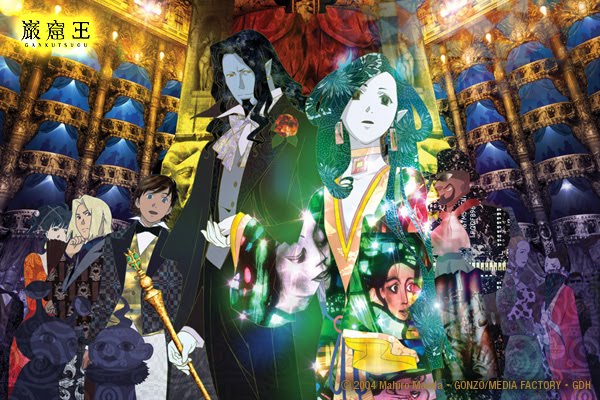
巌窟王 / Gankutsuou / The King of the Caves / Gankutsuou: The Count of Monte Cristo

Gankutsuou truly is something quite different, standing head and shoulders above the vast majority of the trite anime releases of its season, and every season since. Here is something intelligent, daring, beautiful and compelling, with a story from classic literature. Gankutsuou is the Japanese title for Dumas’ The Count of Monte Cristo, and this a clever sci-fi adaptation set in an imaginative future. The heart of the story remains Dumas’, however, and the futurization is mostly aesthetic – yet it is in aesthetics that Gankutsuou is most striking. Gonzo chose to use a transparency effect instead of colouring many of the items of clothing in the series, instead using strange static textures for a rich and rather bizarre visual effect. Coupled with brilliantly excessive scenery and simple but attractive character designs with a striking colour palette, the effect is striking to say the least.

The story is not quite like the novel’s, focussing not on Dantes, but on Albert de Morcerf, beginning with his meeting with the Count to watch the execution – in effect starting a third of the way into the book and turning its exposition into a mystery story. It is a clever way to make a thrilling but quite clinical story very human, and throws the count’s revenge into a very different light to that of the book, our sympathies becoming more mixed by us consider another point of view more attentively. Towards the end the series loses its way a little and some of the ways Dantes’ character is presented are a little badly judged, but I staunchly disagreed with those who complained the novel was 'butchered': this does not replace Dumas’ book, which despite its daunting length is actually very light and compulsively readable, and if anything is a treat for fans, encouraging as it does a slightly different way of looking at the work. This to my mind makes for something much more interesting than a slavishly accurate rendition.

Very pretty to look at, iconic, clever in its adaptation and presentation of a different and likeable protagonist, and of course still having at its core Dumas’ deliciously seductive revenge drama, Gankutsuou is easily my favourite Gonzo work.

(tweaked from original version written 24.2.05, with interpolation from thoughts from 4.4.05)

Wednesday, 27 April 2011

最終兵器彼女/Saishuu Heiki Kanojo/‘She, the Ultimate Weapon’/Saikano

One of Gonzo’s biggest hits, especially on Western shores, has been Saikano, an anime with the kind of premise that unfortunately contributes significantly to the occidental preconceptions of what an anime is. Admittedly, summarising the show makes it sound utterly ludicrous: in war-torn near-future Japan, a teenaged boy called Shuji is dating a cute, clumsy young girl from his school named Chise, only to find out she has a secret – she has been experimented on by the military to make her THE ULTIMATE WEAPON, capable of going into a trance, growing techo-wings and developing an angelic luminosity, then shooting out loads of ROCKETS AND STUFF. Contained within her is enough firepower to level whole cities.

Uh-huh. That’s pretty silly. But while the concept is the biggest problem with Saikano, it’s also what really defines it. I don’t mean that it makes it profound, full of Freudian symbolism about anxiety over female empowerment – I’d really call that projection, or shoehorning. But the way the concept is treated is what makes Saikano interesting.

For most of the series, this isn’t really about a girl who’s full of nukes. It’s about a girl with a job she’s ashamed of, and the way that affects her relationship. It could have been, say, that she had to take off her clothes for saucy modelling or striptease, or that she worked in a morgue, anything that would make her angsty and teary-eyed so that the everyman boyfriend could assure her everything was fine and he would always protect her. Okay, we’re less in Freud’s territory than in Jungian ground here, but it’s a well-known fact that the feeble, childlike girl being protected by the taciturn alpha male sells to the young male Japanese market.

But as I was saying, it’s the way that the weapon-girl plot is somewhat peripheral until it provides a typically 90s-anime apocalyptic, faux-philosophical climax at the end that makes this an interesting experiment, and Gonzo are famous for taking risks. Overlaying what is essentially a typical seinen romance story, in which the male lead is tortured by doubt, angst and temptation while his girlfriend is going through problematic times, with this extreme story of WWIII (the enemies all speak English, though it should be remembered that in anime, ~90% of all foreigners are English-speaking (9% of the rest are Chinese), and it often seems as though foreign=American) very much in the background makes you take the idea seriously – but then you just think, ‘Why not make their problems about something less daft?’ Gradually the focus shifts to the war, and you realise that nothing else could really bring out such extremes of emotion as, well, massacring whole cities, over and over again.

In the end, though, it’s too much, too extreme, too silly. How can you identify with that? Can you really believe someone going through that can just sniffle a bit and find release having sex with their boyfriend in an adorably coy way? It’s an interesting treatment of an extreme idea, but in the end, it comes up short, and emotionally it’s far too shallow. I’m not sure it could’ve been done any other way, except to make it a real-world story, without the war…and then the show would’ve been just another romance story, coming and going without anything to hook people in. It was a brave attempt, but for me, at least, it didn’t work. If what you want is nothing more than a veneer of the cerebral, some explosions and a submissive, mewling teenaged girl looking cute and vulnerable, then perhaps you’ll like Saikano more than I did. Hey, if you watch the utterly superfluous OVA, centred on Chise’s predecessor, you can even see some boobies! That amply demonstrated for me just who the target audience for this show was.

The art is distinctive but in my opinion, those round noses and soft cheeks were kind of ugly, and the animation is very plain, other than some interesting flight-n-fight animations and a great CG tidal wave towards the end, which was somewhat ahead of its time. Gonzo would go on to much greater things, like Last Exile and Gankutsuou, but this was a classic at least worth watching, if not re-watching.

(originally written 16.2.07)

Saturday, 19 March 2011

Peace Maker Kurogane


PMK was one of the anime broadcast in that era, around 2003-2004, when just about everything I watched was great. And while it isn’t the anime I remember most fondly from back then, and nor is it Gonzo’s finest moment, I still love it and have been interested in the historical Shinsengumi ever since.

Indeed, Peace Maker Kurogane is based on historical figures: the Shinsengumi were a group of rōnin who came together in the mid-1800s to police Kyoto and protect the shōgun. This put them on the wrong side of the Meiji restoration and placed prominent members into key battles of that conflict; in the years since their struggle, they have became romanticised and are generally considered some of the last, greatest swordsmen of Japan’s history.

Ichimura Tetsunosuke, along with his brother Tatsunosuke (no, really. You couldn’t make those names up…) are historical figures, too. Tetsunosuke was just 12 or 13 when he joined the Shinsengumi, and became an attendant to the formidable Hijikata Toshizou. PMK ages him up to 15 (to time historical events with better pacing, I suppose), makes him very much adorable, and then turns life in the Shinsengumi into a strange mixture of silly fun and deep melancholy.

All the characters turn out fascinating in their own ways, even if they may not quite sit right with their historical equivalents. Tetsu’s coming of age is achingly compelling, and the silly pig mascot is surprisingly never unwelcome. The music is catchy – although one of the sillier episodes using the can-can was a step to far – and the voice acting superb.

A lot of viewers were turned off by spewing blood in the first episode, far over-the-top. But that was never again an issue, and there’s a realism to the violence here that makes it compelling and actually meaningful.

What starts out seeming to be one of Gonzo’s least mature actually develops into one of their most sincere and compelling pieces. And the characters are just so good that whenever they – or close equivalents – crop up in the likes of Kenshin or Gintama, it’s these designs I think back to.

Tuesday, 15 February 2011

Afro Samurai


It pains me to call this ‘Anime Impressions’, rather than labelling the show ‘Western Animation’, because this production, catering for Western tastes, exemplifies everything that is wrong with the mainstream perception of anime in the West. Being animated by Gonzo doesn’t qualify it as anime – although then again, I'd say being based on a doujin series does.

Watching Afro Samurai was like being transported back to the early 90s, where if I wanted anime, I had to buy shitty VHS dubs of crap like Vampire Wars, only to find that there’s no plot, just cheesy fights between badly-conceived characters, along with an excess of gore, objectified women and awful, awful acting from English VAs. In fact, that pretty much sums up Afro Samurai.

The plot, such as it is, is as such: the great warriors of the world fight for headbands that supposedly grant great power. Anyone can challenge Number Two for his title, but only the existing Number Two can go after Number One. As a child, Afro’s (yes, that’s his name) father was Number One. He was killed by the then-Number Two, who happily remains Number One until Afro can go after him for revenge. On the way he is attacked by several antagonists, just about all of whom just happen to be linked to his past, so that we can have cheesy, dull flashbacks. He is accompanied by his comic relief imaginary friend, seemingly there only so that Samuel L Jackson can do more than grunt – yes, the respected actor gets to reprise his Boondocks role with painful clichés. Only here, it’s not funny.

There are some good voice actors here. Ron Perlman is great in one of the best-voiced American cartoons around, Teen Titans. But it’s the dialogue that’s awful. It’s just obvious, flat, dumb, disjointed. Some of the actors are pretty sub-par, but some are very good, and they falter too because everything’s so excessive.

Even RZA’s beat-heavy music is bland, except for the awesome OP. And Gonzo should have learned from Peacemaker Kurogane that gushing fountains of blood are not cool, and only get in the way. But PMK managed to prove itself a good show despite the fans it lost with the gore in ep. 1. Afro Samurai is just a stinker.

(originally written 17.7.07: 'Anime impressions' refers to label on old site)

Wednesday, 2 February 2011

ラストエグザイル / Last Exile


I was hugely impressed by Last Exile. What a shame I dismissed it after only two episodes originally. It was an excellent piece of writing, and while I wouldn’t put it in my top 10 list, it certainly comes close. It looked amazing, was flawlessly acted – especially the great decision to make adorable little Arvis quiet, polite and nervous instead of the usual voiciferous kid – and admirably ambitious. The plot was of the epic variety, albeit a little haphazard, with a typically ambiguous and rather rushed ending. It also had a slightly absurd premise (Exile unlocked seems to really have no use for the evil Guild) and some underdeveloped characters, but oh…the world in which it’s set! And the characters! The characters we get to know so well!

The story follows Klaus and Ravey, two childhood friends who pilot a vanship – a small two-person flying machine, wonderfully designed by series creators Gonzo to look like 1930s cars. They run errands, mostly delivering messages to huge airborne warships engaged in battle with people from above the sky. Two worlds are in conflict, one frozen over while the other lacks drinkable water, and relations have more or less collapsed.

When these two find little Arvis, a small child on the run, and promise to protect her, they are drawn into a plot that will determine the future of both worlds, and soon find out Arvis is the living key to a mysterious ship called the Exile.

What was special about the narrative was the interplay between the important characters – although beautiful art didn’t hurt. The subtle relationships and histories of some of the characters, even ones who weren’t especially likeable, really made it a joy to watch. Shame that many of the interesting supporting roles were overlooked and things like the relative powers of different ships seemed to change on every writer’s whim.

Overall, though, an excellent and moving series.

(originally written 14.1.05)

Tuesday, 25 January 2011

N・H・Kにようこそ!/ NHK ni Youkoso! / Welcome to the NHK


Sometimes, when it’s feeling like all anime is written to a formula, something very different and quirky comes along and reminds you how nice it is to have some originality sometimes. Animation studio Gonzo often get criticised for putting out ugly animation, or letting the quality of their anime rapidly fall after a few episodes, but in the past few years their risk-taking has made their work essential viewing, and such shows as Gankutsuou, Last Exile and to a lesser extent Peace Maker Kurogane rank amongst my favourites. Afro Samurai may be a risk too far, but I’ll certainly at least watch with interest.

And the most original and idiosyncratic show I’ve seen in the past year, even above Suzumiya Haruhi no Yuuutsu, has to be NHK ni Youkoso!, a show that, like Genshiken, features its own target audience as its subject. While Genshiken was about a group of friends in an anime club, however, NHK is about Satou Tatsuhiro, who is a hikikomori – an agoraphobic youth who spends his days in the safety of his room, dreading meeting others or leaving the comfort of his four-walled prison. Jun from Rozen Maiden is a hikikomori, but NHK is a more realistic show, and as such, it deals with the various perils of modern life that have been in Japan’s public consciousness in recent months.

Plus it plays directly into the reclusive anime fan’s fantasies. Satou, despite being terrified of the outside world and a bit histrionic, is quite a normal guy. Like many otaku, he obsesses over things, spends a lot of time procrastinating and doesn’t mix well with others. But then a pretty, cheerful, immensely adorable girl called Misaki enters his life and tries to ‘coach’ Satou out of his lifestyle while often trying too hard, blushing over Freudian imagery and slowly revealing problems of her own. Can you say ‘EVERY OTAKU’S FANTASY’?

Since the show takes on several issues, it ends up being a bit uneven. It’s at its best when Satou is in his room, being an otaku, getting obsessed by otaku things to the exclusion of all else, like the hilarious episodes in which he gets addicted to an MMORPG or when he and his neighbour, anime otaku Yamazaki, are trying to make a perverted gal-game together. It works less well when baffling but recently common Japanese news-making cultural obsessions like suicide cults and pyramid con schemes are treated in a few episodes – these feel like the issues are left unexplored and the comedy both undermines the seriousness of the event and doesn’t feel right because of it.

Despite its unevenness, though, NHK is a treat. Funny characters who are very gentle on the eyes, believable even in their extremity, some superb fantasy sequences and pastiches of other genres, and a great, totally insane ending theme that sadly was changed halfway through the season. I may not have liked Misaki-chan all that much, and her way of thinking about others was reprehensible, but I am certainly otaku enough to see the appeal of someone a little troubled, a little needy and yet cute as a button coming stalking me. Perhaps for that, one doesn’t need to be otaku at all…

(originally written 1.1.07)

Sunday, 9 January 2011

ブレイブ・ストーリー/ Brave Story


It may not be the most well-known anime, but Brave Story has made ripples: a decent-sized Western DVD release, video games based on the same source novel and there’s even talk of a theatrical release here in the UK. I don’t actually remember when or why I got hold of it, but I’m glad I did, because it has instantly earned a place amongst my favourite anime movies.

This is partly because it’s so ‘classic’ – there’s little original thought here, and it can be called clichéd and derivative, but that only makes it more of a pleasure to watch.

It’s cut from the same cloth as Kingdom Hearts – a young, goofy and good-hearted boy is taken from his world to another, where he meets various loveable creatures and learns to fight against unpleasant monsters with the magical weapon bestowed upon him. However, the cool, slightly older boy he admires in a more or less overtly homoerotic way has the same goal as him, and will resort to more extreme methods to get there, which will inevitably bring the two friends head-to-head sooner or later. The seme/uke relationship of Sora/Riku, Hikaru/Touya et al is repeated almost precisely here, the naive one looking up to the knowing but standoffish one until the pure heart of the dumber one ends up forcing the angstier one to acknowledge his own flaws. As usual, there is a token female love interest for the main character, in this case a catgirl, but let’s just say that at the end there aren’t any tears shed for separation with her and it’s not her who appears in the final scene of the movie.

As I said, the plot is classic – our hero Wataru is having a hard time at home. His father is walking out and his mother is taken ill. Seeking to escape, he follows Mitsuru, the new boy he is infatuated with, through a magical doorway to another world, where he is given the RPG class of a hero and is told that if he fills his sword with magic stones, one wish will be granted. Looking to repair his broken home, he sets off on an adventure, his good heart and loud mouth getting him into scrapes, his sword and his friends getting him back out of them, until he finds Mitsuru and realises just how far his friend will go to get his wish. Ultimately, Wataru comes to understand the cost of getting his own desires, and that he will have to balance his own desires with the needs of many others.

This standard fare is made fun by great characters, that adorable homoerotic subtext that female Japanese writers do so well, some fantastic imagery and smooth animation with the usual CG touches Gonzo have incorporated into their work since Last Exile, energetic voice acting and of course, the naivety that doesn’t care whether old ideas are rehashed or goofy, cutesy ideas get a stage, and also likes to pluck hard at your heartstrings. Cheesy, yes. Simple, mostly. Unoriginal, certainly. But who cares when there’s so much to make you smile?

(originally written 26.8.08)

Friday, 10 December 2010

ぼくらの/ Bokurano


I thought I’d read the original manga before progressing past the first three or four episodes of this anime, after hearing the director disliked the source and because of my admiration for Narutaru, the mangaka’s previous work - but in the end, it was the first anime in a long while that has left me craving more and more, so I happily consumed it all.

Apart from the character designs, quite a lot is familiar from Narutaru – the serious presentation of the extreme hardships teenagers can experience, and the near-fetishising of their suffering and burgeoning sexuality; the cute and bizarre mascot-like characters that you soon start to think of as sinister, and the affection for aircraft and weaponry. But the premise is much more direct and simple. It’s one of those anime concepts that makes you roll your eyes until it’s developed in full, and realise that it can really be taken seriously.

Fifteen children start to play what they believe is a video game, controlling a giant robot to fight off enemies. But of course, it turns out to be more than that, and they soon realise that those who play are ending up dead.

If it seems like a brainless concept in the beginning, and the kids seem to be drawn straight from stock, you soon realise that there’s a lot more going on under the surface, and remember that really, the things these children are feeling can’t be so much different from what goes through young soldiers’ minds when they are going to fight in a war. The situation is grossly exaggerated, but as a medium for provoking thought about mortality, battle and self-sacrifice, it works extremely well. Like Mai-HiME, which ended up in similar territory towards the end, sometimes it makes you uncomfortable watching it, with the inevitability of the characters’ suffering, especially when you start getting attached to them, and there’s no cheesy Sunrise magical resurrection ending to fall back on here. It’s blunt, abrupt and macabre, but also absolutely fascinating.

It’s not an anime to show to newcomers. It works by taking anime fans’ expectations and subverting them. Giant robots are fighting with advanced technology, but they’re also prisons and execution chambers. There are funny cute things, but they’re just avatars for twisted minds. Kids come to heroic decisions, but it doesn’t change their fates or make them anything more or less than the cowards.

A startling and grim anime, and certainly one I’ll be eager to watch again one day. Great theme song, too.

(originally written 23/1/08)

Friday, 1 October 2010

Pumpkin Scissors


When Fullmetal Alchemist became one of the most successful anime of all time, I predicted that in its wake would be a great influx of copycat shows revolving around the Military. In fact, I was wrong, but Pumpkin Scissors is perhaps an early indication that I may yet be proven right. However, the show does something rather different with its military setting, and comes close to being a great show, one or two bad decisions just making it fall short.

Pumpkin Scissors focuses not on the military during a war, but in the wake of one. Yes, that’s similar to Fullmetal Alchemist, but in shifting the focus to war relief, Pumpkin Scissors offers a novel perspective on a country picking up the pieces after the devastation of war, and the class struggles that ensue.

Like many Gonzo anime, the show has a very European feel, with early 20th-Century Western architecture, uniforms and vehicles, and heavy use of German which in tandem with the major subplot of human experimentation brings to mind the aftermath of the Third Reich. The aesthetic of the show is mostly dark and serious, although there is comic relief, mostly coming from the adorable childlike Sergeant Major Stekkin and her over-enthusiastic military dog Mer-kun (who also star in the light-hearted, sometimes inappropriate end theme, which sounds like skiffle). In fact, the principle characters are remarkable, taken from anime stock but put in positions of prominence that are very unusual. Our two main characters are the huge, hulking, simple-minded gentle giant Oland and the stern but softhearted Alice, a noble who nevertheless devotes her life to rebuilding the country and defeating injustice in a purposefully strange way. There are some other likeable soldiers in the military section, and the dynamic between the characters is one of the most enjoyable parts of the show.

The trouble with Pumpkin Scissors is that it’s good – but one feels it could have been great. Oland has been experimented upon to make him a super-soldier, an infantryman who can take on tanks, and the central arc of the show is a fight against another man whose body has been altered by the military. However, once that arc is concluded, the writers seem to think they have said all they need to, and rather than taking on the corruption within the army, the climax of the show is provided by a standoff between disillusioned peasant revolutionaries and decadent nobles that just falls flat. The last few episodes are given over to a duel between Alice and some bodyguard, with a peasant mob standing around watching, because of course angry and disillusioned men who’ve seen their children starve will be persuaded by big speeches and moving words and unexpected tears. Yes, the idea that nobles apologising and peasants forgiving is a nice one, a powerful one, but it’s just not done right and there’s no way that given the situation, with cackling baddies unleashing bodyguards that things would have worked out that way. And then at the very end we get a token scene to show that the powerful corrupt individuals still exist in the army. Yes, it leaves things open for another season, but I can’t help but feel that really, the full story should have been told here, and characters like Oreld and Machs should have been better-developed, because the final arc was a real misfire that cast a shadow back over what was otherwise an excellent series.

(Originally written 13.05.07)