Showing posts with label chibi. Show all posts

Monday, 8 April 2013

ぷちます! -プチ・アイドルマスター- / Puchimasu! – Petit Idolm@aster –


As spin-offs go, this is one of the sillier ones. A little like Hetalia, this is a collection of sub-5-minute animations for the web that are so short they can’t exactly outstay their welcome, even when they’re not very good. I had much fewer fundamental problems with the property than I did with Hetalia, and indeed as I fell a little in love with some of the characters from The Idolm@ster, I was happy to see the characters return.

Yes, this is a cheapo flash spin-off gag series based on The Idolm@ster, based on a silly 4-koma comic from Dengeki Daioh’s vidya-centric sister publication Dengeki Maoh, which largely revolves around the cute little idols finding cuter, littler, SD versions of themselves that speak in baby-talk versions of their catchphrases or names and have strange and stupid powers, from multiplying mogwai-style in water to being able to teleport when they hear loud noises.

I must say that it took a while for me to get interested, largely because my favourites didn’t appear until rather later than expected. But again, these episodes were so short that a bit of silliness is really all they need to satisfy. The animation was largely very linear and bouncy, in a similar style to the 2011 HunterxHunter skit segments after the credits, and in a bit of a departure from the main Idolm@ster series, the Producer is faceless again, like his game counterpart – though not because of a first-person perspective here. Instead, he just has a head that is a giant letter ‘P’.

Although by 64 mini-episodes (and an introductory ‘Waku waku’ special), we’ve seen quite a lot of the little petit idols, they’ve travelled the entire world and blown up the office on more than one occasion, this is light fluff and never feels like anything else. It does exactly what it promises and nothing more, giving fans another fill of their preferred idols but offering no surprises. I have no problems with that, but I must say it just makes me want another Idolm@ster season. Perhaps I should actually go and watch Xenoglossia. Meh. Sometime.


Additional - OVA

An OVA for Puchimasu! has been released for the DVDs, and unsurprisingly for such an inconsequential little spin-off series, it was inconsequential. The Producer sends the idols off to investigate some shrines to one of the little chibis, and about eight minutes of silliness ensue. I would kinda like to see these little characters in some epic, ridiculous situation, but this was fun too. 

Wednesday, 4 April 2012

ロック・リーの青春フルパワー忍伝/Rock Lee no Seishun Full-power Ninden/Rock Lee’s Springtime of Youth Full-Power Ninja Training


First Impressions

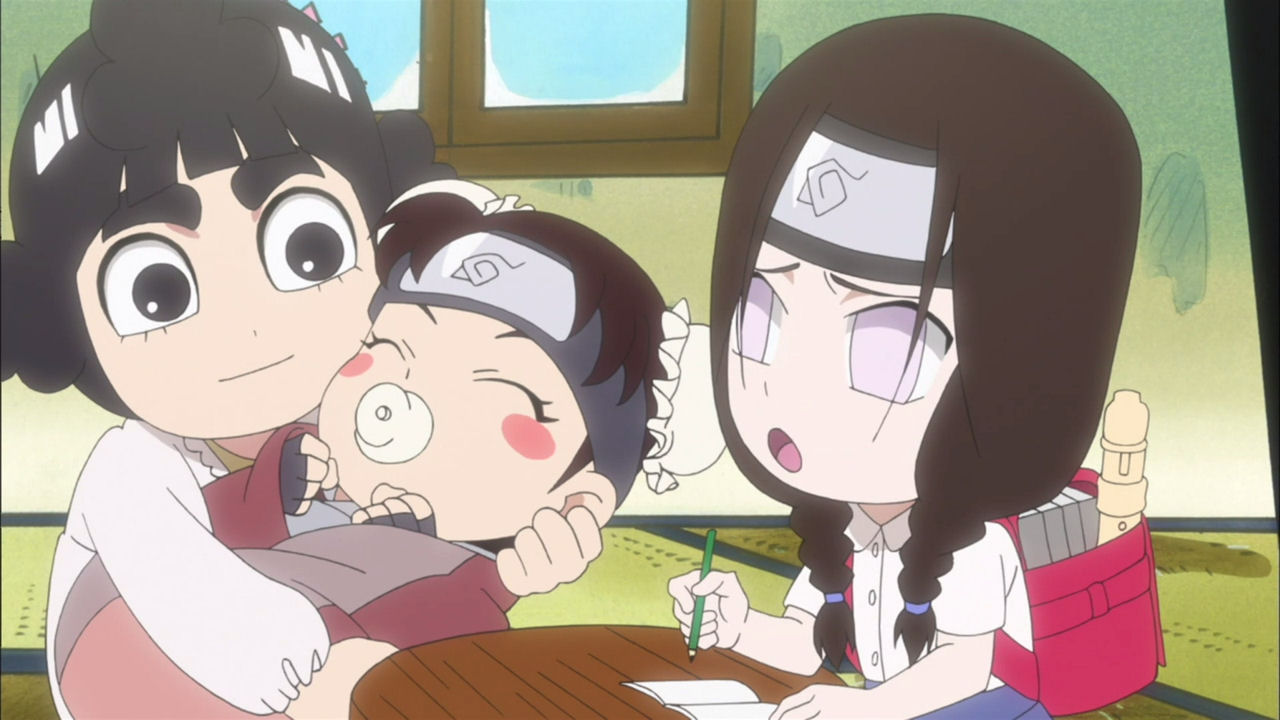
So, episode 1 of Rock Lee’s Springtime of Youth aired in the now-vacated Bleach timeslot. So Studio Pierrot are now animating two different Naruto anime, with the voice actors featuring in both. And…I can’t say I find it a bad idea. Where the Naruto manga has long been a disappointing trudge of stupid twists and dull fights between giant blobby creatures, the SD comedy based on Rock Lee that emerged as the best of the comics in the Saikyou Jump spin-off to Shounen Jump was a breath of fresh air. Even as professional fanfic. And Tenten shone as she never shone before as the comedy straightman.

I was a little surprised it was to be a weekly anime – I had expected it to get truncated and appended to the end of Naruto Shippuden episodes like Bleach’s Shinigami Zukan, maybe getting half-hour specials for Jump Festas or DVD releases or some such. This way may actually be the better business decision, as it’s compulsively watchable – but I’m not sure if it will make for quite such a funny show.

This first episode was a bit of a mixed bag. It expanded the first part of the first chapter into a mini-plot about saving a girl from debt sharks, and while the new enemies were funnier than the throwaway one in the manga, the jokes about dog turds got very laboured very fast and the pacing just wasn’t as funny. The second half, on the other hand, was an improvement on the original, other than the timing and reactions to Lee’s attempts to do Sexy and Harem no Jutsus being off. Lee’s little play about having to raise his young daughters was a great addition and made me like the episode overall rather more: I was doubting the writers’ abilities to come up with gags as funny and sparky as those in the manga, but that made me think that they can riff on basic ideas well.

I doubt it will be as funny or clever as the manga, but I quite like that the strips are being expanded – having a joke repeated in anime form is never likely to offer much that’s new, but if Pierrot continue to put their own spin on Rock Lee’s Springtime of Youth, it could be a great companion piece to expand what’s in the manga rather than replacing or emulating.  

Saturday, 21 January 2012

デ・ジ・キャラット/ Di Gi Charat – s1, OVAs and movie


First Impressions - 3.10.05

Tried some new anime – cutesy classic Di Gi Charat, designed by the same person who came up with Pita Ten, but it was extremely annoying and not at all cute, so I didn’t download any more of it.

Follow-up - 8.1.07

Fortunately, I’m not in bad spirits because Di Gi Charat turned out to be just what I wanted last night. I think I was put off by episode one because I was hoping for something like Pita Ten, and seeing the totally random humour, Dejiko’s annoying hyperactivity and the fact that most of the humans were drawn as fingers with faces, I was just irritated. Total randomness with bits of slapstick really doesn’t make me laugh – that’s why Furi Kuri grated on me. But when more characters are introduced into Di Gi Charat, their totally archetypal character quirks may not be fresh or new, but they at least give a warmth and humour to proceedings, and I’ve now watched all 16 original 3-minute episodes and think it’s actually quite a funny and cute series. Nothing near as good as Pita Ten or that other cute Kogo Donbo-designed series, Chicchana Yuki Tsukai Shugaa (A Little Snow Fairy Sugar), but much zanier and sillier and worth watching when the brain needs to be turned off.

Final Thoughts - 21.1.12

On the strength of those two old entries, Di Gi Charat would be an excellent example of a time I’ve had a bad first impression of an anime but then picked it up again – over a year later – and actually come to enjoy it. It’s happened a few times, including to greater and lesser extents all of Shounen Jump’s big three series. Like Tales of Symphonia’s OVAs, it’s also one I intended to write up full impressions of when I had seen everything, but in this case it’s a little more complicated: I was happily watching everything Di Gi Charat-related a couple of years back when there was a big computer failure and various things got transferred between various computers, and along with Sayonara Zetsubou-Sensei, this is one of the series that has suffered, because I’m not quite sure what episodes I do and don’t have floating about, or when I’m going to get back to watching them. So I’ve decided that I’ll give Nyo!, Panyo and Winter Garden separate entries later, and look at the (loosely continuous) rest here – the firstseries, the specials, the short movie and the Leave it to Piyoko! side-story OVAs.

The story, inasmuch as there is one, is that green-haired alien Dejiko arrives in Akihabara with her sidekick Puchiko and their weird floating mascot Gema. Dejiko wants to be an idol, but has no money and nowhere to live, so takes employment (and a room) in a Gamers store – which makes sense, given that the character was conceived by Koge-Donbo as a mascot for the chain. Dejiko soon clashes with local idol Rabi-en-Rose, and usually outdoes her, while various outlandish and surreal things happen. In the OVAs, the Black Gema Gema gang, along with little Piyoko, who is adorably useless at being evil, try to kidnap Dejiko in the name of interplanetary war, getting into various scuffles that usually end up with Dejiko using amazingly destructive eye beams, Piyoko using her mouth bazooka and poor Puchiko failing entirely to contribute.

Dejiko is a pretty annoying character, all things considered, but manages to just about be cute. The rest, though, are genuinely adorable, and I have a soft spot for the peripheral male characters like Coo, Murataku and overenthusiastic weeaboo Rodoyan. Really, the best thing about Di Gi Charat is how funny and even clever it is when it gets totally reimagined, though – something that would not work without a strong and distinctive base. And that’s exactly what this is. Not everyone’s cup of tea, not all that funny and not clever, it is still adorable, memorable and a great start to a franchise.

Wednesday, 7 December 2011

一撃殺虫!!ホイホイさん/ Ichigeki Sacchu!! Hoi-Hoi-san / One-shot Insect Killer!! Hoi-Hoi-san


In the near future, insects have grown resistant to pesticides. What will mankind do? Well, the answer is simple – they must turn to moé-moé little palm-sized robots to destroy them with guns.

This is a ten-minute animation that is something of an orphan of a franchise I’m never going to explore. It would seem that the franchise started life as a Dengeki Daioh manga halfway between a parody of the girls-with-guns subgenre that includes the likes of Gunslinger Girl and Saikano, and a sincere attempt to be an ultra-adorable part of it. A PS2 game seems to be the main iteration, but I’m quite happy for it to be an amusing and silly little curio I watched for ten minutes and laughed through most of, featuring tiny dolls with lots of firepower and adorable squeaky booties on their feet.

There’s plenty introduced in the 10 minutes of screen-time. Not only do we have the blank-faced and utterly serious little robot, but she has a rival, Combat-san, who seems determined to hunt Hoi-Hoi-san down, but always ends up getting in scrapes herself – more often than not courtesy of Hoi-Hoi-san. Then there is the unfortunate Kimi, who wanted two cute little dolls to dress up but woke up to a pile of dead, steaming cockroaches and never got over the trauma. And poor Aburatsubo-kun, who loves the little dolls he keeps on breaking. For ten minutes, there’s a lot crammed in, and the overall impression was more memorable than many a 26-episode series.

The OVA is also fan-pleasing in that it brings together two very well-known seiyuu to voice the dolls, Kugimiya Rie and Tanaka Rie, who despite being both popular and prolific rarely work together (I can only think of it happening before in Toradora), and I get a small thrill from the idea of a chibi-Suigintou hunting rather uselessly after weaponised Shana-tan.

It’s probably good to keep Hoi-Hoi-san a little rarity and obscurity. Spinning it out into a series Di Gi Charat-style would probably make the little gunslinger-bots outstay their welcome. As it is, I find them adorable!

Friday, 24 June 2011

おジャ魔女どれみ / Ojamajo Doremi / Magical Doremi (season 1)

Though it’s hardly the most well-known of the world’s anime, Ojamajo Doremi is both a big success in Japan and in many ways a real archetype of a series. There are a lot of magical girl series, but increasingly they’ve been in the Nanoha mould: aimed primarily at young men and just slightly creepy. Even Cardcaptor Sakura falls into this subcategory. But Ojamajo Doremi is actually a magical girl series meant for young girls – with a fanbase of young men, without doubt, but certainly not discernibly catering to them or slipping in fanservice. About the closest I’ve seen when it comes to relatively recent anime has been Demashita! Powerpuff Girls Z, but even that certainly wasn’t ashamed of slipping in the ecchi.

Ojamajo Doremi is the story of a daft, slightly bratty but adorably clumsy little girl called Doremi, who one day happens upon a witch. In the magical world of the story, when a witch is identified, she gets turned into a frog. The only way to reverse this is for the witch, Majo Rika, to take Doremi on as an apprentice. Over the course of the series, Doremi’s best friends, tomboyish Osaka native Aiko and bookish Hazuki join her as apprentice witches, along with Doremi’s little sister Pop. A rival later appears, the seemingly perfect preteen idol Onpu, but she has a dark streak and a careless attitude to magic that may just come back to haunt her.

For the most part, Doremi is a cute and whimsical little story, with lots of character-based comedy, a very sweet art style and lots of throwaway but often slightly touching episodes. The girls’ magic can often solve small problems experienced by their classmates, or when used incorrectly, get them into pickles they need one another’s help to get out of. Witching exams, the responsibility of working for a living and relationships with other family members are recurring themes, and of course there is a bittersweet end to the series that aims to be a cutesy tearjerker and ought to at least raise a smile.

The first season – of four – ran a full twelve years ago, now, but remains pleasant to watch, slickly written and likeable. Apparently there was a horrible-sounding localised dub, but it’s not something I’m interested in seeking out.

Season 2: link
Season 3: link

Wednesday, 22 June 2011

びんちょうタン / Binchou-tan

Binchou-tan shared a half-hour broadcast slot with the very different but oddly complimentary REC, but of the two, Binchou-tan was the more naturally suited to the short format, being a winsome and gentle story of several little children in a melancholy fantasy world. The tone is the perfect mix of sweetness and poignancy, and there’s a real ‘classic’ feel and sense of timelessness to the narrative. Binchou-tan, a pun on the Japanese word for ‘charcoal’, is a small child, living alone in the woods in a leaky old shack after her grandmother passed away, making do with what little she has. Like the other children of the town, she is drawn in super-deformed style, with a head rather larger than her body and eyes that would need dinner plate-sized contact lenses. On occasion she goes to the town using a surreal bus system that involves giving acorns to birds to persuade them to take you on as a passenger, and looks for work that largely references the uses of charcoal. Taking home what rice she can buy, she keeps up her traditional Japanese home life – with the bow of her obi sash constantly crooked because she doesn’t have anyone to tie it for her so does it herself over her shoulder. She goes about her humble business in such an adorably quiet way that it’s almost unbearably cute.

Other characters are more boisterous, or more privileged, but their own typical anime personalities are also a joy to watch. It’s written like a fairy tale, evokes the childish, and revolves around children. Over time, Bin-tan meets new friends, from the hyper Chiku-tan to the lonely super-rich girl Kunugi-tan, so that by the end of 12 half-episodes, she is not alone any more. You’ll notice that the characters all have the honorific –tan, partly to make the pun on ‘binchoutan’ work, but also because –tan is a cutesy mispronunciation of ‘-chan’, and its use for mascot characters has become more and more commonplace since this series – see, for example, the popular OS-tan characters.

The anime isn’t supposed to be realistic, or, really, do anything much but make you go ‘Cuuuute!’ It’s the most stylised cutesy show I’ve seen since Bottle Fairy, and similar in many ways – not to mention that Binchou is voiced by Hororo’s seiyuu, in a fairly similar manner. Binchou-tan started out as the mascot character of Alchemist, a games company noted for porting and partly developing visual novels like Higurashi and KimiNozo. After a few manga aimed at the seinen crowd who love cutesy things (ie Dengeki Daioh’s audience), there came this anime adaptation, from knowing peddlers of cute Studio Deen. Drama CDs and even a PS2 game followed, but thus far, the anime remains as short and sweet as its subject.

While 12 episodes with about 10 minutes of story in each off them is very short for an anime, though, it’s worth remembering that’s as much screen time as most feature films get, so there was plenty of time to get to know Bin-tan, her world and the adorable bittersweet misadventures she has. Purposely nothing grandiose or high-impact, it was nonetheless a very appealing and likeable diversion.

(collated and expanded from impressions, 14.3.06 and 17.6.06)

Saturday, 11 June 2011

りぜるまいん / Rizelmine

Rizelmine is one of the sillier animes I’ve ever seen, typical moé, but very cute and funny and compulsive watching. It’s an undeniably odd series about a teenaged boy who spends all day fantasising about his teacher, who comes home one day to find that three government agents have brought him a young girl who they announce is legally his wife.

Rizel is very cute, very innocent, looks about 8 and…well, despite the probable intention is a long way from sexy. Rizel adores her ‘danna-sama’ (respectful term for husband) and spends all day trying to make him love her as much as she loves him, until he calls her an idiot and she cries – and for some reason, her tears are made of nitro-glycerine, so everything blows up. Told you it was silly.

Aimed squarely at the lolicon fanbase, I don’t think it even hits that mark. Rizel is about as desirable a lover as a baby rabbit. But that doesn’t make it any less fun to watch – Rizelmine was always a safe go-to if I felt I needed cheering up, or wanted to relax. It was simplistic, daft and cutesy, but that was precisely its appeal.

In many ways, Rizelmine was deeply influential, or at least part of a general movement that defined anime in the years since it aired, back in 2002. Cutesy, silly moé anime was a guaranteed hit for years after this, and I feel sure that its success was a part of the decision to make that movement happen. Nothing clever, innovative or deep, but fun, memorable and very, very sweet.

(Expanded from impressions, 19.4.05)

Monday, 30 May 2011

ひぐらしのなく頃に / Higurashi no Naku Koro Ni / When the Cicadas Cry / Higurashi: When They Cry

I’m not going to deny it. I only watched this because of its great impact on the anime community. If it were one of those obscure series I often watch, it also would have been one of very few series I’ve dropped, and it’s quite hard to get me to forget something permanently.

As it is, I watched all 26 episodes, and will most likely subject myself to …Kai, the second season. But I cannot for the life of me understand this series’ enduring popularity, over here as well as in Japan. It is just one of the worst anime I have ever seen, in every aspect. The only thing I can say without reservation is that I like the song played over the opening credits…and I can’t even phrase that as ‘I like the opening’, because I really wish they didn’t have Rena’s face appearing over that splat noise on the bass just before the beat kicks in, because it’s always unintentionally amusing.

Anyway, there is very little to recommend Higurashi. I can only think of two reasons you would like this: you’re extremely squeamish but like things that make you cringe just a little bit, or you like the fanservice of tiny girls who look about 5, drawn so close to super-deformed that it doesn’t look like their hands could actually touch the top of their heads. Me, I found the violence unimpressive and the fanservice unattractive. Yes, having to rip off your own fingernails as a form of atonement will make anyone cringe, but it just makes me think of the yakuza, who in real life famously cut off whole joints from their fingers to make amends or just to pledge loyalty, which is rather more horrific, and realer. As for the fanservice, there’s very little attractive in the girls here, partly because they’re really annoying and partly because they’re really badly drawn.

Let’s deal with those two things separately. First, the characters. There’s nothing wrong with the two main boys (Keiichi and Satoko's brother Satoshi), plain old everyman characters, nor with the peripheral, functional cast. But at the centre of the story are the five girls. And all of them – every single one – can suddenly change from cute to psychotic. Ridiculously, the voice actresses are directed to totally change voices, meaning that the tiny little blue-haired girl with the cute voice will suddenly start sounding like a middle-aged woman. Not creepy. Just makes you think of the Japanese actress in the booth. Otherwise, the characters are annoying anyway, especially the little ones, one of whom goes, ‘Nii-paa!’ for no reason and refers to herself as a boy, while the other has a fixation on her brother. Really aiming low, this series.

Then there’s the art. Presumably drawn from an amateurish game, it’s very ugly. Exaggerated hair colour and jarringly cutesy designs, very simple lines, lots of off-model frames and poor animation, especially when the girls go nuts. I’m sure it’s supposed to be creepy, but the ridiculous distortion of Shion’s face when she’s shaking the ladder is just totally laughable, and the size of Rena’s mouth when laughing just makes her look like Kimura from Azumanga Daioh – surely not the desired effect.

All of which would be fine with a good story. This ain’t a good story. Telling events out of order may confuse people, but it does not make a story clever. ‘Which identical twin is which?’ really is just so lazy. And the overall concept? Badly thought-out to fit around desired events, rather than them arising naturally from it. Convoluted, lazy and not exactly watertight. The series’ climax? A girl has taken a school hostage, threatening to blow it up, with a timed bomb they know is plugged into the mains.

Not once does anyone think of, y’know, just shutting off the power.

Cheesy, ugly and unintelligent, it makes me sad that people might think this is the best that anime has to offer. It’s a triumph for marketing, I suppose, because people are talking about this show. I just cannot fathom why anyone would think it was good.

(Originally written 19.6.08)

Sunday, 24 April 2011

ひだまりスケッチ / Hidamari Sketch (season 1)


Lucky Star, Manabi Straight and Hidamari Sketch: those were the three shows that came out in the same season, trying to appeal to the same audience. All of them featured the day-to-day antics of a group of girls in their late teens, yet drawn to look more like 10-year-olds. All aimed to make the audience laugh with exaggerated characterisations and cuteness. Lucky Star was the huge smash hit that everyone saw, Manabi Straight was my personal favourite, leaving Hidamari Sketch to be, honestly, the loser in this easygoing race.

Hidamari Sketch focuses on four girls living in the same apartment complex, full of art students – although one of them is a young novelist. Episodes tend to be structured around their interaction, with their bizarre cucumber-headed principal, with their cosplay-fanatic teacher, with the cute little sister of the novelist girl who’s supposed to be five years younger than the others but is drawn very much the same as them.

The trouble is how difficult it is to get to know the main characters of the series. Not all of the characters in those other titles were memorable, but it was only one or two of the characters who seemed undeveloped, mostly because they didn’t interact enough with the others. But even having seen all the episodes of Hidamari Sketch, I couldn’t tell you any of the characters’ names…and if I were to describe them, I’d say the ditzy blonde one (stupid and brash enough to be the standout, but a comic sidekick and foil rather than the focus), the cute and childlike one (too bland as a main character), the…uptight book-writing one with a tsundere side and the other one with pink-red hair who was just…there. None of them were very endearing, nothing about their lives was very interesting and the most entertaining character was the self-absorbed teacher who loved to dress up.

What could’ve saved the series would have been jokes. If it were funny, it would have been saved, even if only as funny as Lucky Star. Sadly, despite sharing a director with Negima!? and Sayonara Zetsubou-Sensei - namely Shinbou Akiyuki - and having some of that characteristic Shaft quirkiness and disregard for conventional storytelling flow (lots of random little disjointed scenes and random photo collages inserted into scenes), it just didn’t have enough humour or amusing character quirks, and felt like a very poor rehash of Azumanga Daioh.

Without likeable characters, nice art, good humour or sufficient cuteness, this one goes into the small but growing ‘watch but then delete’ pile.

(originally written 29.1.08. Hidamari Sketch has since had two more seasons and several one-off specials.

Tuesday, 29 March 2011

がくえんゆーとぴあ まなびストレート!/Gakuen Utopia Manabi Straight


The big anime of the moment, the most-discussed, most-watched, most polarising anime amongst the up-to-date fansub community, and reportedly in Japan too, is undoubtedly Lucky Star. It has many vociferous fans, and many vocal detractors too – threads frequently pop up in Azuma Kiyohiko image boards, usually full of people annoyed at far-fetched comparisons between Azumanga Daioh and Lucky Star. But at the same time, under the radar, an anime far more similar to Lucky Star, and in many ways rather better, has been broadcasting, and that anime is called Manabi Straight.

Both shows revolve around high school girls with typical anime stock personalities, and the comedy derived from their interactions. The five girls in Manabi Straight are the usual suspects – the timid and childlike one, the athletic and brash tomboy, the sophisticated but rather taciturn one, the ditzy one and the forceful yet simple-minded leader. As with Lucky Star, these girls are supposed to be in their mid-to-late teens, yet look like they’re nine or ten, here with the slightly round-faced look of Petopeto-san, and cute cat-like smiles reminiscent of the :3 smiley. While Lucky Star focuses on being clever, with its incessant in-jokes and long scenes about nothing in particular, Manabi Straight is more conventional, with characters being adorably sweet to one another and a heartwarming story arc about putting on a school festival despite hardships and a lack of interest. Indeed, if there’s a fault to Manabi Straight, it’s that most anime fans have seen this all before, and beyond the very much peripheral gimmick of a near-future setting, the show does not offer much that’s new, and thus relies entirely on its characters.

And yes, the characters are likeable. Ironically, given that the crux of the matter is that Lucky Star has been given far better marketing and relies on the reputation of Kyoto Animation, while UFO Table may get some mid-sized hits but haven’t had a string of productions head-and-shoulders ahead of their competition, I took an initial dislike to Manabi, our protagonist, because she struck me as too similar to Suzumiya Haruhi (Kyoto’s flagship character). I never liked Haruhi, the smug, selfish, bratty, insensitive bully, which made me cautious of Manabi, but after the first episode, she became a calmer, more likeable character, caring of others and willing to work hard to realise her idealistic aims. On the other hand, her spontaneously being able to give a professional-standard vocal performance at a school festival, where the animation standard went up a few notches, was too derivative of Haruhi for my liking.

There wasn’t much to Manabi Straight, and its humour was a little too soft and gentle for it to work as a comedy. Lucky Star probably brings more fresh ideas with it, but in taking risks, it ends up falling flat a lot more. Manabi Straight may not introduce any stunning new concepts, or make its stamp on the moé subgenre, but it does what it sets out to do, introducing well-conceived and likeable characters and telling a satisfying, small-scale story. And that’s why I think overall, it was a better show.

(Originally written 02.08.07)

Tuesday, 22 March 2011

らき☆すた /Raki ☆ Suta/ Lucky☆Star


Lucky☆Star was one of a slew of similar anime of the last two seasons. A light-hearted slice-of-life comedy about a group of teenaged girls drawn much younger than they were actually supposed to be, it had to directly compete with Manabi Straight and Hidamari Sketch.

In this race of silly loli shows, however, Lucky☆Star soon emerged as not only the front-runner, but gained truly widespread recognition and a huge fanbase, while the other shows faded into obscurity. With Hidamari Sketch, that’s no surprise, since it’s terrible, but as I mentioned in my Manabi Straight impressions, it was something of a surprise that show didn’t compete better, since it was warmer, more coherent, more consistent and cuter. Lucky☆Star, though, had a few things going for it that Manabi Straight just couldn’t compete with.

One was the reputation of Kyoto Animation. UFO Table are a big studio, but Kyoto are the new powerhouse and real otaku-pleasers, having produced their impressive animations of Key’s lonely-young-man-pleasing dating sims and the quirky smash hit Suzumiya Haruhi no Yuuutsu, so all eyes were on them for their first cutesy animation. Also, knowing well that they were appealing directly to the basement-dwelling feverish spenders that are the Japanese otaku, they targeted them specifically, putting in lots of references and in-jokes, as well as making one of their cutest characters an extreme geek, playing directly into the fantasy that the audience just might find an amazingly cute, young-looking, childlike girl with interests directly aligned to theirs. This also had the side-effect of drawing in fujoshi, female otaku, especially in the West, who saw themselves reflected in an idealised form, and declared an uncanny alignment with this girl, at the least in personality terms.

I had a lot of problems with Lucky☆Star. A lot of people complained about the show’s slow pace and plotlessness when it first appeared, but I actually liked it a lot more back then. The first episode has a very long discussion of the best way to eat a kind of chocolate-filled pastry. There was a distinctive Azumanga Daioh flavour back then, at the inception, with four girls simply talking about the random things in their lives, the humour deriving from their strong personalities – Kagami is a strong-willed, sensible girl, her sister Tsukasa is air-headed and childlike, Konata is brash and proudly irresponsible and Miyuki is brainy and feminine.

But as the show progressed and one director was fired to make way for another in a bid for better ratings, the show moved away from its 4-koma comic roots and became a smug, self-referential comedy that just loved to pat itself on the back, so that otaku could feel included and pat themselves on the back, too. Slices of life got reduced more and more, becoming little snatched scenes of families watching TV or visits to the dentist, while more and more airtime was devoted to references, especially to Suzumiya Haruhi. The girls go to a cosplay café and see the show’s signature dance performed, capitalising on the fact that Konata’s Seiyuu also portrayed Haruhi herself, or we see her dressed as Yuki and doing impersonations. The references at the beginning of the show were subtle but unobtrusive, so that if you’ve seen To Heart or Maria-sama ga Miteru, you get the reference and get a thrill of amusement (as with other anime with a lot of pastiches, like Sayonara Zetsubou-Sensei) but if you haven’t, the context is still there and you don’t miss much – indeed, there are so many references that it’s unlikely anyone will get them all. But if you haven’t seen Suzumiya Haruhi or know about its cultural impact in the otaku community in Japan, tough luck, great long sequences can go right over your head, with you being made very aware you’re missing something. And even if you do understand, recognising yet another reference to the same show soon loses its sheen. Watching the entire season feels like going to see bad sequels to a movie you like, or turning on an episode of The Simpsons from its later series – you like the franchise and feel a kind of obligation to it, but ultimately it feels hollow and the jokes are less and less funny. New girls get introduced, but somewhat like Scrappy-Doo, they’re less interesting rehashes of the established cast, and don’t really bring anything new or refreshing to the formula.

I’m not saying Lucky☆Star is a bad show. It looks nice, with cute character designs and Kyoto’s usual fluid and detailed animation, despite the simplicity of the aesthetic. It has some great little pastiches and nice music. I loved some of the subtler references, and like most of the keen fans, felt a certain affinity with the habits of the otaku. But I soon grew tired of this show and its lack of big laughs and constant rehashing of ideas – as with the ending credits, which become strange live-action sequences in the second half of the series, funny for the first two or three, then utterly painful. I also disliked it when self-referential humour conflicted with realism, as when Hiraishi goes from commenter in the one-note ‘Lucky☆Channel’ end section (its main draw being the amusing contrast between its presenter’s adopted cutesy characteristics and her real, belligerent personality) to actual character in the main show, but still seems omniscient, for example when in the last episode he shouts out something one of the other characters said earlier in the episode, which he could not have heard.

Ultimately, the big problem with Lucky☆Star is that it’s just not very funny. Put it beside Azumanga Daioh or Ichigo Mashimaro, both slice-of-life shows about young girls that revolve around their character quirks, and you soon realise how lacking in laughs it is, as well as how limited its emotional range is – no heartbreaking graduation here, or sensitive side of comic characters seeping through. Lucky☆Star is superficial and never has any build-up for its jokes. An entertaining diversion but, much like Suzumiya Haruhi, vastly over-rated. Roll on Yotsubato! the anime…

(originally written 15.10.07)

Sunday, 16 January 2011

すもももももも〜地上最強のヨメ〜/ Sumomo-mo Momomo ~The World’s Strongest Bride~


Anime like Sumomo-mo Momomo, adapted from a Shounen Gangan gag manga, have a definite place in the landscape of modern anime. They lack originality, are cheaply and poorly realised, their humour is largely recycled and they will never stimulate or uplift anyone, but they are cute, silly, brainless entertainment with very cute girls drawn to look markedly younger than they are implied to be. The fanservice is unlikely to really turn anyone on more than things like beach postcards or a Carry On film, so even if there are a few times that Sumomo-mo Momomo is little more than softcore pornography, it’s mostly silly, cheeky fluff that passes by pleasantly.

Its lack of substance is also why I wasn’t particularly bothered about actually finishing the series until now, a good three years after I first saw it. Inuzaka Koushi is a studious young man who works hard to become a lawyer and battle injustice with his mind. Unfortunately, he is the successor of a powerful house of martial artists, one of six eastern families engaged in a war with the six from the west. One day, a young girl from the western families comes to tell him she is to be his bride, ensuring peace between all the families. However, there are some amongst the twelve families who do not wish for this union to take place, but no assassin is a match for the fighting prowess of little pink-haired loli Momoko.

This flimsy set-up gives way to lots of fanservice. It’s a classic comedy set-up to have a girl that lots of anime otaku will fall for endlessly trying to give herself to a boy, only for him to show no interest. See Rizelmine et al. Added to the mix are another cute blonde loli, some meathead guys who are never lucky in love and one girl whose fighting style hinges on the embarrassment of losing more and more of her clothes. It’s dumb, lowbrow and very very silly, but that’s really the appeal of it. Disengage brain, smile guiltily at the cuteness of the lolis, and enjoy.

(originally written 23.11.09)

Thursday, 13 January 2011

おとぎ銃士 赤ずきん/Otogi-Juushi Akazukin/Fairy Musketeer Red Riding Hood


Anime speaks in many voices – action-packed and brainless, mature and sophisticated, artsy and whacked-out, achingly romantic, hilarious…exactly like most modes of popular storytelling, in fact. But one area that anime has that you’ll be hard-pressed to find in, say, contemporary cinema, is the mixture of cutesy, action-packed and epic that characterises several popular anime, like Cardcaptor Sakura or DNAngel. The closest you’re likely to get is probably Disney animation, but anime is about cute kids, not cute lion cubs or cute cars, giving an element of moé that inspires a hardcore fanbase of 16-25-ish male otaku to buy, buy, buy. And its to this audience that Otogi Jushi Akazukin shamelessly caters. But while it starts as a paint-by-numbers set of clichés and recycled plotlines, its warmth, strong if archetypal characterisation and knowledge of how to make the cheesy genuinely moving vindicates it, making it more than just a marketing tool for ‘sweet phones’ and action figures – making it charming.

In Akazukin, there are two worlds – the world of science, or Erda, where we all live, and the world of magic, or Fandavale. A young boy named Souta, who used to be told stories of these two worlds by his mother before she mysteriously went missing, is drawn into a battle between the forces of good and evil in the world of magic. You see, he has a mysterious power inside of him, which soon acts as the driving MacGuffin. Yeah, like I said, clichéd.

Akazukin draws heavily from Western fairytales, putting a cool spin on familiar characters to fit them into the anime mould of little girls with super-powers. He is protected by three of Fandavale’s most powerful warriors: Akazukin, which means ‘Red Riding Hood’, an endlessly adorable spunky girl who sometimes thinks with her fists rather than her head, and has a wolf as a sidekick; Shirayuki-hime (Princess Snow White), a gifted mage with a somewhat inflated sense of self-importance; and Ibarahime, the narcoleptic briar princess, based on Sleeping Beauty (‘Briar Rose’ in the Grimm version). But there are more interesting sources, too – the musicians of Bremen are comic relief antagonists, while more obscure figures like Trude pose more serious threats. Rather than the familiar English translations, the Germanic and French sources of these tales are used for names, so Souta is helped by characters like Hameln (based on the Pied Piper of Hamelin) and is ultimately opposed by Cendrillon, whose name sounds far more impressive and sinister than it would have been had she been named Cinderella.

There’s very little new here, but the show succeeds in doing familiar things well. The central characters all have interesting and moving backstories, including Cendrillon. Randagio the comic relief cat is genuinely funny and the comradeship within Bremen towards the end is actually very affecting. The little quirks of characterisation, like Shirayuki and Ringo’s prickly rivalry, help them to be more likeable, and Souta is easy to sympathise with. Let’s face it, there’s little real reason that 99% of the population of Fandavale should look about 11 years old, but it makes them all absolutely adorable and Akazukin in particular, with her good heart and innocent spirit, is pure moé.

This show would not convert anyone who hates anime or is repulsed by cuteness, but it does what it sets out to do, presenting old ideas extremely well, like One Piece or Naruto at its best, like Trigun or Hellsing. One of my favourite shows of the past year.

(originally written 11.9.07)

Tuesday, 4 January 2011

瓶詰妖精 / Binzume Yōsei / Bottle Fairy


Why did I ever stop watching Bottle Fairy? I was really enjoying it when it first began, but then for some reason I just stopped. I don’t know why. Perhaps I was enjoying too many HEAVY things at the time.

Because Bottle Fairy is cute, fluffy, silly fun. It’s about four little fairies who live for some strange reason with a teenaged boy they call Sensei-san, and try to learn about the human world through the somewhat dubious sources of information they have access to – books, and the little kid who lives next door.

In many ways, it’s the spiritual successor to Azumanga Daioh, which remains amongst the very funniest series I’ve ever seen, anime or otherwise. The fairies themselves bear strong resemblances to Osaka, Tomo, Sakaki (though a little more boyish) and Chiyo (though they ALL have the supremely cute factor), and the humour is very similar. The direction, with quick, sketch-like scenes and character-driven, surreal comedy comes from the same school.

While it doesn’t have Azumanga’s emotional range, it does have a more accessible premise and, since it doesn’t have a background of realism, can be even more bizarre.

I must watch the rest. I was missing out, and series 2 is on its way!

(originally written 1.4.05. Sad now that there was no second season!)

Tuesday, 30 November 2010

しゅごキャラ/ Shugo Chara


I am genuinely quite saddened by what happened to Shugo Chara. The anime adaptation came out, really, far sooner than it ought to have, with the manga quite thin on the ground and only coming out monthly, but despite some iffy filler chapters, it actually managed to flesh out its characters in a likeable enough way that it actually stood alongside the original as more of a companion piece than a ropey adaptation. Original characters may not have been universally popular, but they were often likeable enough by the end and allowed for more development for the major characters. So it was saddening when after the series’ major plot arc, the producers seemingly decided to draw it out further, abandon the fanbase to go after a younger demographic. A very young demographic. The last series, Shugo Chara Party, incorporated fifteen minutes of anime, shifting focus to a young original character, while the other fifteen minutes was a hideous variety show. It had some omake mini-episodes in a cutout-like style, which were actually great, but the rest of it was some funny-looking little kids learning to dance, decorating their nails, doing stupid quizzes and pretending badly to be having a great time. Unsurprisingly, it got cancelled, the story had to be awkwardly concluded in two episodes and the ultimate end of the series was one of disgrace. Like so many others, it was an anime series that on the surface looked meant for little girls, but was actually made for older, geekier guys and girls old enough to want to follow the intricacies of a budding adolescent relationship or four.

The manga came from Peach-Pit, who are behind the likes of DearS and, of course, Rozen Maiden. There’s quite some crossover here: a young person who shows a false face to the outside world is gradually changed by small, quirky, secret little familiar-type companions. While Rozen Maiden was a darkly elegant, dreamlike and rather insular tale, Shugo Chara is completely different, dealing mostly with interaction between friends within a school and extremely upbeat. So while there are a lot of parallels between some key figures, Suu and Miki in particular sharing much with Suiseiseki and Souseiseki, in tone the series falls closer to Chicchana Yukitsukai Sugar – A Little Snow Fairy Sugar – especially without Peach-Pit’s distinctive and beautiful artwork. It’s a shame the manga ground to a halt, too.

But what sets it apart is really the romance. Romance doesn’t really matter in Rozen Maiden – there’s some scenes between Jun and Shinkuu, but they are more silly than affecting, and it is of course an impossibility. However, Shugo Chara protagonist Amu first has a big crush on the cute blonde pretty-boy in her school, but later is courted by the dark and mysterious older teen Ikuto, and the tension between the three brings about some of the best episodes in any anime I’ve seen – especially when capricious Ikuto thrusts himself into Amu’s life at his most vulnerable ebb.

There are so many characters I love in Shugo Chara, and more than any other series, it was adept at making me come to like characters I’d initially found annoying. It’s also impressive to think that the silliness here was written at the same time as some of the darker chapters of Rozen Maiden II: versatility with a distinctive voice is impressive.

I must confess I don’t find the ages of the characters a fit. Amu is 11-12 and Ikuto is around 16. This doesn’t fit at all, as Amu seems at least 14 and Ikuto more like 18-19. But that’s a minor qualm, and is probably only to broaden the audience. It doesn’t stand in the way of what is, ultimately, one of the only anime I’ve loved in recent years.

Monday, 7 June 2010

ぴたテン / Pita-Ten

First Impressions
PitaTen is the adorable story of a little boy’s relationship with a teenaged angel who moves in next door, and utterly adores him – much to the chagrin of his little childhood friend, who is in love with him and for some reason has big cat-ears. Love triangles and unrequited affection drive so much of anime, whether anime or comedy, and this is a fluffy, gentle and cute show with lots of manic humour, which is just the sort of relaxing stuff I’m looking for at the moment. Plus it has music that sounds just like Postman Pat, which HAS to be a bonus in anyone’s book.

Final thoughts
CUUUUUUUUUUUTE! That’s the only word to sum up PitaTen. With that many ‘u’s. Cute, cute, cute and a little teeny bit of angst – more in the manga, apparently. Cute as Bottle Fairy, but with more of a storyline, it’s perfect for putting on when you need a break and want to watch something that will make you feel all warm and fuzzy inside.

Kotaro is a normal little schoolboy, other than the fact that he lost his mother in a car accident several years earlier. Bizarrely, his seiyuu was also stately, feminine Shinkuu in Rozen Maiden. He goes to school with his friends Ayanokoji and the teeny, adorable, cat-ear-wearing Koboshi, who even more bizarrely is played by Alphonse Elric’s seiyuu. I can hear the similarity between Al and Hotaru from Gakuen Alice, but hyperactive, squeaky Koboshi-chan? Quelle surprise!

But I digress…

One day, Kotaro opens the door to see that he has a new neighbour, the ever-cheerful, klutzy, loud but always adorable Misha, who soon turns out to be an angel-in-training, and not a very good one at all. She becomes obsessed with Kotaro and begins to follow him everywhere, but soon they become fast friends. Add to this spoilt brat Hiroshi, known as Dai-chan, his tomboyish sister Kaoru, a soft-spoken girl called Shia who has a bad-tempered talking cat called Nyaa and is about the nicest person in the world (thus the worst demon-in-training possible) and a tangled mess of unrequited loves and you get a silly, high-energy comedy show that works a formula, but works it well.

It isn’t clever and it isn’t original, but the characters all look totally adorable, the jokes are simple and funny and the characters have just enough depth for them to be a pleasure to watch. It won’t change anyone’s life, but just for a few hours, it’s sure to bring some happiness.

(Originally written 27.8.05)

Tuesday, 13 April 2010

ちっちゃな雪使いシュガー / Chiccha-na Yuki tsukai Shugā / Little Snow Fairy Sugar

It’s undisputable. Even with such incredibly cute series as Bottle Fairy and PitaTen as competition, Little Snow Fairy Sugar takes the crown as sweetest anime show I’ve ever seen.

Saga is a girl with a painful past. She’s lived with her Grandmother since her mother’s death, and learned to cope with her loss in two ways: by playing her mother’s piano, which the music shop has for sale but which is out of the means of just about anyone in her small European town, and by making sure her life is run on a tight schedule, with no time to sit and dwell on the past. One day, she finds a tiny fairy girl unconscious in the road. Saga revives this little curiosity by feeding her a waffle, only to discover that the diminutive girl has a very, very big personality.

Sugar is an extremely energetic, childlike snow fairy. She is only little, and in training in the human world to become a fully-fledged snow fairy by finding ‘twinkles’, though she and the other trainees don’t know exactly what these ‘twinkles’ are. She is delighted that Saga can see her, since fairies are invisible to most humans, and liked the waffle so much that ‘waffo!’ becomes her general exclamation of delight (since it sounds a lot like ‘wahoo’ in Japanese pronunciation – VERY cute!). Saga, however, is not so thrilled. Her schedules are thrown into disarray, Sugar’s boundless energy grates on her, and she gets into embarrassing situations because she’s the only one who can see the fairy. However, before long, she begins to feel more affectionate and even motherly towards the little fairy and her two best friends, the quiet and feminine Pepper and the typically boisterous boy Salt.

Yes, all the fairies are named after condiments and herbs. There are also the mischievous duo Basil and Cinnamon, plus senior fairies Ginger and Turmeric (which actually makes a very nice name!).

The series revolves around the fairies attempting to find out what a twinkle is, and the ups and downs of Saga and Sugar’s relationship. Everything is very sweet, alternately being fluffy and adorable and pulling gently at the heartstrings.

It must be said that there is nothing very original here. The characters are all right out of anime stock, and the various storylines are oft-rehashed cutesy fare. The most obvious comparison is PitaTen, where very similar characters appear, a human and a non-human bond, and the drama comes when the non-humans must return to their own worlds – and that’s not even mentioning the fact that Koge-Donbo was behind the character designs of both series (but as far as I know had no input in the actual story of Sugar). However, stock characters and typical storylines become overused because they work, and startling originality isn’t the name of the game here. It’s about taking a familiar story and doing it damn well. And that’s what we have here.

Like several other of my favourite anime, the show works well by taking hackneyed ideas and then developing them extremely well. This can be in little touches, as when the focus moves briefly to Salt, who begins to have doubts about whether he really does want to be a sun fairy, or in the bigger storylines, such as when Sugar and Saga fall out because Sugar tried to write a sorry note to Saga and used her mother’s musical score as paper. The charm is in the details: the little hints of deeper emotions than the ones on the surface, the genuine emotions.

It is also a beautiful show to watch. The characters are, as expected from Koge-Donbo, incredibly cute, and, when it comes to the fairies, their clothes are imaginative and witty, tied in with their fairy jobs. Special mention must be made of the town and general culture, which is broadly north-central European in that typical anime way, but wonderfully realised, giving a fairy-tale sense to the aesthetic even with such typical anime character designs.

Little Snow Fairy Sugar thrives on using tried-and-tested anime themes, but doing them very well, with each episode packed with more cuteness than an entire forest full of early Disney animals – and rather less creepy, too.

(originally written 29.11.05)