Showing posts with label mahou shoujo. Show all posts

Sunday, 20 July 2014

劇場版 魔法少女まどか☆マギカ叛逆の物語/ Gekijouban Mahou Shoujo Madoka Majika Hangyaku no Monogatari / Puella Magi Madoka Magica: Rebellion

Well, this is the project that made the movies exciting. After two rehash movies, the third is the payoff – something exciting! Something all-new that advances the Madoka world. But once you’ve made your main character a god erased from all history, where do you go? How do you enhance such a neatly wrapped-up story?

Well, you subvert it, of course!

If I’m honest, there were a few things in the third of this movie series – and the only one that’s all original material – that disappointed me. I thought the world we were shown at the end of the Maoka series was worth exploring, and though this story nodded to that, it was set somewhere quite different. In many ways, the writing is deeply lazy – when you effectively create a character that has the powers of a god, plus an alien race with indistinguishable-from-magic sci-fi technology, you end up with a world where anything at all can happen, and you don’t need much logical consistency or detailed world-building. You can make time paradoxes, and have characters who are removed from timelines to fight alongside a godlike entity for no better reason than she quite likes to have them around. It’s lazy and simplistic and any problems can be very easily handwaved away.

But at the same time, this kind of story allows the writers to deliver fanservice by the bucketload. Not sexy fanservice – just things that the makers of the series would love to see. Characters are dead? Bring them back to life! An antagonist has gotten a big fanbase? Bring her back, make her good and reveal her human form! People have a real burning hatred for your intentionally sinister cutesy mascot? Arrange to have it dismembered, enslaved, tortured and more!

And while yes, it feels for much of its length like a cop-out, Rebellion is a hell of a lot of fun.

Everything is wish-fulfilment, by design. All the magical girls work together in a happy Ojamajo Doremi world of bright colours and cooperation. They even have cute sidekicks – Madoka has a Kyubey who is as cute as it looked like he would be at the start of the original series, and Mami has Bebe. Bebe, of course, an extra-cute version of Charlotte the Dessert Witch, able to communicate in weird gibberish that shows up as floating characters, and a staunch ally of the girls – perhaps the most enjoyable sequence in the film is where the girls chant a creepy nursery rhyme that leads to Bebe showing her true power.

Ultimately, Homura is still the main character and still the one to discover the truth behind this slightly perturbing alternate universe. Behind it, of course, are the Kyubey race, who having hypothesised the existence of the Madoka force of nature – which, after all, Homura told them about at the end of the series – and who want to try to counteract her wish so that they can tap this far more efficient way of getting the energy to save the universe. Neat, but not exactly hard to predict.

What comes as a surprise is that Homura has her own agenda, which is far more selfish than I had ever expected. It makes for some moral grey areas at the very end of this interesting and twisted story, and something remarkable that Madoka couldn’t have accounted for. How she is empowered to do what she does doesn’t really matter – it is poetic and has a bittersweet beauty.


The third film doesn’t feel necessary. It doesn’t feel like it completes an otherwise incomplete story. It feels added-on, an unnecessary appendage. But there’s no doubting that it was deeply enjoyable, especially for fans. 

Monday, 7 July 2014

劇場版 魔法少女まどか☆マギカ永遠の物語 / Gekijouban Mahou Shoujo Madoka Majika Eien no Monogatari / Puella Magi Madoka Magica: Eternity

It seems a little illogical, but actually it makes sense. What perhaps ought to be expected is that if I very much enjoyed the first Madoka film, based on the part of the series that I wasn’t passionate about, surely I should really love the part based on the episodes where I really started to admire the series’ writing. Right? But no – being repackaged as a movie did quite a lot for the first part of the series, especially as the result was a much-increased pace and more of a sense of steady progression. Sadly, the second movie doesn’t enhance its source in the same way here, and because there are far fewer episodes included, the pace is too slow for a standalone film.

Of course, this film covers the remaining episodes of the series after Miki succumbs to despair. She must be dealt with, and sacrifices must be made – so having grown close to Miki, Kyouko takes the fall. So as a result, the only one left to deal with the coming Walpurgis Nacht, the coming of a hugely powerful witch no magical girl can defeat solo, is Homura.

And we learn Homura’s story, which I didn’t see coming in the series and found quite genius – Homura has mastery over time, and has lived this story over and over again, trying to find a way to save Madoka by preventing her becoming a magical girl. Rather than, y’know, talking it through with her – and ‘as you will become the most powerful magical girl ever (thanks to my actions), you will then become an unstoppable witch’ probably would have helped – and rather than perhaps trying to go back and act much more supportive to Miki to ensure she and Kyouko are there to help with Walpurgis Nacht, Homura decides the end of the world is inevitable. Either she stops Madoka becoming a magical girl and the world ends because it seems she can never keep everyone together to fight Walpurgis Nacht, or she lets Madoka deal with Walpurgis, in which case Madoka becomes a far worse witch and the world ends.

Of course, Madoka also has a wish associated with becoming a magical girl, and because Homura has made her fate such a significant event, it can be an incredible one. Perhaps she could have thought of a better one – like, y’know, dealing with the root cause of entropy rather than the effect of Kyubey’s race having to harvest energy from human emotions – but nonetheless, Madoka’s wish makes her essentially a god. She removes herself from the timeline and changes the past and future so that every point a magical girl turns into a witch, she stops them. The girl will lose her power and return to her normal life – it is implied – but will not turn into a witch and need to be killed by her former peers. The result of this needs to be all but omnipresent is that she essentially becomes wiped from the real timeline, creating a whole lot of paradoxes because after all, if witches hadn’t been there before, she wouldn’t have been inspired to become this godlike existence. Nonetheless, the sheer magical power of her potential prevails – and there is a satisfying ending where the girls instead battle wraiths to battle entropy, in partnership with the Kyubey race, but only Homura remembers what truly happened.

It’s neat and it’s clever. It was a great ending to a series that cleverly challenged the conventions of its genre. It took childish concepts and later iterations that sexualised them and subverted them all – with a presentation that despite my initial misgivings because of Hidamari Sketch I think really work. Those potato-headed girls have a classic, winsome look that adds to the subversion.

I do sometimes feel Madoka is a little over-rated. While very good, it is not genius and isn’t nearly as thought-provoking as, say, Kaiba nor as clever a subversion as Princess Tutu. It is only the sheer silliness of magical girl shows that make it seem so intelligent by contrast. This is of course not to say that it isn’t smart. It emphatically is. It’s also compelling viewing and definitely well worth seeing, and there’s more to explore in its universe.


Which is why a third film makes sense – a chance to build on what has been established, and perhaps even subvert that. And that, as we will see, is precisely what the next film does. 

Tuesday, 1 July 2014

劇場版 魔法少女まどか☆マギカ始まりの物語 / Gekijouban Mahou Shoujo Madoka Majika Hajimari no Monogatari / Puella Magi Madoka Magica: Beginnings

Given that I ended up rather liking the Madoka anime, I left it quite a while before getting around to watching the movies – and even now have only seen the first one. Rather disappointingly, the first two movies are mere recaps of the series, which I could understand with Evangelion, because after all many years had elapsed since the series and animation standards had risen considerably, so it made sense. Here, though, there was only about a year between the series airing in 2011 and the film coming out in 2012, so it all feels a little redundant to truncate the series for the big screen. Most of it doesn’t even appear to have been re-animated, with the main changes being better backgrounds and a new opening. So in that sense, I’m pleased I left it a couple of years before watching, because I’d forgotten enough of the plot details to enjoy this again without the feeling of rewatching something I’d just seen.

Madoka was a series that I didn’t feel got really good until right at the very end, starting with the tenth episode of the twelve-episode series. Thus a film version covering the first seven or eight episodes didn’t hold that much appeal for me.

In fact, I was pleasantly surprised by the flow of this adaptation. It works as a single film, pulling off its typical magical girl setup at just the right pace, Mami losing her head in a stressful situation making for a very good climactic moment in a feature-length film (albeit rather a long one), and then the gradual realisation that Kyubey is not what he seems – or at least, operates with an entirely different moral compass – and the ultimate fate of magical girls works well for a reveal-style ending. But what really makes this work is that it becomes Sayaka’s movie: her centre-stage moments are all there in the series, of course, but because of the way the other characters rise to prominence, she becomes rather peripheral in the overall view of the series. Being the centre of attention here, the film essentially following her story from being introduced to the world of magical girls, grasping somewhat the meaning of it, debating the importance of wishes with Kyouko and becoming ever more powerful and ever more lost until the end of the film, she gets a chance to shine more clearly.

I think this works well even if, ultimately, it’s to the expense of Mami, who gets even less of a chance to make an impression as a complete person than in the series, not even getting to talk about her wish.
There’s also a strange dynamic in taking a markedly short series and turning it into a film trilogy. It’s rather strange how there’s the same amount of material, yet the impression left is different because the series was shorter than the usual, whereas a film trilogy is longer than usual. It’s odd how less material seems to be longer and given more time to breathe because of this context, but it is palpable how simply being a feature film expands the sense of scope. It turns out that Madoka suited being a film all along!

Ultimately, I was on board from the beginning. I love how Madoka subverts the genre, not just by being dark and edgy – that’s no real innovation these days, and I talked about Nanoha a lot in my review of the series – but by subverting it early on and then going on to add in more interesting twists and changes of focus. I’m actually looking forward to seeing the second film, but looking forward the most to seeing what new developments the final, original film will bring.


But talking about subversive Magical Girl series that are more sophisticated than they seem at first, go to dark places and would make great movies, how about a Princess Tutu movie version, huh? Now there’s a series that would benefit greatly from reinvention. 

Thursday, 22 May 2014

おジャ魔女どれみドッカ〜ン! / Ojamajo Doremi Dokka~n!

Though of course it can’t compare with how the kids who grew up watching this series felt, I was sorry to see Ojamajo Doremi end. It couldn’t have lasted as long as fellow Toei animation One Piece of course, and nor should it have, but I actually hold it in higher esteem than predecessors like Sailor Moon and Digimon. Ojamajo Doremi had so much heart it was deeply touching, and if ever there’s a revival, possibly adapting the still-ongoing light novels, I will certainly be there for it.

Unlike Mo~tto, I didn’t rush through Dokka~n, partly because the translators were still working on it (and their work is much appreciated!), but also because I was a little resistant to finishing the show and knowing there was no more of this sweet, relaxing series for little girls.

Previous series have in large part relied on the introduction of new witch apprentices to mark the start of new eras. Dokka~n does this too – sort of. In the beginning of the series, little baby Hana, heir to the throne of the witching world, decides she is fed up of being a baby and uses magic to make herself an eleven-year-old. A stubborn baby, she thus must learn to fit in with the structures of Japanese elementary school society alongside the other girls while of course still having the mind of a toddler – and some formidable magic powers. Doremi and the gang must care for her – and at the same time continue to work to free the former queen’s predecessor from her enchanted sleep by delving into her past.

The series is paced very slow, but that is no negative point. After all, this series is at its best when it is focusing not on progressing the main plot – though there are very lovely moments in it, not least the point where the curse on magical frogs is lifted – but on peripheral stories. Aiko and her parents’ broken relationship continues to have the series’ heaviest punches, but begins finally to shift towards a happy ending now. New focus falls on classmates like the one with social anxiety and the one who loves to write books about the people she knows, which make for very sweet asides. Cuter still are the little episodes of puppy love, and the not-quite-confession in the last episode is one of the cutest I’ve ever seen. Perhaps I’d like more of Akatsuki and the FLAT 4, who are barely seen this time, but they are perhaps distracting from the more interesting real-world stories the girls face. Onpu has to face failure for the first time. Hazuki knows that going to a specialist school is the best for her, but has promised Doremi she’ll go to middle school with her and is now in a difficult situation. Momoko is faced with the prospect of going back to America, and even if things go Aiko’s way, that may mean returning to Osaka. There are a lot of goodbyes to be said – and if they all decide to become witches after all, the girls must leave behind the human world altogether.

Of course, all this builds up to that staple of Japanese series about friendship between students – the tearjerker graduation episode. Doubled, because there’s also the ‘graduation’ of witch apprentices to full-blown witches to consider. As graduation episodes go, this is one of the best ones, a superb mix of melancholy, dramatic gestures and humour. It makes for a very powerful episode, and one that made me smile throughout.

Weaker parts of the season include the need to have another ‘shop’ gimmick, and having run out of things like flowers and cakes, the girls decide to try making tapestries, which is not the most dynamic or identifiable of activities. Then there is Hana’s pet baby elephant Pao, which is occasionally cute but mostly annoying, and solves the pecuniary problems of the Maho-Dou by...well, upon vacuuming up dark energy released by the former queen’s predecessor through its trunk, pooping out little golden pellets. That’s...that’s charming, that is.


But Ojamajo Doremi does one of the things that is a staple of why I love anime: it starts with the big premise, the girl who stumbles upon a witch and ends up having to become a witch apprentice, and then after being given plenty of time to breathe and develop, becomes about having to separate from your friends, learning parental responsibility, coping with your parents’ divorce and early romances. That’s not something you see in many cartoons, and it’s to be treasured.  

Sunday, 23 September 2012

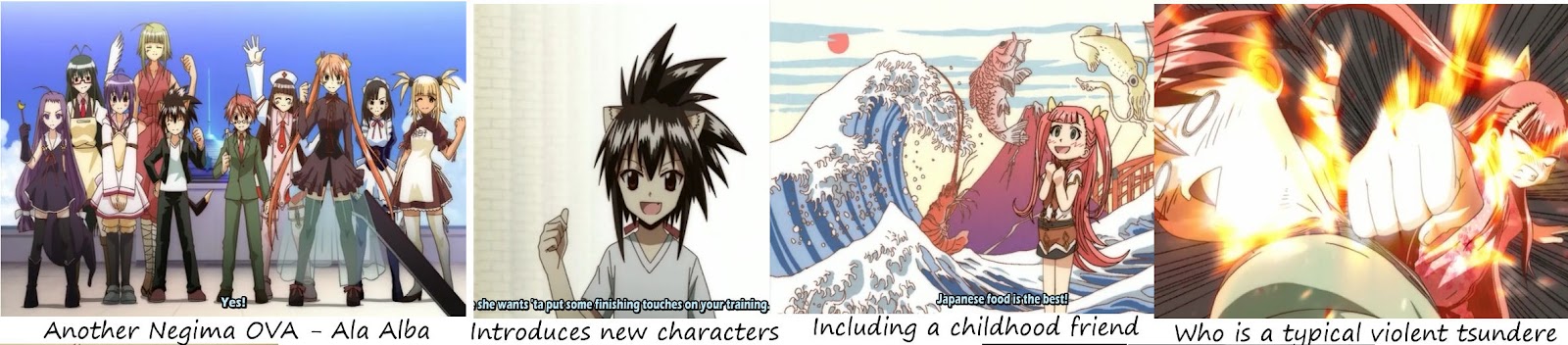
魔法先生ネギま!〜白き翼 ALA ALBA〜/ Mahō Sensei Negima! ~Shiroki Tsubasa Ala Alba~ / Negima OVA: The White Wing


For those of us who have only watched the anime adaptations of Negima!, these OVAs rather drop you in at the deep end. The events don’t follow on from either anime, a different set of characters have formed pactios with Negi, and some characters just show up without explanation – including wolf-boy Kotarou-kun. Events that were never animated are referenced, and generally the backstory is entirely different. This is a pretty bizarre way to follow up a series, and it only really makes sense when you remember that these OVAs were actually freebies with manga volumes. Nonetheless, I can’t think of any other time this has happened, and frankly it continues to be a surprise to me how successful Negima! is, how much anime has resulted from it and how it’s managed to get OVA after OVA (this being far from the last) while something like Rozen Maiden stops.


The three OVAs here are almost unrelated. The first covers a fight with a character from Negi’s past and some action during a festival, the second has Negi’s childhood friend come to persuade him to go back to Wales and the silliness that follows, and the third is largely a selection of fan-pleasing little skits about the girls in the harem-class and their activities.


Though very true to the manga, these animations are chock-full of fanservice. Evangeline dresses as a goth loli, unleashes her power as a teacher and has various adorable versions of Chachamaru with her. The secret idol character goes to Komiket and the others tag along, leading to awkward moments with 18+ doujins. The two oldest-looking characters try to get the tickets they’re meant to at the cinema, where the lady doesn’t believe they’re 15.


SHAFT obviously didn’t have huge resources on hand here, but this was clearly a labour of love and they made it look nice. The magic, the combat and the festival kimono/yukata in particular are eye candy.
But this is decidedly fan-centric and as such, for those of us who’ve always found the concept of the 10-year-old boy surrounded by 15-year-old girls who want to seduce him and are without exception quite purposely drawn from anime stock a little tiresome and creepy, thus have no interest in picking up the manga, it’s very much throwaway. Still, it foreshadows the events of what will presumably be the next set of OVAs, with the characters heading towards Britain.


And I wonder if I’m the only one who found the scene with the fat girl, where almost nothing happens and she’s basically left on her own, deeply melancholy and almost upsetting? 

Wednesday, 20 June 2012

もえたん/ Moetan


First impressions, 14.7.2007: And now something that’s extremely cute and very silly indeed. Step forward, Moetan, with yet another adorable Tamura Yukari performance!

Final thoughts: Several times now, I’ve brought up Moetan as an example of a terrible, terrible anime. But it’s not quite so clear-cut – Moetan is terrible, but it’s kinda meant to be. It’s a parody of magical girl anime – and most of the parody becomes simply doing the same unsavoury things, but very much exaggerated. While this creates some very silly humour, it also means that ultimately, Moetan is getting its audience from the same tropes it mocks, while making them much, much worse.

Based on comedy study aids for Japanese students learning English, the title is a backronym – ‘Methodology Of English, The Academic Necessity’, which of course is a clumsy excuse to be able to use a word that combines ‘moé’ and the oft-used moé version of ‘-chan’, ‘-tan’. The book is full of magical girl parodies and direct references to other series, and the anime follows suit – with a whole lot of ecchi lolicon fanservice.

Our story revolves around Nijihara Ink, a 17-year-old who looks and acts like a preteen. She has a crush on her classmate Nao-kun but is not very good at studying. When she meets Ah-kun (short for Arcs), the magician banished from the magical world and trapped in the form of a little duck for perving on little girls, she is granted the ability to transform (in very pervy transformation sequences that make Ah-kun drool) into Pastel Ink, magical girl and English teacher extraordinaire. Of course, she has a rival, the similarly loli-ish Sumi-chan, given her powers by the little cat-mage Ka-kun, and Alice, the young idol who has a history with Arcs in the magical kingdom.

Though only 12 episodes aired, one of them a recap (seemingly because episode 6 was too explicit even for late-night anime, arguably having more overt imagery than episode 8, which is boldly stated as pure fanservice), Moetan struggled to get past its initial premise. Early episodes set up the exposition and the rivalries, and then Moetan doesn’t really have anywhere to go until the one episode where a dark force threatens the magical world and the girls must battle it – which could have been strung out but was thin enough as it was. Thus, you have episodes of cute girls doing cute things (Ink gets ill and the others care for her), silly romance (Ink’s perfect date with Nao-kun goes awry) and even one episode that opens with the anime staff discussing how stuck they are and that everyone just wants fanservice, so they basically go ahead and get everyone naked over and over again, in bathrooms, bathhouses, anywhere – with the flimsiest of excuses.

After their mini-epic battle, the girls are depowered but continue trying to do their jobs as magical girls in cosplay, which is quite sweet. The series ends with a daft throwaway side character becoming the new mage sidekick and turning Nao’s little sister into the next mahou shoujo.

None of it really works well, and it’s all a long way from original. The potential gimmick – learning English – was relegated to gags centred on poking fun at the anime industry at the end of each episode. Thus Moetan carves out its niche by just going to greater extremes than anything else. I wrote that after the ruling on late-night anime corrupting the youth made the extremes of perversion had to be toned down would probably lead to Kanokon being the most perverted thing ever to appear on late-night TV anime, but that was before I saw Moetan’s greatest extremes – and I think this pushes more boundaries, getting very, very close to the line where it would have to be classed as porn, falling short only in that it doesn’t draw details but opts for Barbie-doll anatomy. It really succeeds when it is directly parodying – there’s a parody of Jigoku Shoujo that works perfectly – but too often it’s just a general mishmash of Nanoha and Saint October-type fanservice that nudges and winks and says ‘Look how stupid these shows are’ – while doing it all far worse in the name of comedy.

The series would probably have benefited from (a) not exaggerating Ink’s design quite so much – if she was more Madoka and less Bincho-Tan, if she didn’t always look like a parody image with no nose and no real features, probably it would have been easier to identify with her (though that comes with the source material) and (b) wholeheartedly going into parodying the epic storyline by taking it seriously but subverting it at key moments. A big joke where a whole episode, even two or three, had to be taken seriously only for a big payoff of bathos at the end would have worked, and while the DVD-only episode 13 comes close by having a non-dramatic death and recasting Nao as a megalomanic with ambitions that echo those of the main character once he grows up in Bokusatsu Tenshi Dokoro-chan, but it needed to sustain and break its serious mood rather than keeping undercutting it with gags – especially if they have to be fart jokes – as out-of-place and unfunny here as they are in something serious like Korra.

I’ll always remember Moetan as an extreme. But not one that worked. It was a silly parody, one that occasionally raised smiles, but definitely not one to recommend, or that I would ever rewatch. Would I be tempted by a season two? Well, perhaps – but after all those jokes about how clueless the anime production committee were and how few people it pleased, I very much doubt that’s going to happen.

Sunday, 15 April 2012

ネギま!? / Negima!?

First impressions - 11.10.06
This remake, more an Alternate Universe retelling, is called Negima!?, based on the same manga as last year’s Mahou Sensei Negima but in a different style. The manga’s fans insist that the original series, which I thought was a dumb but occasionally charming throwaway comedy with little substance and a lot of brainless fanservice, was a hideous slight to the masterpiece that is the original manga (but I’m doubtful anything based on the premise of a preteen magician teaching a class of risible harem-anime clichés, including ghosts, samurai and technological geniuses, can ever SERIOUSLY be good). The new version wasn’t a hit with me. The jokes, especially the big comedy reactions, were just lame and badly-timed, and the little references to other anime on the blackboard, while amusing, didn’t suit the tone of the scene, dragging the whole episode down. The art style also isn’t as cute as in the badly-animated but nice-looking original version. Ah well. 


Final thoughts - 15.04.12
Given that it was way back in the October of 2006 that I started to watch this, and I can only blame the fact that I lost a lot of episodes when an external hard drive died so far for it taking five and a half years to get through, I have to conclude that though Shaft’s version was more entertaining and far more sophisticated than the Xebec Mahou Sensei Negima, I actually found it quite boring. Not in a good way.

For whatever reason, when Shaft got hold of the Negima property and gave it to their leading light Shinbou Akiyuki, he decided to make it very much like his Pani Poni Dash!, which had ended a few months before. With Sayonara Zetsubou-sensei, it became rather his signature style, though now has reached the point where it has further evolved into something a bit less zany, making something more straightforward like Madoka have a unique aesthetic.

While it took it further from its roots, Negima wasn’t a bad thing to adapt in this way. It’s about one little magical boy and his immense harem of anime clichés – from robots to ghosts to ninja to acrobats to scientist girls who can make large mecha. If ever there were an anime that leant itself to abrupt style changes, exophoric references and pastiches, it’s this. And the parodies are laid on thick – Negima!?’s style happily parodies just about any anime subgenre you can think of, plenty of film ones and even has a South Park scene, which while not especially necessary or insightful at least seems more affectionate than FLCLs stab at the same. Add in a great opening track (‘1000% Sparkling’) that seemed to be a real hit in Japan (if remixes, stepmania/osu et al maps and Nico Douga medley spots are anything to judge by) and you seem to have great entertainment.

But it just…missed, for me, in a way Pani Poni Dash! just managed to avoid and Sayonara Zetsubou-sensei seemed to have outgrown – not that it didn’t have problems of its own. Here…I think the problem was with the story. With PPD you had plots where there was a problem to be resolved each episode, be it a bus teetering on the edge of a cliff or an alien trying to conquer the world: they were episodic and there were numerous tangents, but it went back to that at the end. Zetsubou-sensei similarly kept things episodic, usually focusing an episode on a particular issue facing society (or blown out of proportion by the media) and exploring it. But Negima!?...well, it tries to have more of a contiguous story, centred at first on the general concept of Negi and his pacts, then moving to a series of antagonists, with Evangeline, a ‘black rose baron’ and some family members providing adversity, but the snatches of plot progression there are largely buried under endless skits, some of which raise a smile, a few of which made me laugh aloud, but most of which just got in the way and failed to amuse – and not just because jokes were going over my head (though I’m sure that happened more than once).

Taken as a whole, I’d say I liked Negima!? and what Shaft did here. I liked the stupid new animal characters. I liked the useless mascot forms some of the girls took, and the cosplay cards. I liked the way the antagonists were by and large relatable and interesting. I liked the odd surrealism, pacing and switching. But I’ve never much liked the premise of 10-year-old-genius-teaches-class-and-makes-magical-pacts-by-kissing-them-and-making-them-transform-into-fanservice-friendly-outfits. I’ve never much cared about the characters beyond liking some of the peripheral ones, especially when they have manzai-like routines. And I will go on to watch the OVAs (eventually). But I would not dream of rewatching Negima!? from the start, and certainly wouldn’t recommend it to anyone who wasn’t already acquainted with the Shaft/Shinbou way of doing things and certain they liked it watch this. Too much confusion is seldom a good thing. 

Saturday, 14 January 2012

も~っと!おジャ魔女どれみ/ Mo~tto! Ojamajo Doremi


Though I’ve been watching Doremi for years now, it’s only with this series that I’ve really started to love it. I suppose it’s quite telling that while it took me six months to watch Sharp, I watched the full fifty episodes (plus rather surreal short movie) of Mo~tto in under four weeks. It’s really the only series I’m watching just now that leaves me wanting more each time – and it’s a silly, playful comedy about little girls, for little girls. But at the same time, it’s very well-done.

After the climactic action of Sharp, the Ojamajos were again left without magical powers, having sacrificed their crystals to save Hana-chan from a deadly fever. But involved here is the fate of a very powerful witch destined to be the new queen, as well as the politics of bringing the witch and human worlds back together – and so the queen proclaims that the gang can be restored as Witch Apprentices, as long as they convince every member of the witch high council who opposes their restoration that they are worthy. For whatever reason, the way they are to convince these high witches of their worthiness is to bake cakes for them, which sometimes gets a bit Yakitate!!. To help them in this task, the Queen introduces them to Momoko, a blonde Japanese girl who moved to New York at a young age and forgot most of her Japanese, but there met a witch named Majo Monroe (who even has Marilyn’s beauty spot), and from her not only learned magic but how to be a pâtissière. Meanwhile, Hana does not cope well being taken away from her ‘mamas’ to be kept in a magical kindergarten, as is traditional in the magical world, a situation that comes to a head when the lingering spirit of the queen-before-last, responsible for the curse that turns witches whose cover is blown in the human world into frogs, takes notice of Hana and curses her to hate vegetables.

Thus, several plot strands run concurrently – the various dessert-making exams, more or less replacing the last season’s health tests; the heartache of missing the child you bonded with, which after a while turns into the attempt to make Hana like vegetables again by disguising them in different foods or changing the circumstances in which she is eating; and Momoko’s attempts to fit into Japanese society again when she is culturally very much American and doesn’t have a very good grasp of honne and tatemae. This last part spreads out to encompass the various other little stories of girls in Doremi’s class, including the other ojamajos, and is very much the backbone of the whole series, and its heart. It’s what makes the series much more interesting than the last ones, for while it covers similar ground to the ones in Sharp revolving around the young wizards (who I was quite sad to see were never mentioned again, even by Oyajide), they were much better. There’re some very touching little stories here, including ones revolving around classmates old and new: one girl is a hikkikomori who needs friends just like Doremi; another wants to be best friends with the writer girl who idolises Aiko. The SOS trio is split up, and one very cute boy wants to join in the terrible comedy action. A new smart boy is in Doremi’s class, who rather oddly is the second character voiced by Takeuchi Junko (or third if you count a female witch who happens to look just like her first character Kimitaka), which is a slightly strange choice given that her voice, best known as Naruto and the original Gon, is so distinctive. He comes into conflict with proud Tamaki, as does straightforward Momoko, but in reconciling some interesting ideas about racism, arrogance and tact get explored. These are the sort of episodes that really flesh out characters and make them interesting, and it’s these that make me so interested in what happens next.

Momoko’s seiyuu finally provides a strong link with Demashita! Powerpuff Girls Z, which always seemed to me a poor imitation of Ojamajo Doremi – previously other main Ojamajo girls played minor characters in PPGZ, Hazuki having been Miss Keane and Onpu having been rather oddly having been Sedusa, but Momoko was Bubbles herself. She’s an interesting voice actress, having learned English while at an international school at Austria, and thus being seen as a specialist in English. Her pronunciation is certainly far from natural, but it’s definitely a step up from a lot of supposed English-speakers in anime. She was previously on the cast – as the cool guy Masaru – but now she really gets to shine, and though it took a little while I soon warmed to her. Though she looked like she was…really designed to be a white girl but then it was decided that’d be too alien and turned into a blonde Japanese girl (in a world of natural blue and purple hair, mind), it allowed for some interesting things that aren’t often covered in anime, like xenophobia and tolerance.


A strange thought occurred to me when at one point I watched a new episode of My Little Pony: Friendship is Magic and it struck me that the two are really very similar. Several of the girls are much like those of the popular pony cartoon’s so-called ‘mane six’, there are similarities between the Magical World and Equestria, and the way stories are told when an individual main character causes problems when facets of their personality are exaggerated certainly has some crossover. Of course, Ojamajo Doremi isn’t as slick, as widely-lauded or as funny as MLP:FiM, but I have to say that nothing in the season and a half that show has produced so far has inspired the same sort of feelings I had when Aiko’s father lost his job and tried to drive his daughter away to have a better life with her mother.

Tuesday, 20 December 2011

おジャ魔女どれみ# / Ojamajo Doremi #/ Ojamajo Doremi Sharp

The different series of Ojamajo Doremi almost don’t count as such, seeing how after the season finale, invariably a cliffhanger about the girls no longer getting to be witches, the first episode of the next season airs the very next week. So it was with the beginning of this season, and so it was again at its end.

However, the seasons seem very much to have been conceived as separate, whole storylines with a good sense of progression and strong themes to define them. The first season revolved around Doremi and co learning to be witches, then taking part in a collection quest while having to face opposition from the mysterious Onpu. By the end of that season, Onpu was more ally than antagonist, but still had the wrong attitude to magic, and it was that which provided the climactic action.

We join Doremi and co given a new chance to be witch apprentices. Through coincidence – or fate – Doremi and co go to the magical world and happen to witness the birth of a new witch from a flower in the Queen’s garden. Naming her Hana-chan, they are now responsible for raising the baby. The first half of the series is more or less concerned with raising Hana, who is adorable but whose strong magical abilities cause problems. The second revolves around Oyajide, the collection quest summarily dispensed with, returning to the Wizard World and then conspiring to kidnap Hana to ransom her for more territory. He is aided by four young wizards, who are more or less counterparts to Doremi and co, though most of the time they manage to get hold of Hana, they just hand her to Oyajide at the wrong time, and he ends up on the receiving end of a spell from the Ojamajos and goes spinning off, Team Rocket-style.

These larger storylines are peppered with one-offs, both character-developing and throwaway. Most revolve around the theme of family – we have Aiko (the tomboy and thus inevitably my favourite) trying to reconcile her family, Doremi and Pop learning the value of their sisterly bond in the short movie (aired between two Digimon movies) and even see Majo Rika’s mother, a lovely but clumsy old dear who has the same habit of saying ‘Ara ara, maa maa’ as Alicia from Aria. Then there are numerous little stories, such as trying to help the fat girl diet before finally just accepting her as she is, and then in the last few episodes the tone swings to that pleasantly non-serious atmosphere of a cute anime going for melancholy as it looks like only a great sacrifice can save Hana-chan from her sudden fever.

It’s almost as if to offer proof that this is an anime for young girls and not for Nanoha fans, the priority being a mother and looking after a baby gets. Hana is more than a doll, and sometimes it’s hard for the girls to care for her in the right away, after all only being children themselves, but they love her very much and regard themselves as Hana’s ‘Mama’. For her part, she’s very cute, always causing problems, and the contrast between the hapless baby and her huge magical power is one of the charming points of the series. Doremi and the others are on occasion tested by the witches to ensure they are raising Hana right in a series of tests, and the writers prove themselves equal to Peach-Pit in taking characters formerly hard to like but then very loveable with an examiner who starts out prickly but eventually softens – as if Onpu were not evidence enough. Recurring comic characters from the first season who take the exam alongside the girls are hilarious, with the examiners Mota and Motamota both raising babies who they brilliantly call Teki and Tekipaki, and if the octopus/squid love story from the first season seemed ill-judged, their hilarious baby Atarimeko-chan more than makes up for it.

There is almost nothing in this series that isn’t cute, but it is also smart, likeable and can be quite moving when it likes. The only thing I could do without is sucking at a baby’s nose to clear its sinuses, but that may just be culture shock…

Series three: here

Tuesday, 19 July 2011

魔法少女リリカルなのは/ Mahou Shoujo Ririkaru Nanoha /Magical Girl Lyrical Nanoha (season 1)

Nanoha is in several ways an archetypal series now. It’s become the prime example of a strange subgenre of anime – shows about an extremely cute little girl given amazing powers that take her on magical adventures…but made for an audience of lonely young men. These little girls are sexualised, given combat powers that tend to centre on large explosions, energy beams and exaggerated weapons. They are usually diffident and submissive despite their powers, and blush a lot in an ideal of innocence. They tend to have to suffer as the plot becomes darker in a way that inspires protective instincts, and win through on the strength of their good hearts and belief in what is right. And many, many figurines and posters are made for collectors who like to surround themselves with moé.

Of course, magical girl anime are far older than Nanoha’s 2004, and much of this was prefigured: Cardcaptor Sakura had much of the same appeal to male audiences, Princess Tutu was experimentally dark and multilayered and the likes of Sailor Moon and Cutie Honey had both sizable male fanbases and darker moments. Even mahou shoujo anime I see as very much aimed towards young girls like Ojamajo Doremi are widely watched by male anime otaku and have merchandise that caters for them. But the combination of all the elements, not to mention the casual nudity of transformation sequences featuring under-10s and the portrayal of the main character as hapless and in need of protection despite her strength have proven extremely influential: in the wake of Nanoha have come numerous lesser imitations (ie Saint October), comedic parodies (ie Moetan) and one rather clever knowing refiguring of the concept (Madoka).

I started watching Nanoha many years ago, stopped for a while, then was pleased I did because the rest was screened by my university anime club. I thought I’d leave impressions until after I was finished with A’s and StrikerS, the sequel series, but now after rewatching some and in the wake of Madoka, I want to do each on its own.

The story is one so familiar now it seems almost a joke. Nanoha, who first appeared in Triangle Hearts as one of the characters’ little sister, is given magical powers in order to help a little cutesy rodent collect 21 MacGuffins, here ‘jewel seeds’. The series’ tension is derived from a girl her age and with similar powers but with a much darker past and outlook, Fate Testarossa, also vying for the shards, collecting them for her abusive mother.

The setup is simple and most of the plot is given over to Nanoha fighting with Fate and then wondering why, slowly trying to win her over with her kind and gentle heart. Of course, though, both girls have powerful factions behind them, and they both must come to a head by the end.

Nanoha has very little special about it. It’s not sophisticated or visually very impressive. What it is, though, is cute. Very cute. Cute characters, cute situations, cute set-up, cute sidekicks – even cute boys to go with the cute girls. And strange as it is, there’s no denying cute kids struggling to fight to save everything they know is…well, moé.

Friday, 24 June 2011

おジャ魔女どれみ / Ojamajo Doremi / Magical Doremi (season 1)

Though it’s hardly the most well-known of the world’s anime, Ojamajo Doremi is both a big success in Japan and in many ways a real archetype of a series. There are a lot of magical girl series, but increasingly they’ve been in the Nanoha mould: aimed primarily at young men and just slightly creepy. Even Cardcaptor Sakura falls into this subcategory. But Ojamajo Doremi is actually a magical girl series meant for young girls – with a fanbase of young men, without doubt, but certainly not discernibly catering to them or slipping in fanservice. About the closest I’ve seen when it comes to relatively recent anime has been Demashita! Powerpuff Girls Z, but even that certainly wasn’t ashamed of slipping in the ecchi.

Ojamajo Doremi is the story of a daft, slightly bratty but adorably clumsy little girl called Doremi, who one day happens upon a witch. In the magical world of the story, when a witch is identified, she gets turned into a frog. The only way to reverse this is for the witch, Majo Rika, to take Doremi on as an apprentice. Over the course of the series, Doremi’s best friends, tomboyish Osaka native Aiko and bookish Hazuki join her as apprentice witches, along with Doremi’s little sister Pop. A rival later appears, the seemingly perfect preteen idol Onpu, but she has a dark streak and a careless attitude to magic that may just come back to haunt her.

For the most part, Doremi is a cute and whimsical little story, with lots of character-based comedy, a very sweet art style and lots of throwaway but often slightly touching episodes. The girls’ magic can often solve small problems experienced by their classmates, or when used incorrectly, get them into pickles they need one another’s help to get out of. Witching exams, the responsibility of working for a living and relationships with other family members are recurring themes, and of course there is a bittersweet end to the series that aims to be a cutesy tearjerker and ought to at least raise a smile.

The first season – of four – ran a full twelve years ago, now, but remains pleasant to watch, slickly written and likeable. Apparently there was a horrible-sounding localised dub, but it’s not something I’m interested in seeking out.

Season 2: link
Season 3: link

Sunday, 5 June 2011

魔法 先生 ネギま! / Mahou Sensei Negima (original series)

Negima is one of the more popular manga series in Japan at the moment. However, it would seem that nine out of ten fans agree: the anime is vastly inferior to the original. Still, I don’t feel much compulsion to read the manga version. It’s a cute show, and certainly entertaining, but the premise is so daft that I feel I’ve now been exposed to it long enough to have little interest in going any further.

Negi is a ten-year-old magician from Wales. Part of his magical training is to be a teacher to a class of thirteen-year-old Japanese schoolgirls. Naturally. I mean, how can you be a magician without being a teacher on the other side of the world? And why wait until you’re older than your pupils, after all? But there’s more – the girls are all anime archetypes! I don’t just mean ‘the shy one’, ‘the athletic one’ etc. (though they’re all present and correct) – here we have ‘the ghost’, ‘the ninja’, ‘the vampire’, ‘the robot’ and even a scientist girl who can invent things far beyond the boundaries of current technology. So far, so silly, cliché comedy show. And for a while, that’s what this is. Somehow, several of these 13-year-old girls develop a heavy crush on this 10-year-old, and pretty much all the rest think he’s totally adorable. Yes, it’s a harem anime with a 10-year-old protagonist.

Luckily for the girls, not only are there baths for everyone to get naked in as often as possible, but for Negi to awaken his true magical power, he needs to fight with a girl who enters a ‘pactio’ with him by standing in a magic circle (drawn by Negi’s annoying ermine/ferret/stoat-type-thing sidekick) and kissing him. The story centres around the relationship between Negi and Asuna, the one girl who doesn’t seem to like Negi too much, but always seems to be with him just when disaster strikes.

And the series bumbles along in this manner for a while, which is perfectly agreeable. In last few episodes, a bombshell falls, and all of a sudden, the series becomes dark, intriguing, brave and quite moving. It seemed like it was genuinely going to be something quite special. But then the last couple of episodes made the ending of Mai-HiME look sensible, and the writers extracted from a certain cavity a time machine, some sort of rite that mysteriously solves a problem that no-one else had ever solved in a matter of minutes, and a ridiculous battle where ALL the girls get powered up by the pactio and defeat hoards of demons with their individual skills. This includes the fat girl who makes them eat so much good food that they die. Yup.

It’s a shame, because for a while, there, I thought Mahou Sensei Negima was going to be genuinely daring with its ending. Instead, it was a total cop-out. Still, the impact of episode 24 remains, and there’s fun to be had in total ridiculous excess.

(originally written 22.11.05, before the announcement of the Shaft reimagining.)

Tuesday, 17 May 2011

舞-乙 / Mai-Otome

Well, since it’s been well over a year now since Mai-Otome: Sifr came to an end, and it looks like the planned follow-up has turned into Sora–o Kakeru Shoujo, the preliminary plot possibly going into the new Mai-HiME manga, so I felt it was finally time to watch the very last episode and lay out my impressions.

Mai-Otome is the follow-up to Sunrise’s highly successful Mai-HiME, which I enjoyed very much. Rather than the usual continuation of plots and new perils for the same characters, however, Sunrise took the unusual decision of total reinvention. The general idea is that hundreds of years have passed, present-day sci-fi transformed into a futuristic and very, very silly vision. Sunrise are all for embracing the silliest concepts they can and then taking them very seriously, filling their plots with melodrama. That’s the case here – a naïve but sprightly young girl called Yumemiya Arika, looking for clues about the life her mother lived, goes to a special school where they train otome (meaning ‘maidens’), young girls who for whatever reason can use old nanotechnology to fly, wield huge weapons and become incredibly resilient. So incredibly strong are these girls that they have becomes the primary way wars are fought, all the leaders of the world employing an otome. Arika not only gets tangled up with her future queen, but manages to enrol in the school and in spite of her natural haplessness, becomes rival and friend of the best student.

The link between this and Mai-HiME? Strange. One character is, it is inferred, the same as in the original series, but the rest just happen to look identical to older counterparts. Some are reimagined cleverly, like Mashiro, while there are surreal turns in other places, one or two characters returning as animals. Essentially, the link is tenuous and if anything, it comes over as a hollow attempt to cash in on a successful series despite offering something completely different. Oh the other hand, Otome was successful enough to spawn not only a second series but a rather confusing and lowbrow OVA prequel as well. The characters are fun, pretty and likeable, the daft premise soon becomes deeply enjoyable, and when things turn serious, it all works well. Arika is a great character, and so are Nina and Mashiro. Mai-HiME was nothing very sophisticated, although it did get surprisingly heavy and emotional, and Mai-Otome was considerably lighter yet, but for something to relax to and enjoy, few action series did it better.

(originally written 6.3.10)

Tuesday, 10 May 2011

舞-HiME / Mai-HiME

Mai-HiME was a big hit for Sunrise back in 2005, becoming one of the most widely-watched series in the anime community and spawning a sequel series that got increasingly overblown and ridiculous. Typically for the studio, it was big-budget, with gorgeous animation, impressive action scenes and some great music – and a polarising ending.

The story took some time to develop into interesting places, and it takes a little patience to get through early episodes about big silly monsters and little underwear-stealing mutants – but the main story arc is well worth waiting for, and there’s something very skilful about a writing team that can switch gears so dramatically: it deeply impressed me that episode 15 could have me close to tears and then episode 16 could leave me hysterical with laughter. Mai-HiME really shouldn’t be as good as it is, but it works so spectacularly because it takes concepts that are extremely tired or cliché, and does them so well that you realise why these ideas got so overused in the first place. The plot is trite shounen anime fare: a group of girls have the power to manifest weapons and huge guardian spirits (most of them references to mythological figures), and fight monsters. So far, totally uninspiring. But when things become darker and more complex, the story leads to a show that towers far higher than you would expect such shoddy foundations to support. The pacing relies on a tried-and-tested shounen (and Hollywood) technique – have three million different stories going at the same time and no-one will ever get bored – but played expertly, these elements become something rather special. Even frivolous episodes do a good job establishing extremely interesting characters, and I loved the ending for being absolute, unadulterated cheese.

The designs are all very attractive, simple but cute, and the characters’ personalities are all typical anime stock, but never cliché. The best of them, and my favourite thing about about Mai-HiME, was Mikoto-chan. Probably the most adorable female anime character I’ve ever come across, she’s innocent, naïve, childish and very, very cute. An odd, catlike young girl, the fact that she has an enormous sword and can cut a ferry in half just makes her even more strangely fascinating. I was also fond of Akira, the girl-dressed-as-a-boy who looks very much like her male namesake in Hikaru no Go...and has a relationship with Mai-Chan's little brother Takumi – also adorable – very much like that of Hikaru and Akira's, but with that odd Shakespearean twist of cross-dressing. Although these are my favourites, the series is crammed full of great characters, all of whom I liked: Natsuki; Shizuru; Nagi; Mashiro…Yukino, the shy, vulnerable girl who is truly devoted to her chalk-and-cheese best friend, Haruka; along with Mai herself – the way she really does do the best thing in almost every situation, only for that to be turned around into a source of suffering is chilling genius. All these characters really mean something to me – I’ve made connections with every one. That’s something I envy.

Mai-HiME was the very first anime I decided to write down my impressions of back in February 2005, which eventually became this review series, and this version is collated from impressions from then and from August of that year. A favourite.

Sunday, 24 April 2011

魔法少女まどか☆マギカ / Mahou Shoujo Madoka☆Magika / Puella Magi Madoka☆Magika


I didn’t know quite what to expect from Madoka. I’ll admit I was cynical, and for irrational reasons: given where people were making the most noise about it, I assumed it would be the latest in a line of juvenile, schlocky, plotless and brainless anime that were beloved of many and then all but discarded when they finished, starting with Higurashi, through Angel Beats and to High School of the Dead. But that was a snap judgement, and after all, this was a Shaft anime. I love Shaft.

On the other hand, the immediate impact Madoka makes is that its legacy is part of the one Shaft production I really haven’t enjoyed watching: the character designer here was the mangaka for Hidamari Sketch, Aoki Ume, so the look of the piece reminded me instantly of that, making me wonder if this was going to be at all serious. All I had heard about Madoka was that it wasn’t your typical Mahou Shoujo series, and the opening animation made me fear that it was going to be a Moetan-ish send-up. Not so, though. It took a long time to assert itself as truly subverting the genre, even when it got dark, but ultimately it did so, and extremely well – and that opening became cleverly ironic, images of defeat rather than ideals.

The director, Shinbou Akiyuki, also helmed the original Nanoha – and thus he had credentials for directing Magical Girl anime. And not the sort that is actually aimed at young girls – such as Ojamajo Doremi – but aimed at the seinen crowd. However, since Nanoha he has gone on to direct most of Shaft’s best, including the productions steeped in irony and surreal humour like Sayonara Zetsubou-Sensei and Pani Poni Dasshu, though at the very least Hidamari Sketch proved he didn’t have to go all-out with the chalkboard gags and utter bizarreness. I expected more depth and irony as a result, but it also struck me that Shinbou hadn’t really done anything requiring a strong narrative and neat ending since…well, probably Nanoha. Not even Negima?! really qualifies for that. Any doubts I had, though, were unfounded.

It took a while to convince me. The first episode was as expected, setting up the archetype to later subvert. Familiar stuff: an innocent girl has a dream about becoming a magical girl, then meets the real thing after getting caught up in an attack by a witch. The only really remarkable part was the way the witches’ reality was represented by techniques that were an extension of the collages used in Hidamari Sketch and played with in Zetsubou-Sensei: essentially, paper cutout animation of the Gilliam school, only with computer graphics making for a whole plethora of kaleidoscopic backgrounds. Striking stuff.

Things take a turn for the dark by the end of the third episode, and though it was signposted a mile away, I certainly didn’t expect it so soon. In a 12-episode series, though, it was well-timed. It was like reaching the darker parts of Nanoha in just a handful of episodes. After that the focus shifted to Madoka’s friend Sayaka, and it becomes increasingly apparent that the subversion comes from the fact that the dilemma is whether or not it’s really good in any way to become a magical girl at all. There are echoes of Bokurano in the motives of Kyubey (or should that be ‘Cubay’?), but instead of any malice or duplicity, he is pleasantly detached from everything and objectively may well be in the right – a nice touch.

Still, for a while I felt quite indifferent to Madoka, feeling it to think itself a bit cleverer than it was, not particularly liking the art and finding it all quite predictable despite the heavy themes. Mai-HiME had done much of this better. But then the tenth episode centred on a background character came along, and I begun to love the series. That episode gives her full backstory, at much greater length than I expected – indeed, long enough that you realise that the entire show is not really Madoka’s story at all, but that of this other character, who I don’t name in case it ruins a surprise. The remaining two episodes don’t seem enough to pack in any more surprises, but the final ending is cleverly bittersweet, arguably not the best solution at all, but certainly great for an aftermath and a satisfying conclusion.

There are a few things I would have liked in greater detail. It’s implied that the power of the wishes corresponds to potential, but it’s still quite vague and I would have liked to have seen more wishes than the final one be actually about the system the girls are entering into, or to give them personal power. Everything was set up carefully so that Homura never actually explains to Madoka the potential final consequence of her action, to the point it gets quite awkward at the end, and it would have been interesting to see the additional conflict if Madoka knew the final effect on the world she would cause.

Madoka set out to be different from other Magical Girl stories, but starting out just like them, continuing like only a few, and concluding in its very own style. The overall story is admirable, but the shift in focus made me love it.

Friday, 4 March 2011

プリンセスチュチュ / Princess Tutu


As I wrote when I first saw it, ‘Princess Tutu is a wonderful, weird and wacky anime about ballet with a lovely soundtrack [made up of] new interpretations of the great ballet themes by Tchaikovsky, Bizet, Delibes et al. Where else can you see a duck-girl taught by a crazy Puss-in-Boots teacher who threatens to marry pupils if they misbehave watching an anteater girl perform the male part of a pas de deux with a prince in the place of the girl?’ (Oct 20, 2003).

There’s something about Princess Tutu that makes it very, very special. I quite genuinely call it amongst the best anime of all time, and I’d quite vehemently defend an assertion that it’s the very best anime ever to have a very, very stupid premise, stupid name, stupid way of having characters resolve their problems and stupid overall world. Because what Princess Tutu grows from is very daft, and where it goes is masterful. I pity those that can’t get past the name or premise.

Princess Tutu is, probably unsurprisingly, an anime about ballet, and most of the most popular ones get a reference of one sort or another. Tchaikovsky is at the heart of the plot: in a ballet school in a romantic fantasy kingdom, a young girl is at the bottom of her class. Her secret, barely known to her, is that she is in fact not a girl but a duck with a magical pendant: indeed, her name is Ahiru, which simply means ‘duck’, and if she quacks, then she transforms into a cute duckling until she gets into some water, when she changes back. But the pendant allows for a further transformation, from the brave girl into the beautiful ideal ballerina, Princess Tutu. Ahiru is in love with the mysterious Mytho (pronounced ‘Myuuto’, probably better transliterated as ‘Mute’), a quiet and strange boy in the school. But as the mysterious Drosselmeyer sets a new story into motion, all the central characters find out that they are connected to the characters of an old story, and soon are forced to question whether they are real at all, or just characters in a story with an inevitable fate.

The balance of the story works brilliantly, for any audience prepared to give it the slightest chance. The first episodes are carried along by the sheer eccentricity and humour of the world - the aforementioned cats and anteaters, not to mention puppets and strange prawn-like innkeepers. Where normal magical girl series might feature a fight, Tutu features a dance that reveals the innermost heart. Really nothing very compelling, but fun and idiosyncratic enough to engage. But that is when, more or less with the shift to a second season, Tutu got darker and more sophisticated, although the ideas behind the change were obviously in place from the start. By the end, very little turns out as expected. At the time I finished it, (Dec 5th 2004), I ‘felt the end was so unfair on poor Ahiru, the noblest character in the anime, despite her humble nature…’, but the more I thought about it, the stronger the ending was because it wasn’t fair. Princess Tutu is not a story of magical happy endings and contrivances. It’s about a cruel (but likeable) madman manipulating others, and the struggle to stop him.

It doesn’t matter if the idea of ballet puts you off, or the first episodes seem babyish and trivial. Princess Tutu will impress you by the end. I feel I can say that with complete confidence. Its quality by the end is some of the best anime can offer, if not in aesthetic then in writing. And of course, it has some of the best music in hundreds of years.

Monday, 21 February 2011

学園アリス/ Gakuen Arisu / Gakuen Alice


It’s often much easier to know whether a manga, or an anime based on a manga, is written by a man or a woman than it is to describe why, even when they’re generally action-oriented. It’s difficult to say that female mangakas tend to make ardent friendships central to their story and resolve tension with melodramatic speeches while men tend to focus on striving for a goal and solving problems with fights when you have, for example, Naruto and Sasuke’s deep friendship in a very male comic indeed (though it’s true that Naruto makes more concessions to its female fanbase than most shounen manga) on one hand and the dramatic fights of Rozen Maiden on the other.

But sometimes you get shows on very familiar turf that are a little bit different because of gender differences. Gakuen Alice is about a little girl who follows her best friend to a privileged school, only for it to turn out that all the children there have super-powers known as ‘Alices’. But while the premise is very X-men, the tone of the show turns out to be far more Harry Potter – and I mean before it got ‘dark’.

Pretty much every male character is waifish, pretty and sexually ambiguous. Girls tend to have crushes and get themselves into embarrassing situations that make them blush. There are darker themes, kidnappings and forced child labour, but really, the problems never seem very threatening, and there’s never much real sense of danger. Kids may be tied up and dumped in a warehouse one week, but soon after they’re happily watching boys cross-dress in school plays. (Now there’s something typical to female writers!) No combating galactic perils here, only threats to a way of life, and problems that can be resolved by having a tearful talk with the opponents. And of course, the show is cute, cute, cute, cute, cute!

The heroine of the piece is Mikan, an earnest little girl who isn’t too smart but who always tries hard, voiced by Ueda Kana (Yumi from Marimite, to whom Mikan bears some resemblance) with such a strong Osaka-ben accent that when she tries to speak English, she calls herself ‘House’! Mikan’s best friend is the spacey, rather cold Hotaru, voiced by Kugimiya Rie in a role very far from Alphonse Elric in Hagaren, which is amusing because Paku Romi voices Natsume, the dark, brooding boy with a painful past who of course starts to open up to kind-hearted Mikan, with a voice very similar to the one she used for Edward Elric. Natsume’s best friend is Ruka, who can talk to animals, and while the two are together with suspicious frequency, they might just both have a crush on Mikan. All these characters are adorable kids, with very cute character designs and archetypical anime personalities. It’s nothing new, it’s nothing incredibly gripping, but it’s very sweet and makes for compulsive viewing.

But it is undeniably girly, with a lot of cute and not much cool – and what cool there is neatly packaged into understandable categories. Which is fine, for a nice, light series. There’s nothing epic about Gakuen Alice – except for how long it took to get subtitled: I started watching this show in 2004 and the last eps were released yesterday!

(originally written 22.5.07)