Wednesday, 10 July 2013

亡念のザムド / Bounen no Zamudo / Xam’d: Lost Memories

There’s an air of the historically significant about Xam’d. No, not because it’s my first-ever review starting with the letter ‘X’. But – though it’s similarly underwhelming – because it was the first series to premier as a download. Released over the Playstation Network, it was actually made available to American downloaders before Japanese ones, which is curious.

This little footnote lends a little weight to the series, but sadly…well, I’m starting to think of this sort of execution as having ‘Done a Bones’. Bones love making really interesting worlds, with attractive and interesting characters, and then meandering for too long, making things obscure and confusing, then ending the whole thing with a finale on a truly epic scale that couldn’t feel more distant and uninvolving. They are masters of making the apocalypse dull.

What makes it a bit worse here is that…well, basically, they’ve just rehashed Eureka7, but gone ‘What would happen if we replaced Eureka with Nausicaä and Renton with Rock from Black Lagoon?’ It’s not just the look of the thing, it feels like the same sort of journey, with the same sort of annoying made-up guff towards the end.

A young man is involved in some kind of altercation with a strange bio-engineered beast on a bus. Through a sequence of events, he ends up on an airship populated by a very eccentric but loveable crew, including some slightly obnoxious kids, where they go such lengths to deliver letters that a Tegami Bachi would be proud. He tries to fit in there while getting to know the mysterious, knowing girl on board called Nakiami, and discovers about the ‘humanform’, a person with some sort of gem embedded into them that allows them to transform into these monsters – a situation Akiyuki now finds himself in.

The rest of the series is basically about exploring people who have this power and how they use it. I really thought that the series had ended halfway through, when one character turns into a giant face-spider thing and rampages, with Akiyuki saving the day, but there was much more to uncover and a much bigger scale to go to. Of course, by the end, overambitious doctors have released a huge emperor monster-thing to turn everyone to stone with its ‘warm rain’, Akiyuki has gone through a period of having a mask fixed on his face but becomes mega-powerful, Nakiami is some sort of goddess who has lived thousands of years and there is some sort of cult of white-haired people ready to give their lives in a vague sort of purification ritual.

I’m sure that, like Eva, given enough time it could be unfolded and examined and most of it will make sense. But it suffers the same central flaw of Final Fantasy XIII’s story – it throws numerous terms at you (‘Xam’d’, ‘humanform’, ‘Tessikan’, ‘The Quickening Chamber’), which has the cumulative effect of being confusing at first and boring in the end. And without the coming-of-age angle Eureka 7 and Evangelion have, it feels even harder to engage and empathise. Ambitious, no doubt, and very attractive to look at, but sadly has an air about it of trying too hard and recycling older, better ideas. 

Saturday, 6 July 2013

Kyoto Animation Commercials Series

With Free! looking to be one of the big series of the season, even if a huge portion of its fanbase likes it in an ironic sort of a way, I thought I’d write this after quite enjoying the first episode of the semi-viral ‘Swimming anime’ to highlight just why I thought Free! wasn't going to come to pass. Well, thought it highly unlikely. Though at the same time, why it was also a little more likely than some others aware of the series of KyoAni commercials were making it out to be. 

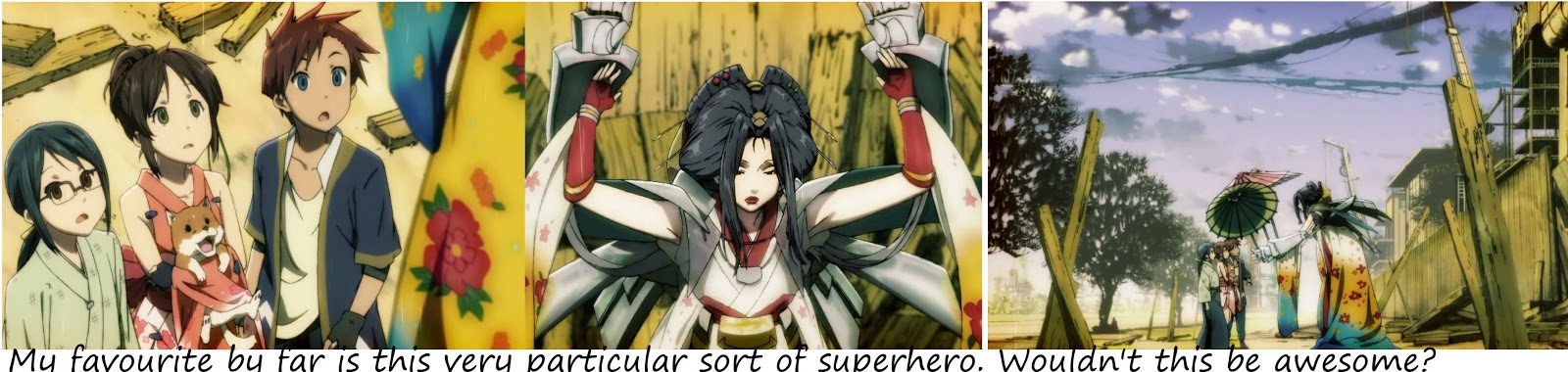
The now-(in)famous commercial that led to Free! was in fact the ninth in a series. And the other eight haven’t gone viral, nor become a new series. Indeed, there are other little shorts that I think I’d rather have seen made into a full series – especially the one about a huge robot woman in a traditional kimono who saves the day with the big metal arms on her back and then rockets off into the sky, which was even more brilliant in its absurdity than an openly homoerotic series about cute boys in very little clothing. But most are not animations that would lead to something bigger. That’s simply not what they are.

There are broadly speaking some obvious boundaries between three different thematic backgrounds here. The first mini-animations are basically eyecatches, pleasant adverts for the studio itself – kids plant flowers or skydive to form the Kyoto Animation logo. They, along with the little dance routine celebrating imagination and escapism that is the third in the series underline the KyoAni of K-On! and Haruhi – there’s a focus on cuteness, prettiness and that very nice-to-look at facial style that most of the studio’s leading series has, though it’s slightly disconcerting how the little kids basically look exactly the same as those oh-so-cute high school girls.
After that, the commercials become a place for animators to experiment, to create shorts in styles they otherwise wouldn’t get to try out. Little pencil sketch kids come to life, dive through the air and end up sitting on logos. A woman who looks like a fashion sketch imagines inanimate objects are coming to life and tries to interact with them – all drawn in a very slender way with colours that remind me of pastels, and the aesthetic comes over as very Western…despite the catgirls.

Finally, the last phase is little snippets of an imagined world – the shorts that could potentially be developed into something longer. Sure, one cute one about cat pilots reminiscent of Porco Rosso and a pretty girl going into a store in a lovely overgrown building is linked to KyoAni’s online shop, but the last four animations could definitely become series of their own. As I said, the one with the robot woman in traditional Japanese clothes and what seems to be a 1940s setting would be my favourite, but the guys doing magic and the cat pilots are also very interesting.

And then with the strange thumping song and the perfect muscled bodies comes A New Challenge, a snippet of a swimming anime. I suppose part of why it’s compelling is that it hints at competition and rivalry, that semi-obsessive sense of competition between young boys that made Hikaru no Go so good. But ultimately it seems to have hit a note because it’s absurd, even more absurd than robot women in kimono saving kids from a collapsing building. Not inherently, but in large part because it’s funny imagining anime fans watching the commercial. It’s funny to picture teenagers insecure in their sexuality looking at the taut bodies and unashamedly suggestive expressions and being discomfited. It feels a little inappropriate and yet amusing. It’s pure camp. And you don’t quite know whether it’s meant seriously or not.

But I’d like to see some of these other ideas fleshed out. Perhaps this commercial series will become the equivalent of What a Cartoon! for Cartoon Network…!

Monday, 1 July 2013

The Powerpuff Girls – season 1

After the previously-documented show pilots, The Powerpuff Girls made it to a full series at the end of 1998, a couple of years later than its partner Dexter’s Laboratory. Though clearly Craig McCracken’s baby, Tartakovsky is clearly still heavily involved, co-directing a majority of the episodes.

It’s clear from the start that the series was heavily developed before ever reaching the air. It’s not unusual for a series’ title sequence to show characters who don’t appear until many episodes in, but this one even has characters who don’t even appear until the early episodes of season 2 – the guy from The Collector and, more prominently, Princess Morebucks.

The series does that very syndicated-American-toon thing of having no establishing episode or premiere but simply launching into the setting without explanation with the assumption that the audience knows the scenario and characters already – so random episodes can easily be broadcast in any order. It even seems very likely that ‘Tough Love’ rather than ‘Octi Evil’ was written as Him’s introductory episode, but things were swapped around. Indeed, however the show was broadcast when I used to watch it on TV was likely pretty random – I’d seen most of these episodes before, but some, like ‘Insect Inside’ and series finale ‘Uh Oh Dynamo’ were new to me.

Split into 22 half-episodes and 2 full episodes, Powerpuff Girls is very easy to watch. Its exaggeratedly cute characters are of course adorable, but what makes the likeable is the heavy emphasis on their faults and failings despite their powers. Bubbles is childlike and gullible, a bit of a crybaby despite not wanting to be underestimated, allowing for her to be adorable, to learn and also for reversals like her deciding she wanted to be ‘hardcore’ being very funny. Tara Strong’s brilliant voice work (here still credited as Tara Charendoff, as she hadn’t gotten married yet) brings the role to life. Blossom is perhaps the least immediately distinct of the three, wanting to be a leader and taking charge, but getting a little boastful when she develops new powers and easily annoyed when Buttercup challenges her authority. And Buttercup is the quintessential tomboy character, making her most probably my favourite – she’s stubborn and self-conscious and that makes me feel like she’s actually the most vulnerable. And y’know, there’s something pretty heavy about an episode where she falls for a guy, he makes her feel really special and loved, and then only by happy accident does she see he’s actually just getting her out of the picture so he can brutally murder her two sisters. That’s a lot for a kindergartener to take on!

Indeed, the series gets its adult-friendly edge in two ways, really – first, by being irreverent with what’s appropriate for kids to see, taking pride in showing gross-out humour, its tiny adorable heroes being constantly abused both physically and mentally, a whole episode about how funny the mayor looks without any clothes on, and in its wanton destruction, the certain death of many thousands of Townsville residents. And second, with a real sense of bathos – some episodes feel they’re late in the run of a well-established show, like one with Mojo just trying to go about his daily routine in peace but the girls bothering him interminably, endlessly and indeed unendingly. A new superhero shows up but turns out to be engineering crimes, but the way the girls beat him is by doing the very same thing. And one episode is about the Gangreen Gang making prank phone calls, which ends up with the villains sorting the problem out while the heroes are unawares.

The strength here is really in the characters, major or minor. The girls are immediately engaging and understandable, Professor Utonium’s protective nature but vulnerability to women is easily understood and though some baddies are duds – ‘Roach Coach’, with power over cockroaches, for example, or some kid who eats glue before a radioactive insect turns him into a huge hulking glue monster that’s actually one of the girls’ toughest challenges – many, many more of them are brilliant and iconic. The Gangreen Gang and the Amoeba Boys from the pilots/shorts are great, but it’s really Mojo Jojo with his ridiculous pleonastic way of speaking and Him with his evil mind games that stand out as classics. The Rowdyruff Boys are an obvious but strong idea, and Fuzzy Lumpkins becomes much stronger conceptually with his pseudo-Southern attitude to people on his property. Plus you can’t help but love the Mayor.

The voice work is also top-notch, which is something that made 90s cartoons appeal so much to Gen-Xers and stoners. The three girls have an instant dynamic, two of them having starred in Rugrats before this, and of course Tom Kenny puts his stamp on every role he plays, from Spongebob to The Ice King. Where Mojo’s daft speech patterns came from I do not know, but they’re absolutely inspired, and Him’s voice sends chills down the spine.

Being ironic and going for a lot of parody – from Star Wars to Godzilla – protects the show from a lot of criticism. Of course it’s lame – it’s a joke on silly superhero tropes! But there are some real shortcomings. Sometimes the episode length means a strong idea has to just be randomly dropped, like when Him’s Octi just blows up because it’s made to drop the captive girls, or when a cure for a terrible disease can simply be taken out of the Amoeba Boys. It is also unashamedly politically incorrect to the point of being offensive – racial caricatures abound, there’s something anti-trans in how Him is portrayed, I don’t know why Mojo has that accent and with the mecha parody episode and all those unflattering representations of the Japanese, it’s amazing they loved it so much. And while sure, kids won’t notice or care, this is emphatically not just for kids and I don’t see what gets added by it.


But it doesn’t stop the real brilliance of the writing, how it turns typical Hanna Barbera-style cartoon making into something hip and intelligent, or how well-performed and well-executed the whole thing is. Impressive work.

Wednesday, 26 June 2013

My Little Pony: Equestria Girls


So on the back of the stratospheric success of MLP:FiM comes the first feature film, released theatrically in the US so that bewildered parents can look at the multitudes of [insert your own stereotyping adjectives] bronies sharing the cinema with their families with great concern, and likely have their kiddies get disapproving looks right back, what with the presence of the target audience being an unfortunate distraction.

The Equestria Girls project has had little approval in fandom – set in an alternate universe, it has the ponies represented as teenaged schoolgirls attending ‘Canterlot High School’. Not, as I had expected, a completely alternate-universe setting, it is in fact not only within the timeline of the show but directly follows on from the end of season 3, with Twilight newly alicorn-ified and quite sweetly having difficulty adjusting, with a sweet scene of her unable to get comfortable in bed with the new limbs that sprouted from her back. The other world is much like our own…only with nobody at all alarmed by blue, orange or violet skin – anything as long as it isn’t a dark shade, slightly worryingly. Just look at Luna!

After her sparkly princess crown is stolen by a mysterious former protégé of Celestia’s by the name of Sunset Shimmer – clearly she selects student with light-phenomena-at-times-of-the-day themes – Twilight has to follow the ne’er-do-well through a magic mirror to another world, with only her loyal dragon Spike as company. On the other side of the portal, Spike has turned into a dog, and Twilight into something weirder – a human teenager. After some obvious culture shock, she makes her way into the ‘castle’ – actually a high school – and finds that not only do all her friends and acquaintances have counterparts here, but the crown was picked up by this world’s Fluttershy and given to Principal Celestia. Unable to talk her way into getting the crown back as her property in an inelegant scene that would have been much clearer if they stressed that Twilight’s crown looked just the one that was to be given to the prom queen that year, Twilight of course resolves to be that year’s prom queen – but will have to become popular first to win the hearts of the student populace!

Like most in the fandom, my reaction to initial leaks of the ‘Equestria Girls’ concept was scepticism. Much of the appeal of the ponies was – to me at least – their distinctive, stylised design, bright colours and despite all that clopping business, rather abstract, non-sexualised forms and simple world without the baggage of real American high schools. And of course, like just about all media based on life in American high schools, it focuses on issues of popularity, that weird and quintessentially American need to be very tribal, and the rife bullying that I’m sure is partly just a media representation but is clearly a big part of life there. You see, Sunset Shimmer has made her place in that world, established herself as the dominant bully of the school and always gets her way – because she’s a terrible bully. With Twilight having such quirky behaviour, she is of course an easy target for ridicule and the film has a chance to explore overcoming bullying…but sadly cops out with Twilight reuniting her best friends’ counterparts in this world after Sunset set them at odds with easily-undone tricks, they do a deeply embarrassing flashmob-style dance in the cafeteria in furry ears and tails, and suddenly Twilight doesn’t have to deal with the ridicule any more. It just…never gets mentioned again and she’s abruptly popular. And because her friends all belong to the different cliques (except Applejack, who hangs out with her little sister and the CMC, apparently either much older than they look and act or child prodigies accepted to high school at about  ~11 years old), there are some throwaway lines about uniting all these disparate peoples.  

Unlike many, I actually quite like the humanised designs – except Rainbow Dash, who looks kinda like some weird alien, and Vinyl Scratch who looks like a zombie. They’re skinny and idealised, but I expect that anything else would result in board members worried that dolls wouldn’t sell. Twilight’s human form is very sweet and there’s something less annoying about Rarity when she’s a teenager. I guess I kinda picture her as mutton dressed as lamb in the series, for some reason.

The problem here is really that the project clearly isn’t big enough in scale for a feature film. Even South Park and Beavis and Butthead knew that if they made the transition to the big screen, they couldn’t just churn out the animation of their series for the entire running time, but that’s what happens here. In fact, at the end, where it ought to get all epic and the animation stops pulled out, there’s a noticeable drop, with lazy transformation sequences (yes, really), and an altered Sunset Shimmer who looks a lot like the rather clunky early attempts at a Dofus animation. In story terms, it is also unsatisfying, with the aforementioned skirting of issues of popularity, the easy-out of the power of friendship, and the way Twilight relies on it so much despite, y’know, this super-magical friendship being based on a group of girls knowing her for a couple of days, and the way that while her pony friends are fretting to the point of tears about her back home and suffering terrible anxiety, she has a party and flirts with a dishy human boy (who has a pony counterpart, oh the drama!).

But we all know this is dished out for the monstrous fandom. I can almost see /mlp/ frothing at the mouth at all the ‘pandering’. Look, there’s Derpy dancing with a muffin, and there’s Scootaloo doing a chicken dance, and totally unneeded cameos for Trixie just because of her popularity with a leading news site. They must hate it. Yet…well, doing this humanised thing wasn’t really what the fandom wanted. It was much more what the little girls probably wanted. And beyond the thin plot, it takes the Pony concept somewhere a bit different, and I rather like that. Plus it comes a step closer to defining the characters’ ages and introduces a bit of romance beyond puppy crushes and secondary characters getting married. I don’t have as great a connection to the franchise as some and don’t care if it goes in new directions, so I quite enjoyed this for what it was – flimsy, light-hearted entertainment about some cute girls doing cute things.

And there’s a darker question here. I wondered what happened to Twilight’s counterpart, which was answered by Pinkie mentioning her being in ‘the city’. So where is Sunset Shimmer’s counterpart? Just what did she do to her to take her place?

Tuesday, 25 June 2013

夏のあらし! / Natsu no Arashi! / Summer Storm!

In typical Shaft style, Natsu no Arashi! chucks you in at the deep end. The first episode is disorienting, as two duos of characters in a strange old-school art style hold hands to zip back in time, with attempts to stop a prank going wrong made extremely convoluted and successively more disastrous as different timelines intersect and various typically random Shinbou Akiyuki visuals flash up. Shaft’s immediate follow-up to MariaHolic, this show is decidedly less accessible, but soon becomes just as straightforward – if never as likeable. 
But as is fairly often the case with Shaft (lest we forget the episode of Sayounara Zetsubou Sensei where visuals, soundtrack and subtitles were a weird mash-up of an audio episode, a manga chapter and original material, or whatever it was, or the previously unseen characters who crop up unannounced in the Negima! OVAs), it feels rather as if the series is aimed not at fresh viewers, but fans of the manga – by School Rumble’s Kobayashi Jin.

But yes, the second episode goes back to the beginning of the story, and it runs linearly from there, gradually making that first episode explicable. In the world of Natsu no Arashi!, a thirteen-year-old hot-blooded boy with a silly face that directly recalls 70s anime design called Hajime takes a job at a café after falling for a sixteen-year-old girl working there and protecting her from a strange meathead. Though the café is of course staffed by some oddballs – including the foul-mouthed owner who is a capable confidence trickster – Hajime takes a job there, only to discover that Arashi, who he saved, is in fact the ghost of a girl who died in the 1940s…and when she touches Hajime, they ‘connect’ and can leap back through time. The two of them begin to help the people Arashi knew in the past, who would otherwise meet sad fates in the wartime bombings of Japan.

Natsu no Arashi!, in trying to flesh out its characters, does rather two much, so that it feels like two completely different anime. In hindsight things seem neatly settled, but while watching it felt too disjointed, like the anime pulled all the way in one direction and then in the other immediately after. There is this story about time travel, made more complex when Arashi’s German friend Kaja, also a ghost from the past, makes a connection too and starts a similar mission to change the past, with some action added on when a very silly post-credits sequence about two sedate young women grandiloquently describing the plot of classic anime as though terribly serious novels only to undermine the tone with the anime’s catchphrases gets linked into the main plot as two more dead classmates are revealed – and are a good deal less friendly. By the end, of course, these two are introduced to the harem of odd spindly girls in bishoujo art styles, making for rather less interesting background characters, but the comedy segment was certainly worthwhile – if only for making this an anime that ends on the punchline ‘DOSTOYEVSKY?!’ – you can’t really beat that, I have to say. Nods to Touhou, MariaHolic, Hidamari Sketch, Gundam and even K-On! also raised smiles, even if background gags sometimes don’t sit well with me. And nor do weird body-swap episodes.

At the same time, a whole lot of screen time is given to Jun, who in what seems to be fast becoming a Shaft tradition is a ‘reverse trap’ – that is, what seems to be a weak and pretty young boy but is in fact a girl pretending. I’m a sucker for traps and reverse traps as an extension of feminine guys and tomboys – making favourites of Minami-Ke and Mai-HiME for me – and this is no exception, as Jun is incredibly adorable and much of the humour surrounding her is about her being humiliated or Hajime being too thick to realise her gender, which for whatever reason always make me feel protective and affectionate, and I loved the episodes centred on her. I also liked how the series would swing towards being extremely serious, with Jun’s reaction to the wartime bombing in particular being affecting and well-executed. I also liked how time paradoxes were discussed, in a serious way with Arashi becoming worried her saving lives was snuffing others out until it was discovered time is linear and everything they did they had always done, and then in a fun but incredibly random last episode with a long discussion about the paradoxes of taking some expired milk back in time to swap it with its non-expired earlier incarnation.


For all I liked bits and pieces, though, and much as Jun is catered specifically to someone like me who loves gender-bending character types, I just found myself unable to really love Natsu no Arashi!. I might one day rewatch episodes, but certainly not the whole series. I got that the art style was meant to be a nod back in time but I found it very unappealing overall and most of the older girls never felt fleshed out. But that isn’t to say I won’t be watching the second series. I certainly will – sometime. 

Especially as it was heavily, heavily hinted that Jun is going to develop a one-sided crush on Hajime… 

Friday, 14 June 2013

The Powerpuff Girls / Whoopass Stew! – pilots, forerunners, and show history


Lest we forget, my blog is intended to be about animation from around the world, even if I horribly neglect the Golden Age, arthouse European and experimental shorts that I sometimes watch. But I do sometimes get through an entire American cartoon series and write up my thoughts – albeit mostly something nostalgic from the 80s. But I fully intend to watch the totality of The Powerpuff Girls, one of the best of the cartoons around in the late 90s and early 2000s, somewhat after my main period of watching cartoons for fun but before I got a bit more serious about the art form.

In many ways, The Powerpuff Girls, along with its sister production Dexter’s Laboratory, defined how animation would look for the decade that followed. The bold, simple lines, extremely flat presentation, tongue-in-cheek, anarchic and hyperactive direction and post-Ren & Stimpy Show self-awareness not only proved hugely influential and spawned a slew of inferior imitations but created a style that was easily adapted into Flash for easy animation – for better or for worse.

But the series began in 1992 with a very silly short Craig McCracken made at CalArts – which of course was founded (through a merger) by Disney. While Genndy Tartakovsky was making the short that would later become Dexter’s Lab, Craig McCracken put together a funny little short called Whoopass Stew! – The Whoopass Girls! in: A Sticky Situation!, starring as you may have guessed the Whoopass Girls, who of course would later be refined to the more universally-acceptable Powerpuffs. He worked on three more mini-episodes, but never finished them, and the little story with its intentionally retro set-up is imaginative but very thin. The first of the Powerpuff Girls’ nemeses to appear, perhaps surprisingly, were not Mojo Jojo or Him but the Gangreen Gang – there essentially to get wiped out in an introductory scene – and the Amoeba Boys, who here had not yet got their endearing quirk of being useless at crime but prove quite formidable opponents for the girls, almost absorbing them before they seem to spontaneously develop powers of flight (it being ambiguous before that whether they were flying, leaping or simply running without a solid background) to take the poor criminals to roast in the Sun itself. Impressive powers these Whoopass Girls have.

The young CalArts animator must have created a buzz of some sort – McCracken’s slightly unsettling No Neck Joe played at some animation festivals, and so did this short, and apparently the right people took notice, because he was in 1993 hired as the art director for Hanna-Barbera’s Two Stupid Dogs shortly before they were absorbed into Warner Brothers – after just enough time to define what Cartoon Network was going to be. After a couple of years of Tartovsky paying his dues on Batman and The Critic, Genndy Tartakovsky was recommended by McCracken and the two soon began to assert their presence in Hanna-Barbera just as it seemed to be turning a corner with this fresh new blood. Being in the right place at the right time, the two former classmates were to provide the first episodes for Fred Seibert’s new, expensive project to produce a great number of pilots for potential shows, which he called What a Cartoon! (and also World Premiere Toons, but that was just for promotion). From the same trailer, the two collaborated to develop their student films, the very first of this influential series eventually being the 1995 pilot for The Powerpuff Girls, and the second being Dexter’s Laboratory. Both also had a second pilot in early 1996 – and though it seems apparent that it was McCracken’s creative properties that were given precedent, it was Tartakovsky’s that were the more immediate hit, winning a vote and becoming a series in its own right later that year. The Powerpuff Girls, meanwhile, would not get its own slot until 1998, which was after fellow What a Cartoon! pilots Johnny Bravo and – sad to say – Cow and Chicken.

It’s not entirely a surprise that the two pilots didn’t hit the chord the series eventually would manage with a generation in which cartoons are adored by both little kids and stoners in their teens and 20s. The pilots just aren’t a very good representation of an idea, and it’s down to McCracken’s writing rather than Tartakovsky’s animation direction. In the first episode, Fuzzy Lumpkins – an ugly and jarring design if there ever was one – gets angry that the girls don’t name his meat jam as winner of a competition so goes on a rampage with a gun that turns everything to meat, including the mayor – though he can still talk. In the second, rather better episode, the Amoeba Boys now have their useless hook and have to be taught how to rob a bank by the girls – but it’s an angle that thrives on knowing and loving those good-hearted girls so doesn’t work when they’re brand new to an audience. Quite apart from the unpolished visuals compared with the developed series, the trouble here is that the storytelling just isn’t smooth enough to work.

But Hanna-Barbera and Cartoon Network had turned a corner with these shorts, and soon Dexter’s Laboratory would be such a hit it was impossible to ignore. So Powerpuff Girls thankfully got another chance. Series 1 eventually followed. 

Saturday, 8 June 2013

家庭教師ヒットマンREBORN! / Kateikyoushi Hittoman Riboon! / Home Tutor Hitman Reborn! (Seasons 1-3)


When listing the significant long-running anime based on Jump comics, even fans would be forgiven for forgetting Reborn! – while it had quite a notable impact, a successful anime run of over 200 episodes and plenty of merchandising, fanart, cosplay and the other hallmarks of a success story, ultimately it’s just…quite forgettable.

Recognisably a shounen work by a female mangaka, it has that seemingly characteristically female-mangaka protagonist, reminding me of D.N.Angel and the pilot for D.Gray-Man – a hapless, innocent, very childlike young adolescent boy who is adorable by grace of being the runt of the litter, very feminine and rather whiny, but with a hidden strength that comes out when needed. If most shounen protagonists are clowns who have a hidden powerful side, there’s a definite subtype that is very often seen from female writers that is very reminiscent of the ‘uke’ in yaoi writings, perhaps at least in part explaining why this series and many like it are hits with the fujoshi crowd.

Sawada Tsunayoshi, known to his friends as Tsuna, is hopeless in school – no good at studying, no good at sports, and no good at acting on his crush on pretty classmate Kyoko. One day, a strange baby in a sharp suit who introduces himself as ‘Reborn’ enters his life, informing him that as the great great great great grandson of a prominent Italian mafia boss, he is now in line to inherit the title – and this the baby, one of Italy’s elites, is there to tutor him and to teach him what he needs to know to become a mafia boss. Since he is not very good at this, Reborn often uses a special bullet shot from the gun form of his magical chameleon to induce a state of near-death in Tsuna – who as he expires regrets the things he didn’t manage to do just before dying, then resurrects with a flame on his forehead and all clothes but his underwear being torn away through the sheer force of his ‘dying will’, and sets about rectifying the things he regrets with superhuman strength and speed.

It’s a very silly set-up and only gets sillier as more outlandish characters are introduced – the baseball nut who turns his bat into a real sword; the boy who creates supernaturally accurate rankings while objects float around him; the little Chinese girl who when flustered turns into a human bomb; the mafia assassin who kills with her ‘poison cooking’ but seems unaware of it being deadly and tries to give it to her friends; and especially the little boy with a big afro, horns and a cow-print romper suit who calls himself ‘Lambo’ and sometimes disappears into a bazooka to switch places with himself ten years into the future.

Eventually, as is pretty inevitable with these things, the silliness gives way to action and tournament-like set-ups are emphasised, with a conflict over ‘vongola rings’ marking the point that not only a series of easy-to-write one-on-ones can take place (familiar to anyone who’s seen Naruto’s chuunin exams, the latter stage of the exam in HunterxHunter, most of Fairy Tail and One Piece or the entirety of MÄR), but where things take a more serious tone and Tsuna uses his powers – no longer involving shedding clothes – to save his friends’ lives rather than lend a hand in sports or take on the role of a support teacher.

While I enjoy the light fluffiness, have fun with the daft characters and enjoy seeing the tone get more serious, the trouble is that Reborn! never really goes anywhere. It never captures the attention very much or makes you feel concern for the characters. Artland’s very simple animation looks cheap and ordinary, but the real issue with engagement comes from the writing: a lot of characters are very much defined by one quirk, usually not very interesting, and I spent much of the first 50-odd episodes wondering just what any of the fans saw in these uninteresting characters.

By the end of the Vongola Ring arc, I am beginning to get it. The more mature edge is making it a series I feel less inclined to ignore. The only problem is that it took so very, very long to get there that I think that’s going to overshadow everything else. I may only be a third of the way through the series but if it feels like it’s only just getting off its feet after 76 episodes, I find myself doubtful it will go much further in another 130-odd. But we shall keep watching – and we shall see.