Showing posts with label futuristic. Show all posts

Monday, 29 September 2014

攻殻機動隊 / Koukaku Kidou Tai / Mobile Armoured Riot Police / Ghost in the Shell


For a long while now, I’ve been meaning to rewatch Ghost in the Shell and review it. And by a long while, I mean several years – since around the time I wrote my Akira review. After all, when I was growing up, those were the two most iconic anime films in the West – Akira and Ghost in the Shell, held up as the pinnacles of what anime can achieve. And having enjoyed Akira, I expected to love Ghost in the Shell too. But I must confess, I did not. I was disappointed at the time: it was beautiful, but rather sterile and dull. I never felt involved with any of the characters, and found the incessant nudity a bit puerile – too obviously titillation masquerading as art.

Yet I’ve always wanted to reassess, and to rewatch. This was especially the case on a recent trip to Japan, where I visited an exhibition of the artwork for the film and its various sequels. I hadn’t fully appreciated the sheer level of detail in the artwork, nor the obvious joy in machinery, weaponry and the human form that went into them until that gallery. It really is astounding and rather beautiful, and the long pan up on the city that ends the film made for a beautiful sketch and painting. That really set me wanting to watch the first film again – but still I put it off, and I’m quite glad I did. Last night, there was a one-off screening of the remastered version in a local cinema, and that really was the best way to see this visually stunning film.

Plot-wise, for an action piece, it actually moves very slowly and makes a point of making much of its more dramatic violence stately, with languid, epic music composed by Kawai Kenji rather than pounding rhythms. It’s remarkable how far that goes to elevate things. Based on the first part of the manga by Shirow Masamune, it tells a thoughtful but not very eventful story that unfortunately ends just as it gets most interesting.

In a world of cybernetic implants and enhancements, law enforcement officer Kusanagi Motoko is almost entirely robotic, to the point that she worries if she is still human or not. We see her and her likeable team of colleagues investigating the ‘puppet master’, a hacker capable of controlling others. Eventually, it turns out that the Puppet Master is actually artificially created, though now believes itself to have a mind and a soul. Trapped in a single body so as not to spread over the network, it engineers events to bring itself into contact with Motoko, realising that without the human element, it can never diversify in a way that it can protect itself through unpredictability. Everything works, a new gestalt being is created and...the film ends, just as it becomes most intriguing.

Still, the journey has many very interesting elements, including interesting philosophical questions related to the Cartesian ghost in the machine. Most affecting is the minor character manipulated into believing he has a wife and daughter: if the soul results from important memories and relationships, what is the soul when those are fabricated? Is the mind just a ghost and the body the shell? How is that affected when the body is artificial? For a film that also has a beautiful woman stripping off all her clothes to do physical battle with a huge spider-like ‘tank’ and beat up her target while cloaked to even scratch at the surface of such questions is quite satisfying, and this balances them well.

But the problem with that very elevation is that especially around the middle, without any real clear goal or motivations made apparent, the film is actually quite dull. I was kept engaged by simply enjoying the art – the detailed backgrounds, the interesting angles, the highly detailed machinery. But I ought to be engaged by the plot. And the thing is, I know that Oshii Mamoru can give his characters a whole lot of heart and soul and interesting character arcs. But I don’t really see it here, and that Motoko remains a glacial figure of intrigue and mystery works only if the real emotional heart of the piece is with her teammates. And while the beginnings of that are there with Batou and Togusa, it’s not taken nearly far enough. The result is something rather beautiful, but icy and distant. Conceptually understandable, but for 90 minutes, not especially enjoyable.


The film achieves much, especially visually. But I can’t call it one of my favourite anime films of all time. Nice to have finally, finally watched it in Japanese, though! 

Friday, 3 May 2013

ヱヴァンゲリヲン新劇場版:Q / Evangerion Shin Gekijōban: Q / Rebuild of Evangelion 3.33: You Can (Not) Redo


Well, they can say what they like about being (not) able to redo, with this the third of the four Rebuild films, a whole lot has been redone. We’re a long way from the first in the series’ repetition of crucial scenes from the original here, and in a whole new and interesting continuity.

You Can (Not) Advance finished with a big deviation from the plot of the original – it seemed instrumentality was imminent, until Kaworu showed up with the Lance of Longinus and put a stop to that. ‘I anticipate a good half of 3.0’s length to be given to trauma and suffering and weirdness’, I wrote at the time, and I wasn’t exactly wrong – though what I got was nothing like what I expected.

Fourteen years have passed since then. Shinji, who was about to trigger the Third Impact from inside Eva Unit 1, was extracted, but remained asleep for that long. Asuka and Mari are still piloting Eva, but the three of them seem not to have aged at all as a side-effect of piloting. It is hinted that in the interim Touji joined the other ‘children’, but it is only a hint – though his little sister is now involved in the running of the Evangelion. She does not work for NERV, however. There the most dramatic changes have happened.

Misato and Ritsuko are no longer juniors at Nerv. Instead, they are part of WILLE, set up to oppose NERV and the machinations of Gendou. When Shinji began Human Instrumentality in his attempts to save Rei, many of the horrors seen in the original End of Evangelion’s version of the cataclysm seemingly came to pass, including immense crosses sprouting in a red wasteland and, implicitly, a giant Rei rearing up and having its head fall off. The simple act of trying to save a girl he cared about brought about the deaths of millions and only Kaworu’s intervention with the Lance of Longinus stopped it. Of course, Shinji is ignorant to this at first, to why Misato and the rest treat him like a criminal and fit him with an explosive collar, why they have taken his Unit 01 and converted it into the power source for a huge airship called the Wunder. He is still confused when Rei – some version of Rei – attacks in a new Eva and wanting answers, Shinji goes with her.

He is taken to NERV, now with the sky visible above it. Distant as ever, Gendou tells him he can pilot a new Eva alongside mysterious white-haired boy Kaworu. Kaworu is once again mysterious, gentle, deeply insightful and preternaturally knowledgeable, and takes Shinji under his wing to treat him respectfully in a masterful display of manipulation. They begin to play piano duets in some of the film’s stillest and most beautiful scenes, but part of their bond involves Kaworu revealing the truth – that what has happened to the world is Shinji’s fault. Shinji begins his descent into despair again, and if anybody wants to complain about his whining and angst, I think being responsible for the deaths of almost all mankind justifies it.

Kaworu convinces Shinji that recovering the Lance of Longinus – and also the Lance of Cassius, added for whatever reason and the iffiest bit of Christian mythological esoteria added here – the near-Third Impact will be undone and everything will be happy again. Now, for the plot to work, it must be that Kaworu truly believes this, and is not simply being manipulative, because otherwise his actions stopping the Third Impact in the first place, as well as his heroic, horrific actions once he realises that this ‘Lance of Cassius’ is not there, only another part of the Lance of Longinus, make no sense. He is still everything he was in the original and perhaps more, still oddly homoerotic with his affections, and still acts based on a piece of information that turns out to be critically wrong, but it seems that to make sense of the plot of 3.33 we must accept that he was misled and did not want the ‘doors of Guf’ (slightly iffy but acceptable Judeo-Christian mythology reference) to open or the Fourth Impact to take place. He has essentially become another of Gendou’s pawns.

As ever, the plot is complex and full of bizarre lofty ideas, but everything is presented in an exciting and fast-paced manner, and leads to an interesting cliffhanger with Asuka, Shinji and Rei together again, this time with no Eva units left. The fight scenes, explosions and huge flying battleships are a marvel, and the CG-heavy imagery is stunningly good throughout, even if it’s the human parts that are most interesting. The scale is a little overblown now, post-apocalyptic with advanced technology, and the human heart of this film is kept at a distance knowing Kaworu is not all he says he is. I hope that the next film has a little more humanity, but at the same time I will not be surprised if it is still more harsh and clinical – yet beautiful. 

Tuesday, 3 July 2012

Superjail! – season 2

I'm not sure what it is about Superjail! that keeps me coming back, but there is something.

Season 2, despite a change of animation studios (from Augenblick to Titmouse, the animation studio of Chris Prynoski, who won much acclaim for the fantastic hallucination sequence from Beavis and Butthead Do America), was more of the same. There were a few hints that the studio had changed – a bit more wildness in the Warden’s reality-bending, some sloppier art and some extra fluidity – but they were really very minor, and the style remained much like the first seasons. As did the jokes, the fetish for violence and the resolutely politically incorrect humour. 

Over the course of the scant ten episodes, The Warden and co have a Wacky Race, ruin a gay marriage, attempt to replace Jailbot and encounter various alien races. The twins suffer more than they did in the original run, we find out just how far along Alice is in her transitioning and it all ends on a cliffhanger, ready for this autumn’s season 3. 

Somehow, the limited premise never wears thin, the stupid ideas for weekly stories manage to get fresh spins on them and the characters remain oddly likeable despite being freakish stereotypes. I think a large part of it is the sheer exuberance of animation on display, which reminds me of old Golden Age morphology: if the storyboarders/ director decides that it would make sense for the Warden to change form several times over the course of a sentence, including into a chimney funnel, why not? It’s expressive, it’s strange and it gives everything a weird spark just not seen elsewhere.

Superjail! is successful because it doesn’t need to explain itself. It just does what it wants. It’s not for everyone, but rather to my surprise, it’s for me.

Saturday, 2 June 2012

Starchaser: The Legend of Orin


I don’t often watch The Nostalgia Critic, but I happened upon a link to his thoughts on Orin and it brought back a heavy rush of nostalgia. Not because I had ever seen it before – it never got a cinema release in the UK and I was tiny when it came out in 1985 – but because as with The Adventures of Mark Twain, the trailer had been on a favourite video and stuck in my mind. Not nearly so keenly – I had entirely forgotten it until I saw that link. And it piqued my curiosity, even while it was getting slated.

It is indeed a pretty poor film – but it’s much better than I expected. For an early 80s production from a no-name studio (animated partly in LA and partly in Korea) it has some remarkably good art and animation, and CG spaceships that are leagues better than I had expected and fit into the film’s aesthetic perfectly. There’s also some incredibly dodgy animation, continuity slips and bad rotoscoping, especially near the start, but Zygon in particular is superbly realised.

The trouble is that the story is both badly-conceived and poorly delivered. It starts out with some good ideas that make it seem like an influence on later properties, but eventually it becomes so derivative of Star Wars that it’s absurd – as was pointed out in reviews at the time. The film opens with a highly clunky exposition showing that young, luxuriously-coiffured Orin and a whole society of humans are enslaved to work in the mines. Even though it seems he’s too volatile to have lasted this long without rebelling, especially given powerful weapons to work with, Orin breaks loose only when his drilling uncovers a strange weapon that is key to a new power. If you think this all sounds like Gurren Lagann, you’re not the first person to have noticed the connection. After the evil but excellently-animated (and, unlike most of the characters, distinctively and for the most part very well-acted) Zygon kills his girlfriend (she’s soon forgotten/replaced), Orin escapes and makes it to the surface. He is nearly cut apart by the nightmarish Man-Droids, whose aesthetic and desire to harvest parts in some ways prefigures AI: Artificial Intelligence, but escapes and runs into the rough-talking, roguish smuggler Dagg – and here it really starts to rip off Star Wars, only with even more reliance on prophecies, a lame lightsaber ripoff far too close to the centre of the story, sound effects lifted almost directly from Lucas’ films and an uncomfortable misogynistic streak that extends to a robot girl who is sexualised in a really cringe-inducing way. Orin’s journey is sloppy and based on a lot of made-up rules, and Zygon is thwarted in very unconvincing ways – plus the importance of the characters much like Navi from Zelda grates somewhat.

For all its useless plotting, its lazy resolutions and its bad storytelling, though, it was oddly enjoyable. 80s cheese is in vogue for a reason, after all – and it really is better than it seems at first glance. It’s usually very nice to look at, it moves along briskly and there’s plenty of unintentional humour. That said, the film would have been much aided by less attempts at intentional humour, especially when it came to Dagg’s weird delving-into-a-robot-girl’s-butt-to-reprogram-her-to-be-a-sex-slave antics, and the random ‘lol you are hanging out with a young boy so you must be having sex with him’ jibe from one of the film’s several offensively stereotyped non-white characters…yikes! Still, for all that, it was oddly entertaining.

It would also be interesting to see it in 3D, too, as it was the first ever 3D animated film… 

Saturday, 19 May 2012

Superjail! (season 1)


There will always be room in American animation for shows like Superjail. Crude, ultraviolent, ugly and careful to present any cleverer ideas masked beneath a layer of intentional stupidity, it descends most directly from Beavis and Butthead and shares similarities in tone and humour with other cartoons airing on Cartoon Network’s Adult Swim section such as Aqua Teen Hunger Force and Metalocalypse. On the other hand, Superjail! may be the bloodiest, most surreal and most morally reprehensible cartoon to make it onto a mainstream television channel. That said, in the Internet age there are more shocking things on every imageboard, on every flash cartoon site.

Superjail! is the story of an enormous and ridiculous jail. In every episode, a criminal is apprehended by an advanced robot called Jailbot and flown to Superjail past a series of fantastic scenes in a brilliant title sequence that is one of the season’s main hooks. Indeed, it is usually the same criminal, who has escaped somehow or other in the previous episode. The jail is run by another of the series’ main draws, The Warden, a winsome and idiotic master inventor with an effete manner and dress sense that draws comparisons with Willy Wonka. He is helped by officious, neurotic little Jared and amusingly masculine prison guard Alice, while havoc is wreaked by two identical twins with monotone voices I’m sure are an impression of somebody, though beyond Austin-Powers-doing-an-impression-of-Tim-Curry-in-Rocky-Horror, I can’t place it.

Most episodes involve the Warden deciding there is some problem with the jail or getting inspired to improve it somehow, which invariably goes wrong or is sabotaged by the twins and ends up causing a fiendishly inventive bloodbath. As the concepts were often clever or so silly they were very amusing (as when genderswapped versions of all the characters made an appearance), this did not become tiresome over the course of the series – but it was also after all only 11 episodes of 10 minutes each. Plus it was fun to speculate that it was all an illusion, a jail to contain the one criminal – The Warden.

I honestly thought Superjail! wasn’t going to be my thing. Too juvenile, I thought. Too obvious. The amusingly awful moment in the first episode’s intro where Jailbot tries to give the little girl some ice cream would be the only laugh I got from it. Yet there was enough humour, enough clever references and enough fascination in these horrible but compelling characters I found myself really enjoying the show, and happy to watch season 2 – and the upcoming season 3. 

Plus I have to say, slipping in visual nods to the mythological animations in Watership Down definitely didn’t do any harm. 

Thursday, 1 December 2011

The Animatrix

I got The Animatrix shortly after its release, back in 2003 – nine pieces of varying length that acknowledged what the Wachowski brothers had already made abundantly plain: that The Matrix was as cool as it was because it drew heavily from anime’s aesthetics. This was an homage. It was also several months before The Matrix Revolutions made the whole world realise that there was not going to be an impressive and satisfying end to this immensely popular franchise, and it was going to disappear into psychobabble and overwrought symbolism.

You could say it was anime that made The Matrix the incredible success it was – and ushered in an era of anime being more fashionable than ever before. On the other hand, you could also say it was anime that held it back from being what it so nearly was: the new Star Wars. Because that ending fitted right in with 90s and early-2000s anime storytelling. But it did not cross over to a mainstream audience, because not enough people wanted to trust the filmmakers when they promised depth in what looked like nonsense. It’s 2011 now, and I know far more about all the studios who worked on The Animatrix.

The Final Flight of the Osiris
First on the DVD is The Final Flight of the Osiris, a 10-minute CG story that Square Pictures gasped out before the debts from The Spirits Within consumed them. Like that film, what in freeze-frame looks like an impressive piece of work comparable to much of today’s CG work is in motion stiff and awkward. As is the writing - the best contemporary animation money could buy was used to render a scene where a man and woman, blindfolded, use advanced martial arts techniques to slowly strip one another. Back in reality, they discover Zion is in danger, and decide a message must be delivered within the Matrix. The girl makes the drop (later seen in the Enter the Matrix game), but the ship is overwhelmed.

It’s a mere snippet without much of a distinctive voice – and there isn’t really much to connect the viewer with the characters. It’s basically a showpiece for CG, a box ticked for saleability, and at heart is just a video game intro.

The Second Renaissance: Parts I&II
The main ‘meat’ of The Animatrix, The Second Renaissance is essentially a documentary told from the point of view of the machines that the main Cartesian twist of the first film reveals have taken over the planet. It begins in an almost twee post-Asimov manner, with little humanoid robots gaining the ability to at least claim to have desires and fears. Humans and robots clash, humans make mistakes on an absurd scale, the tone shifts first to purposely confounding juvenile expectations – as in the scene where a robot woman first has her clothes ripped, then her face, and ends up in an unsettling middle ground that is a complete opposition to the techno-erotic imagery of the likes of Ghost in the Shell. Throughout the second part, the image of a human being is systematically objectified, until one final image of a child reminds us briefly that we are considering real people, before the illusion gives way to the reality in a harrowing sequence that is by far the most striking and memorable part of this project.

The animation screamed Gonzo to me – but as a matter of fact what I was recognising was Maeda Mahiro’s style. In evidence is the animation-overlaid-on-static-pattern most famously used in the brilliant Gankutsuou, and those CG creations were very much like what he designed for Last Exile. In fact, though, the animation work was provided by Studio 4°C: their work here is possibly what made them able to go on to such strong and successful work in 2004-6.

Kid’s Story
Kid’s Story comes next, and is again animated by 4°C. While much of the line-art, pseudo-rotoscoping and mixed media brings to mind eccentric 4°C works like Mind Game, the overall aesthetic, pacing and use of music owes much more to director Watanabe Shin'ichirou, building on his Bebop work and pre-empting SamCham. It’s a basic story of a student who discovers hints of the Matrix online, gets a phone call from Neo telling him to run, so does. What it lacks in interesting storytelling or interesting characters, though, it makes up for in style and fast-paced but quirky, down-to-earth action.

Program
This time when there was a strong Madhouse flavour, it was an accurate one. In fact, this one looks right out of Vampire Hunter D – Bloodlust, with an extra notch or two of stylisation. This is probably unsurprising given that it was written and directed by that film’s helmsman, Kawajiri Yoshiaki – with the character designer/animation director he had collaborated with there and in Ninja Scroll, too, Minowa Yutaka.

The melding of great, old-fashioned art, feudal aesthetics (in a ‘simulation’) and an interesting dilemma – what happens when one who knows about the Matrix wants to go back to ignorance with the robots’ help? – should make for a great short, but ultimately this one is sterile and predictable. No small part of this is down to the flat, lifeless voice acting.

World Record
Always my least favourite segment, this is another Madhouse effort, and it is ugly, disjointed and totally out-of-keeping with the tone of all the rest of the project, never mind the main films. I disliked the idea that a ‘kid’ who was contacted by Neo, escaped agents and has a near-death experience could escape from the Matrix by himself, but a guy who just pushed himself to extremes? As though that doesn’t happen all the time, all over the world? Directed by an in-betweener who years later would make the interesting and much less insipid Redline, it is ugly, its story is mawkish and the way the creators have obviously decided on certain little animated exaggerations thinking they’ll seem clever and unique only adds to the impression of it being juvenile, undeveloped and unnecessary.

Beyond
This segment sees Studio 4°C’s founder and Outomo collaborator Morimoto Kouji step up to the plate, and all the stops are pulled out. Beautiful background art and extremely detailed animation pre-empt Steamboy while the quirky character design and great work with an imagined camera lay the groundwork for Tekkon Kinkreet, the former being one of the studio’s landmark collaborations (with Sunrise) and the latter being their most groundbreaking movie. The kids playing in the abandoned house are gloriously in the middle of the two films design-wise in a way that makes me very happy as a fan.

With a lovely tense mood that often rapidly changes, striking visual images with the glitches and an interpretation of the world of The Matrix that is highly individualistic yet still works very well with the established premise, it is by far the best of the experimental films. The voice acting is also generally speaking much better than in the other shorts.

A Detective Story
Watanabe’s second contribution is again full of mixed media, but this time to pastiche noir films. The anime flavour, though, is very 80s, largely thanks, I think, to animation director Nakazawa Kazuto, who made the very juvenile and ultraviolent Bubblegum Crisis spin-off Parasite Dolls. He would later go on to work as an animation director with Watanabe on SamCham. I like the look of this piece, and the general concept, but it’s just not very interesting story or consequential.

Nice final pose, though. An archetypal image for a pastiche. Very Watanabe. Yet also very Studio 4°C.

Matriculated
The writer/director behind the last segment is not known for anime, but by the Korean American Peter Chung, with DNA Productions. Most remember Chung primarily for Æon Flux, but I remember him for Phantom 2040, and ‘Baudelaire LIKES the Phantom’. He also had a hand in the design for The Rugrats. There’s something nice about the inclusion of this different flavour, not so familiar as Square’s. The CG is bad and some of the animation needs a lot more subtlety, but the Giger-derived backgrounds are great and the concept – making a robot empathise with the humans – is a lovely bit of reversal. The very American animation flits between immature and absolutely perfect, and there are gorgeous lighting effects here.

Sunday, 9 October 2011

ウルフズレイン/ Wolf’s Rain

Stray! Stray!!

It’s quite easy to forget, eight years on, how frustrating it was to watch Wolf’s Rain when it was airing. Not only did the series slap its fans with no less than four back-to-back flashback episodes, retelling the events of the first half of the season from the point of view of each principal character, but it did not end properly, so that we had to wait six months for four final OVA episodes.

On the other hand, it was well worth the wait. Wolf’s Rain has endured very well over the years, and often gets recommended highly, picking up waves of new fans who don’t have to put up with the recaps and delays. Yoko Kanno’s music, riding on the wave of popularity Cowboy Bebop had brought her, was excellent – if not as good as Bebop’s OSTs – and another collaboration with Steve Conte brought a memorable and uplifting opening theme. The end song, with Sakamoto Maaya, is one of my favourite anime tracks of all time, at least in its short form. The production standards are mixed, some episodes looking far better than others and some seeming barely to move, but the overall aesthetic of the piece is excellent, with very interesting and instantly memorable character designs and great ideas about two images of the same person overlapping in ways that aren’t always clear yet never need to be overanalysed.

The concept is strong. In a grim future, wolves have learned to pass as humans in order to survive. Unlike humans, they can sense ‘Lunar Flowers’ and are compelled to seek out the ‘Flower Maiden’ who will lead them to a Paradise. With the end of the world approaching, though, there are humans who want to find their way to Paradise themselves, and some believe that it is the wolves’ blood that will open the way.

Central to the story are the wolves who come together at first unwillingly, but soon learn to rely upon one another. Kiba (‘Fang’) is our main character, determined but taciturn and standoffish. Hige (‘Whiskers’) is the comic relief, an easygoing and laid-back wolf who helps bring the others together. Tsume (‘Claw’), with his daft Village People leathers, is the cynical fighter, a little arrogant to disguise his loneliness. Then there is Toboe (‘Howling’), the adorable juvenile with a great desire for affection – especially from humans – and a diffident nature. They are later joined by Blue, the female wolf-dog with a past she is ashamed of, as well as Cheza the flower maiden, who they all consider a kind of mother figure. Pursuing them is fearsome masked Darcia, hoping to save the love of his life.

In the end, the story collapses under its own weight, even with the long-awaited OVAs. There’s an inevitable need for tragedy, but it all becomes rushed and artificial and relies on antagonists going insane in a rather unconvincing way. While the final scenes stop short of everyone coming back to life for a happy ending, it really isn’t far off, and rings false.

But other than a difficult ending and pacing issues, the series is incredibly enjoyable and revolves not around quests or fights or animal nature, but characters interacting and growing from lone wolves to a pack of mutually reliant comrades. In story terms, it was ultimately unsatisfying, but in terms of memorable ideas and great characters, it remains a favourite of mine and always will.

Thursday, 6 October 2011

Fire Candy (manga)

I think few people knew what they were in for when they started Fire Candy, the mangaka included – something that’s more or less admitted in the apologetic afterword. The concept is quite interesting – half-human half-animal teenagers in a future that seems quite heavily influenced by Akira cope with their status as pariahs by forming rollerblading gangs, inevitably ending up surrounded by the passions and tragedies of gang warfare.

This is a seinen manga, meant for older teenaged boys and young men, so everything is stepped up a notch, made adult in the same way that Western comics tend to be made adult. An emphasis falls on sexuality, with emotionally fraught sex scenes and rape. And then of course the violence becomes extreme, more extreme than I’ve seen in any manga as far as I remember. When reading the chapters about Ryoaki, our main character, being angsty and trying to replace one girl with her sister and having occasional scraps with other rollerblading delinquents, or some middle-aged man who looks like a little girl being sexually provocative, I most definitely did not think that we’d eventually end up seeing kids getting sexual kicks from decapitating their enemies and sticking their thumbs through the eyeballs of the severed head. It walks a fine line between shocking and just plain melodramatic, but somehow, making vicious murder sexual keeps it the right side of cheesy crap. Some stunningly good art doesn’t hurt, either. The plot is loose, meandering about with no encompassing story, but each mini storyline is fairly direct and carries the characters to interesting places.

But the real shocker is that this ultraviolent, testosterone-fuelled and gang-centred bloodbath is that its mangaka is female. There are telltale signs (using, of course, huge generalisations): the sexualised representation of the teenaged boys, the delight in flustering them with a headstrong older man who looks like a sexy young girl, the close relationship between Ryo and his close comrade Leo (a rare positive, attractive representation of a young black guy in a manga), but really, given the kind of things you see in Bleach and Naruto, those aren’t obvious indications of the creator's gender. In the end, it makes very little difference what gender the people writing manga are, but sometimes expectations are confounded.

A strange, subversive little manga I only read because it was scanslated by one of my favourite groups, it’s far from world-shaking, but I certainly enjoyed it.

(originally written 6.11.07)

Monday, 26 September 2011

デッドマンワンダーランド/ Deadman Wonderland

Deadman Wonderland is one of my favourite manga of the past few years, although admittedly I haven’t picked up all that many lately. There was an interesting link here with the anime Eureka Seven, which was adapted during production by the mangaka duo Kataoka Jinsei (story) and Kondou Kazuma (art) for Shounen Ace. When that series came to an end, Kataoka and Kondou were given a chance to make their own story, and the result was Deadman Wonderland. I like that - two artists given a chance to develop from adapting another’s work to flourishing on their own, and Deadman Wonderland is an excellent story in its own right. And while the character designs and something of the main relationship between a young, naïve boy and a girl with hidden powers hark back to Eureka Seven, the series itself feels very different from something the latter’s chief writer Satou Dai would write. There’s something of a juvenile immaturity about the first few chapters, but the title settles into something clever, dark and full of interesting characters.

So I was pleased when I heard that an anime adaptation was being made. It seemed to me a great time to release something like this, violent and grim but with more relatable characters and genuinely smart plot elements than the likes of Higurashi or High School of the Dead. And so Deadman Wonderland was released with slick animation from Manglobe – albeit not so impressive as on their previous series like Ergo Proxy or Samurai Champloo (both, incidentally, Satou Dai-linked projects) – and a great opening song only slightly marred by the singer getting a bit over-excited at the end. It seemed well-received, OVA releases were announced before the series even began to air, and word-of-mouth was very positive. Personally, I objected only to the casting of Paku Romi as Ganta – her well-known voice (for roles such as Edward Elric, Hitsugaya, Ueki etc) is a little rougher than I ever imagined Ganta’s - but I soon grew to accept her acting without finding it inappropriate, and she delivered a good performance particularly at Ganta’s most vulnerable moments.

But the problem was that Deadman Wonderland needed a nice, extended adaptation. It needed a good long run – 52 episodes would be about right. What we got was 12 too-short episodes, covering about the amount of manga I felt the creators had needed to find their voice and start making the story really strong. The story covers the exposition and the first major conflict: young Igurashi Ganta’s entire class is butchered by a mysterious ‘red man’, leaving only him alive. Trusting in a lawyer Enzai-style, he is framed for the killings and incarcerated in the bizarre Deadman Wonderland – a prison modelled on a theme park, where convicts are forced to partake in deadly games for the entertainment of the public, an endeavour so successful the institution can fund itself. There, he not only discovers his own mysterious power, but is befriended by a very strange girl who he half-remembers from his early childhood, and may or may not be a regular inmate. His abilities soon lead him to discover a hidden underworld in this prison, where those with odd powers are forced to fight one another – sometimes to the death. Will he be forced to submit, or will he be accepted by the resistance movement?

Quite a lot for twelve episodes, I grant you – but it’s really only after the attempted uprising that the manga gets really gripping. I remember reading the chapters surrounding Owl and thinking they were a bit rushed, but that things improved drastically just afterwards. On one hand, the chapters focusing on him becoming the final climax of the anime gave those events the gravitas they needed to work even better than in the manga. On the other, though, this is a series that ends just as it is really beginning.

I know there is more, but I am worried we will see only the OVAs and no more. The problem with OVAs is that oftentimes they signal the end of an anime’s televised presence – although that’s certainly not always the case (witness Maria-sama ga Miteru, for example). If Deadman Wonderland is allowed to continue and flourish, it could be one of the best dark shounen stories to have aired in years. If it remains as it is, however, I fear it will end up like Claymore or Narutaru’s anime adaptations: interesting companion pieces to a much wider and more compelling story that considered alone, are a mere shadow of what their potential could have made them.

Thursday, 22 September 2011

タイガー&バニー / Tiger & Bunny


I was a bit cautious about Tiger & Bunny. When everybody tells me this is the next big thing, I tend to get sceptical, especially as there have been a lot of very popular anime in the last few years I’ve not liked one bit.

But Tiger & Bunny was not only superb in concept and execution, but the perfect series for Sunrise to make. It fit their style perfectly, and the hilariously understated ‘Sunrise ending’ was both poking fun at expectations and fulfilling them.

In a future metropolis in what is pretty clearly the United States (Sternbild’s money still has the motto ‘In God we trust’), superheroes are celebrated as reality TV stars. A whole industry has grown around the core superstars – the ice-powered Blue Rose, who wants to be a singing idol; big powerhouse lummox Rock Bison; lightning-slinging Dragon Kid with her adorable Mickey Mouse ears; flamboyantly gay businessman Fire Emblem; the unintentionally goofy but very successful Sky High; the silly inexperienced Origami Cyclone, who mostly wants to be in the background of important scenes to please his sponsors – and the stalwart veteran a little past his prime, Wild Tiger, who can greatly boost his strength, speed and agility for five minutes. Into the fray comes Barnaby Brooks, Jr, with no secret identity or sponsorship – but the same powers as Wild Tiger.

He is quickly picked up and given a deal, but their similar powers mean that Wild Tiger and Barnaby are put into a double-team, paving the way for an odd-couple set up that works brilliantly. The first major arc of the story revolves around the two gradually coming to accept and respect one another and to work as a team, while helping the various other heroes with their various problems. Tiger gives Barnaby the nickname ‘Bunny’, as especially in Japanese they sound similar, and soon finds out that his new partner’s purpose in life is to track down the murderers of his parents, who apparently work for a criminal organisation called Ouroboros. Inexplicably, almost nobody seems to have heard of the symbol.

More about this organisation comes to light, but in the wake of a confrontation with the man Barnaby believes killed his parents, it becomes apparent that his memories may have been tampered with. With Wild Tiger facing his own problems – waning powers – the series reaches its final climax…albeit leaving plenty for a follow-up.

This is a classic example of what anime does best – takes a rather daft concept and comedic characters, but develops them to be taken very seriously, so that you care about them by the time they are in real danger. It’s the little touches in the characters that make everything work so well, when they get some depth. It’s when Blue Rose realises she has a crush, and when we see Dragon Kid’s thoughts about her parents. It’s the shocked reaction Sky High gives when he realises people think he’s goofy and when Fire Emblem drops the ridiculous pouting to become serious. It’s the funny scientist man whose voice is so quiet he needs to amplify it to be heard, and the way Kotetsu always gets it wrong with his daughter.

And the look of the thing is great throughout. The mixture of CG and cel animation is obvious, but hangs together better than in any other series I’ve seen use CG so extensively, and allows for some impressive fluidity. I like how the character designs have the usual signifiers for black and white people from anime, yet without them looking too absurd to be major characters. I like the music and the crazy design of the city and, in fact, the whole world of Tiger & Bunny.

Neither what I expected nor something startlingly new for Sunrise, Tiger & Bunny did a superb job with a good, solid idea. There’s plenty to expand on yet – Ouroboros, Lunatic, young Kaede’s developing power – so I both expect and hope for more!

Monday, 11 July 2011

GoBots: Battle of the Rock Lords

Chances are that if you were born in the 90s, you know the Transformers well and have probably even seen the 80s animated movie. But you may not have heard of the GoBots, who time has not been so kind to. Back in 1986, though, The GoBots were a serious contender in the toy world, and this theatrical feature, released several months prior to the Transformers film, came on the back of a television series, Challenge of the GoBots. Personally, I think I had as many GoBot and Rock Lord toys as I did Transformers, and this VHS tape was as well-loved as Transformers the Movie’s.

Even if this was the Digimon to Tranformers’ Pokémon, though, that does not mean it ought to be dismissed. I still have an affection for this film, even if it was not a stellar success, meaning that by 1987, the Transformers’ company Hasbro absorbed the Tonka GoBots lines (certain of the characters later cropping up in Transformers comics) and only a few months later the distribution company was bust. Since then, the GoBots have largely been seen as a poor imitation of Transformers and vastly inferior – c’mon, the commander of the good guys is called ‘Leader-1’ – and it’s not hard to find some of the toys and still frames of this animation hilariously bad, but the distance isn’t so very huge as all that.

I am admittedly biased. Rewatching this for the first time since I was seven or eight, I could still remember lines before they came, plot twists and the scenes to come. I could still remember my dislike for Scooter, how brilliant Crasher’s laugh is and how I always felt Marble to be oddly effeminate. I remember my admiration for Cy-Kill seeing through Solitaire’s deception, and finding the idea of being executed in the Tumbler genuinely chilling. I even remembered how certain toys felt to hold and to transform just by looking at their onscreen counterparts. There is much to cringe at, including dreadful transformation sequences from a motorcycle being formed by the robot just sort of bending forward to rock lords who just squat; Scooter having his face visible even in vehicle mode; and, to be honest, the whole concept of humanoids transforming into rocks - and Hasbro definitely had better ideas of making things look cool. But I like this film.

The plot is simple, working only because it builds on an established cast: there are two factions of good guys and bad guys. A rock lord goes to request help from the GoBots with a war between the two factions, but the evil GoBots hear of it, kidnap the ambassador and go to offer their services – of course intending all along to seize the ultimate prize for themselves. The prize is a sceptre of power, rather confusingly supposed to require all the lesser sceptres but in the end being forged from all but one - and proves not to be much of a threat at all, really - but what the story is really about is the journey and cooperation.

With some celebrity voices – chiefly Roddy McDowall and the girl from Superman, along with the voices of both Optimus Prime and Megatron from Transformers, in roles very different from those – the acting is over the top but has its charm, and some performances are genuinely strong. The animation is classic Hanna-Barbera, and if the cast being mostly made up of robots designed in Japan obscures this slightly, close-ups of faces, explosions and that signature awkward way of having the background scrolling along when the imagined camera dollys with characters in motion soon betray the truth.

It’s in many ways awful. Lots of bad designs, silly dialogue, a flimsy plot and characters hard to empathise with. Its charm is certainly in part ironic. But this film is a whole lot of fun, very silly and an indelible part of my childhood. A cult classic.

Saturday, 18 June 2011

東のエデン / Higashi no Eden / Eden of the East

Four noteworthy things ran through my head in the first minutes of Eden of the East. The first was, ‘Wow, this has to have the same character designer as Honey and Clover’. The second was, ‘Hey, great, finally anime studios are getting American voice actors to do the English parts – not to mention having a great opening song in English’. The third was, ‘Well, would you look at that, censoring a naked person’s rude bits with a white scribble – that’s new.’ But ultimately, the fourth was, ‘It looks like Production I.G. are finally doing something I’m going to like as much as Seirei no Moribito.’

These were pretty insightful things to have thought, if I may say so myself! Well, apart from the one about the rude bits. The character designs were indeed from Umino Chika, mangaka of HachiKuro, which suited Saki’s character extremely well. That song was actually Oasis’ most recent single, which shows the kind of budget involved here – and was in fact more interesting than anything else I’ve heard from the band in years, with a nice reference to Pope. And the director was Production I.G.’s leading light Kamiyama Kenji, who also helmed Seirei no Moribito.

There are two movies following the series, so it’s a consciously unfinished story, but also a fascinating one. Taking its cues from The Bourne Identity, the story opens with a sweet-natured young girl very confused by the appearance of a young, good-looking, thoroughly naked young man outside the White House. He has nothing but a gun and a phone, but gets her out of a scrape with the police after she decides to try and throw a lucky coin into the White House fountain. They manage to get away, and she gives him her coat – but forgets her passport is in the pocket. Managing to find him again, moments after he gets to an apartment listed on his phone with several passports and takes one on as his identity – the most explicit Bourne homage – she is wrapped up in an intrigue involving an organisation that can seemingly do anything, twelve people with ten billion yen each, and missile attacks on Japan.

With a very near-future setting (towers have been rebuilt on the World Trade Centre site, and programming technology has moved on just a little), the issues explored actually turn out to be closest to those of Welcome to the NHK, with which this shares much thematic ground. Saki is involved with a group of NEETs and hikikomori (shut-ins) who very nearly became successful with their revolutionary augmented reality software. However, somehow the disappearance of several thousand such shut-ins and some mysterious missile attacks on Tokyo that hit only uninhabited areas seem to be related – and have links with a strange, deadly game to save society (with a fun football theme to it). Of course, some of those trying to win such a game take extreme measures, and others end up having to use everything they have to stop them.

Eden of the East looks great, has superb pacing and likeable characters, and is full of good ideas. There are some elements that just don’t satisfy, though, especially towards the end: would anyone really think they could win the game as the antagonists do, and was it not anticipated that the Seleção would just waste money to cancel out one another’s plans? No matter how powerful, how does Juiz pull off some of her feats? Was it really necessary for our loveable seleçinho to erase his memory? Why the shipping to Dubai when the men could easily have dissipated unnoticed? And while much of the series’ humour comes from inappropriate nudity, by the end none of it is really explained. Why was he nude at the start? Why are the men that pour out of the crates unclothed and shaven-headed? But these are either minor quibbles or things that may yet be explained. Eden of the East is definitely one of the better recent anime, and I’m eager to watch the feature films.

Wednesday, 8 June 2011

ファンタジックチルドレン / Fantastic Children

Fantastic Children is something a bit different. Ignore the bad title, a misleading bit of Engrish – I’m sure it sounds cool to the Japanese, and I assure you that there are no super-babies in this show. This anime is actually a lyrical, mysterious and quite beautiful piece of work, with one of the most complicated and fragmented plots I’ve ever witnessed. The show is sometimes melodramatic, sometimes falls flat, sometimes becomes truly epic, but is always ambitious and bold.

With distinctive, old-fashioned character designs, which I see as part of the charm, this anime does not look how you might expect from the sophisticated and challenging plot. Several complex strands run simultaneously: a group of strange (yes, fantastic, if we ignore the campy connotations of the word) adolescents known as Befort’s Children appear at various points throughout history. They have an ethereal appearance – white hair and blue eyes – and unknown to the world, Conrad Röntgen (Wilhelm Conrad Röntgen is the historical figure) was one of their number. Röntgen allowed himself to grow up, forgot his past and pioneered his research into x-rays, which he seemed to know about intuitively. At the same time, a girl called Helga grows up in an orphanage with her friend Chitto. She is always drawing the same picture, a strange shape like a crescent moon behind a great tower, a picture that other solitary women have drawn at various points in history. When she runs away from the orphanage, she meets Thoma, a boy trained as a fighter, who immediately swears to protect her. There are still more plot strands: Dumas, known as Damien, a boy who looks like the Befort’s children yet is not one of them, is part of an agency searching for Helga. Dr Gherta is a leading scientist in this organisation, but why does she feel so drawn to the mysterious object that opens a path into another dimension, where it seems that dead souls go? Then there are the men and women who were used in experiments involving this zone, who have grown old before their time. Finally, there is the detective trying, like the audience, to draw together all these disparate strands and see how it is all linked together. It finally becomes clear that the answers lie in another galaxy altogether, where a princess’s spirit can only be saved by transferring it to Earth – but can it be retrieved? The strands eventually do intertwine, and a charming, elegant story results, ambitious and grandiose.

As you can no doubt tell, this was extremely convoluted for 26 episodes, and in all honesty, it needed to either move more quickly or have an extra three of four episodes towards the end, because everything was resolved far too quickly and expediently. Considering the story is supposed to work over several generations, it seems bizarre that all the coincidences happened at once, and in all honesty, the ‘Losing their memories once they pass 12’ plot device was rather an irritating contrivance. Plus the Gricia arc was too slow and tried so hard to be stately and impressive that it ended up looking very false. The first half of the series was almost entirely exposition, and it provided such intrigue that the answers, when they came, were rather a let-down.

But Fantastic Children really stands out in terms of style. It looks like old-school anime, being produced by Nippon Animation, harkening back to their World Masterpiece Theater series. As ever, their designs bear a resemblance to Osamu Tezuka’s simple style, as well as 3,000 Ri In Search Of Mother, which this pays homage to with a little simian cameo. Characters sometimes have very exaggerated noses or hair, but at the same time the animation is for the most part top-notch, albeit with one or two rather unnatural character motions, an annoying tendency to direct combat as one character hitting the camera, and then cutting to another bouncing away, and one obvious example of (gasp!) recycled animation (taboo!). However, for the most part it was excellent, and the impressive CG blended in well.

Despite the shortcomings of the story, there were a lot of wonderful ideas and well-drawn characters. Not a perfect series but nonetheless an extremely enjoyable and charming one that I will enjoy watching again someday.

(collated from impressions, 19.3.05 and 17.11.05)

新世紀エヴァンゲリオン/ Shin Seiki Evangerion / Neon Genesis Evangelion

It was close to a decade between me seeing the first two episodes of Eva, when the were the only episodes released on VHS, dubbed, in the high street, and my finally finishing it. This is where my anime experience really began – and for me, it is the big one. This is the anime that kick-started the current movement towards intelligent, eloquent and ambitious anime series that really drew me in. Just as Dragonball influences everything in the popcorn-entertainment side of anime, Neon Genesis Evangelion pushed back the boundaries of what can be achieved in just 26 episodes. And unlike Dragonball, Eva has yet to be bettered.

On the surface, the concept seems banal. Strange creatures are attacking the earth, and the only ones who can save the planet are 14-year-old pilots of Evangelions, which appear to be giant robots. Not the most original prospect of all time. But then we begin to see the references to Christian mythology, and though there is little real significance to the allusions, they give a veneer of intelligence that makes you pay attention. Then the characters begin to develop, and it becomes clear that not only are the adults very much adults, doing their laundry, having affairs and neglecting their children, but the children are children: they bicker, their hormones are out of control, they are confused about their sexuality – the boys fight, the girls menstruate, and Shinji reacts to extreme situations in increasingly inappropriate ways, until one incredibly memorable scene by the side of a hospital bed in one of the movies. People who think that anime is just for kids need to pay attention.

Honestly, the power and inventiveness of the storytelling makes this amongst the few things I consider to have most influenced me in my life – in any medium. I didn’t see it all when I was about Shinji’s age, but I saw plenty of it, and I am not exaggerating when I say that my ideas of visual impact, good storytelling and the way people interact have been shaped by the anime. It is that important to me, and while I know that there are some slow episodes, some bad ideas for angels that should have been left out in favour of more development of the exemplary peripheral characters, at its best, Eva’s untouchable. The angst-&-robots-by-numbers of Soukyuu no Fafner and Gundam just can’t compare.

But then there is an issue of contention in any discussion of Eva – the ending(s). There are three, essentially: first, the final episodes of the series. These left some unsatisfied, so two movies were made, one of which is mostly recap, the other of which basically follows on from there. These provide the ‘saabisu, saabisu’- ie fanservice - that Misato promises throughout the series. There are huge fight scenes, the characters get another chance to shine, we get sex, explosions and a high body count, including casualties amongst the principle cast. And the world ends. However, despite some fantastic scenes, these movies in my opinion don’t provide a more satisfying ending. They spell out what Instrumentality is a little better, but their flaws are their shallowness in delivering a trite climax that the audience wanted, and the empty ambiguity of the ending.

The last episodes didn’t go down well because they look bizarre. Taking place entirely within the minds of the characters, this alternate perspective is represented by different types of art, from line sketches to watercolours, which often look lazy, as though the episodes were never finished. This works far better than the empty symbolism of the movie, and crucially, it coheres. Shinji learns that he doesn’t want all the souls of the world to mingle. He wants restraints, and he wants the freedom to choose what he can be. He imagines his ideal, normal life (bizarrely, yet appropriately, given Shinji’s character, extremely like the beginning of a typical shoujo series), and then realises that he CAN change what is around him, and it is how he perceives things that really matter. This is what the series was building up to, and while the final scene is rather abrupt and a touch silly, it works far better than the explicit, bangs-and-flashes apocalypse of the movies, which only further complicated the story and irritated fans. The original worked.

Brilliantly adult despite its juvenile characters, Eva is a strong and cohesive story, a simple premise spun out into some fascinating character studies, and peopled with some of the best characters found in any medium. One of my top five anime of all time, and certainly the first one I loved, I cannot recommend it enough, ending included.

(originally written 28.6.05. Since then, the new rebuild movies have been announced and released: You Are (Not) Alone and You Can (Not) Advance)

Tuesday, 7 June 2011

Wall-E

Considering I didn’t like the trailer, finding Wall-E’s Johnny 5-derived design bland and the premise dull, I was very pleasantly surprised by the uplifting experience of seeing the film. This is what Pixar should have been doing instead of Cars. This is their first film since Finding Nemo that feels innocent and good-hearted - The Incredibles is great but it’s smart and sassy. Wall-E is unashamedly cutesy and sentimental, as if John Lasseter and co took that thank-you from Ghibli to heart and started trying to make films like Totoro.

Balancing the Pixar strengths of fondness for the underdog and high-octane slapstick, it encapsulates all that they do best. The intro film about a magician reminds us that Pixar is great at expressive silent comedy, and most of the first act of the film reinforces that, and Wall-E himself is undeniably extremely cute. The second half has a darker tint, although it’s worth remembering that the reason given for the characters’ lifestyle is low gravity rather than laziness or escapism (not a hugely original idea): the effects of this sedentary way of living are not nearly as permanent as they ought to be, so in many ways the uplifting ending rang slightly false. But mankind is not central to this story, robots are - and bleakness has little place here. Pixar's small-scale story painted on an immense canvas cannot fail to charm.

Obvious and familiar, but then, it’s telling time-honoured stories in strange new hues that Pixar does best.

(originally written 21.7.08)

Wednesday, 1 June 2011

アキラ / Akira


So what has made Akira probably the most internationally famous piece of Japanese animation of all time? Well, there’s been a tendency to say that all anime before the 1988 landmark has been atrocious, with Akira for the first time taking the leap to smooth, impressive animation, realism and ambition. But that story doesn’t hold up well. Akira looks fantastic and has a challenging storyline, but it was hardly alone in this. By 1988 Ghibli had answers to all those things: their films have animation that stands up at least as well as Akira’s, 1988’s Hotaru no Haka’s level of realism is clearly more advanced, and Topcraft’s Nausicaa, made in 1984 by the team who would largely go on to form Ghibli, while arguably a mess, has plenty of ambition. But Akira demanded to be taken seriously as an adult piece of animation, not by being basely obscene but by being complex, gritty and occasionally gruesome. There is blood and violence here, and nudity too, but balanced by a plot more sophisticated than most sci-fi stories, a brilliantly grim atmosphere and a very interesting central relationship.

At the same time, there is much that is unsatisfying about Akira, not least in that it’s based on a much longer manga, which can go into greater depth about the world and the progression of the story. What for some people is a sophisticated plotline that needs repeated viewings and concentration to understand is for others a garbled, badly-conceived mess.

The story is this: Kaneda and Tetsuo are the leaders of a biker gang in a post-apocalyptic ‘Neo-Tokyo’. During a fight with a rival gang, Tetsuo gets mixed up with a strange government project involving small children with psychic powers and strange, preternaturally aged faces and is abducted by the military. Tetsuo is determined to have impressive potential for psychic powers, ones similar to Akira, the most disastrously powerful experiment yet, now apparently held frozen underground. He escapes from the hospital in which he and the other children are kept using the powers the government scientists have given him, but is recaptured after he meets Kaneda again. Tetsuo escapes again, his powers going out of control, and it falls to Kaneda to rescue him, with the help of a girl from an anti-government resistance movement (who looks oddly like him) – but will simmering resentments from an old rivalry get in the way?

I saw Akira when I was 12 or 13, the old Streamline-dubbed VHS version, which wasn’t as terrible as is often made out (and most of its voice actors are still working today), but was very much lacking in subtlety. I was, naturally, pretty confused, but intrigued enough to spend the time getting explanations for the parts I wasn’t clear on – and there’s really not much in Akira that doesn’t have an explanation within the film: it can be fully understood without the manga, even if it doesn’t live up to it.

The story is good and solid once you get your head around it, the characters are more than one-dimensional (if quite hard to like, especially Kaneda) and the world-building, while not exactly original, is superb. There are some real laughs in Akira as well as moments to make you wince, and the animation deserves all the praise it’s got. Not perhaps as different from all around it as has been claimed, but certainly a standout and a classic of animation. Granted, it’s a favourite because of its slightly lowbrow themes, its bloodiness and its explosions, and yes, I would rather the world thought Gauche the Cellist was the classic of animation rather than this, but that doesn’t take away from the fact that Akira is excellent.

Tuesday, 31 May 2011

Transformers: The Movie

Transformers, despite how erratically it was broadcast on UK terrestrial TV – all I had – was my favourite programme as a child. The movie, which bridged the two major eras of the classic television show, is as much of a cult classic as it’s possible to get, and the quintessentially 80s rock soundtrack is oft-played at nostalgic and geeky events.

Older commentators in particular have been hostile to this film, objecting to Transformers fundamentally because it existed to sell toys, and the 1986 film can be interpreted as an old toy line being killed off so that kids would want to buy newer ones. But while there is undoubtedly truth to this, it is also an oversimplification: part of the cultural impact of the film was its brutal killing-off of favourite characters, and if anything, it was the Autobots who ended up as part of the bodycount who ended up being the most desired toys, even when like Ironhide and Ratchet, theirs were hopelessly inadequate – those two came with no heads.

The film, with its sprawling cast and multiple locales, is difficult for the uninitiated. Set a generation after the beginning of the original series, it comes after a time-skip that unsettles even those familiar with the world of Transformers. The identifiable human character Spike now has a son, Daniel, who is friends with a plethora of transformers who have apparently come into being since the end of the series, notably Hot Rod, Springer, Arcee and Kup. The Autobots have set up a permanent base on Earth, Autobot City, but the Decepticons have control of the Transformers’ planet Cybertron. A supply run to Earth is ambushed and most of the leading Autobots from the first two series are shot down in pretty violent fashion, robotic heroes allowing for more brutal animation than could have been possible with humans. A lot of people will tell you they were traumatised as children by this scene, but I must confess it didn’t really affect me: I was too young, I suppose, and the likes of Prowl and Brawn being killed didn’t affect me too much when they were still being shown in the series when I tuned in – although I was amused enough when I first got online by the controversy around Brawn’s easy death to buy a T-shirt referencing it, like the complete and utter nerd I am.

The Decepticons infiltrate Autobot City and are just barely repelled when Optimus Prime arrives with reinforcements. Both sides have sustained heavy casualties, and thus begins a new era, with the Autobots searching for their new, worthy leader and the Decepticons rebuilt by a sinister force that has an agenda of its own.

Animated by Toei at the beginning of what I suppose should be called their silver age, a lot of money has obviously gone into making this look slick – it looks much smoother and more polished than, say, the first Dragonball episodes or the last Yamato film. Being a very masculine effort – lots of explosions, big robots and action – there’s a temptation to dismiss the animation as immature, but that would be unfair: some of the shots are ambitious, clever and well-realised: witness Unicron transforming or Prime’s big arrival to the war. The amount of money changing hands here is also reflected in the voice cast: Leonard Nimoy’s gravely tones sound great, Eric Idle sounds like he’s enjoying the performance more than anything he’s done since early Python and the film was the last Orson Welles worked on. Welles, a true legend of the screen – some have portrayed this as a terrible fall from grace, such a legend in his own words playing ‘a toy’, but the role is as memorable as it is short, and I doubt that he’d have been horribly embarrassed by it had he lived on for another decade.

Transformers: The Movie is not supposed to be clever or innovative. But it is both brave and powerful. It is emotionally heavy-hitting without coming over as exploitative: there’s something impressive about both the drawn-out death of a major character and of poor Wheeljack just being a random dead body glimpsed for a second at most. On the other hand, Huffer doesn’t even get that, which is a disappointment. The film meanders around its saggy middle section, with underwater sequences really not necessary overall, but the big payoff is worth it.

Sunday, 29 May 2011

雲のむこう、約束の場所 / Kumo no Muko, Yakusoku no Basho / Beyond the Clouds, the Promised Place / The Place Promised in Our Early Days

I watched director Shinkai Makoto’s famous debut Hoshi no Koe when it was first available, a beautiful short film all the more astonishing because he produced it entirely by himself – drawing, animation: just about everything but the sound. Here, he has been given a greater budget and presumably an entire production studio, and made a full-length animation.

Unfortunately, it suffers the same problems as his debut, which while stunning to look at, was ponderous, mindlessly pretentious and self-indulgent. Both films have good premises: Hoshi concerns the heartache of a couple separated when one of them goes into space, the time it takes between sending and receiving messages growing exponentially wider as the distance between them increases, until finally messages sent by a youth are received by an older and older addressee; Beyond the Clouds, meanwhile, is about an alternative, divided Japan where a huge tower has been constructed, and some schoolboys’ dreams to one day fly there in a plane they are building.

The film is breathtakingly beautiful. Some of the finest depictions of skies and buildings I’ve ever seen pass by in the background of scenes only a few seconds long. However, the director unfortunately seems to think that painfully slow, vague storytelling is how to make something seem deep and profound and beautiful, and it just becomes dull. However, the characters are much more interesting than those of Hoshi no Koe, and overall it was a solid, dazzlingly beautiful film - just one I don’t think I’ll have much inclination to sit though again for a long, long time.

(originally written 12.5.05)

Friday, 20 May 2011

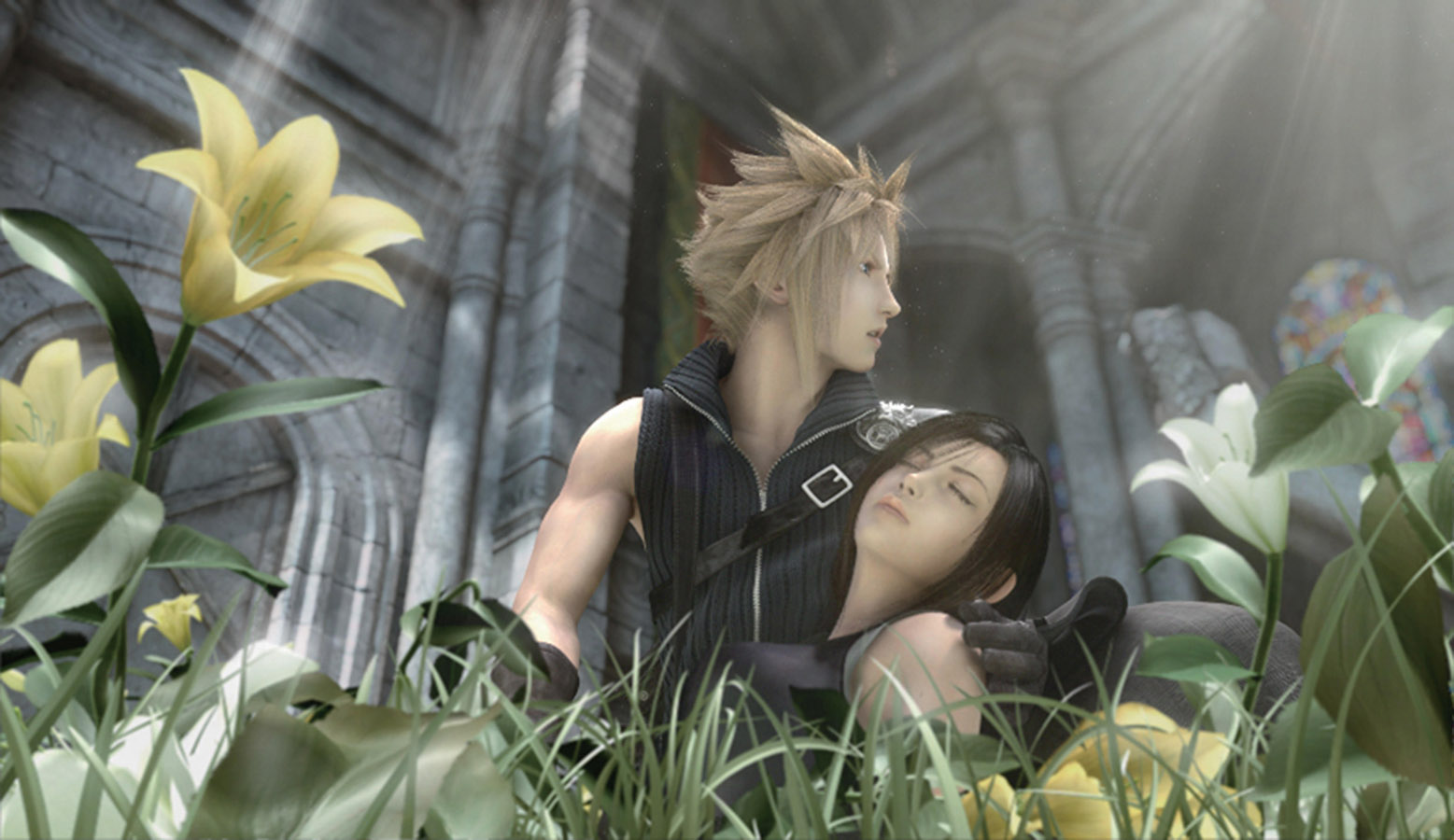
Final Fantasy VII: Advent Children

I watched Final Fantasy VII: Advent Children almost the moment it was leaked. I know I’ve mentioned this before, but I devoted a monstrous amount of time to FFVII in my early teens, seeing every last scene in the game (although I never bothered to play it so that Cloud would take Tifa to the Golden Saucer. Yuffie and Barrett, yes, but Tifa? Meh. Even though they ended up together, ring and all!). I spent my days reading various speculations on the ending and even having my own little site with what would now be called crack fanart comics. So I was understandably quite excited by the prospect of Advent Children.

CG still has a long way to go before it looks truly real, but the graphics displayed here are phenomenal. Beautiful stuff, with some daring directorial decisions. The early fight scenes seem a bit clunky to me, and not all the animation is convincing, but by the time the whole gang was reassembled to fight the Bahamut-like summoned creature, I was so captivated that I didn’t care. That scene had me grinning for its entire length. Even Cait Sith made an appearance!

Set two years after the end of the game (I guess Red XIII just ages badly!), human life goes on as normal, despite the intervention of the life stream. However, many people have been infected by the cells of Genova, giving them a disease called Geostigma, giving disturbing visions and scars. Three men have apparently received more of Jenova’s cells than others, as well as being 'remnants' of Sephiroth thanks apparently to his strong will refusing to be absorbed. These men, led by Kadaj, assemble everyone with Jenova’s cells in order to have a ‘reunion’, which will heal them, or bring back Sephiroth, or stop them making angsty nonsensical speeches, or something. Honestly, the plot barely exists: it’s just a loose framework in order to link one fight scene to the next. For this reason, it’s not a great film, but its entire purpose seems to be to give a thrill to fans like me – and in this, it succeeds admirably.

Snazzy graphics, overlong and overblown fight scenes, lots of psychobabble and plot incoherence are exactly what I was expecting from a FFVII movie. And if it made little sense to a devotee of the game like me, to the uninitiated it would surely be an hour and a half of utter nonsense. Cloud says ‘I pity you, who understands nothing’ - but I can't help but feel he's talking to the audience as a whole.

Not too impressed by how totally useless the Turks were, and it was a shame they didn't have an updated version of their theme, which was always damn cool. Still, an in-joke involving a ringtone really made me giggle.

Nice to watch something from Japan where the characters, to my eye at least, actually look Japanese. Albeit all Japanese models and boy band members. Oh, and Vincent rocks my socks, clocks and even my box. And I love Yuffie, too. They need more screen time!

Overall, highly enjoyable just for the fact that I could see well-loved characters in glorious CG. Otherwise, not great.

(originally written 13.9.05)

Thursday, 19 May 2011

エイリアン9 / Alien Nine

I was expecting all the wrong things from Alien Nine. A lot of the anime and manga I love subvert expectations. Princess Tutu begins as a daft shoujo piece and then later on starts playing with your mind and you realise just how clever it has been. Narutaru begins a cute show with dark edges, and then evolves into a dark show with cute edges. 20th Century Boys purposely revolves around the kind of clichés preteen Japanese boys love. So when I heard it had dark elements, I thought Alien Nine might be similar. In the end, though, the only subverted expectation was that the annoying character flaws of the protagonist would be overcome and she would prove herself in some way – but no, despite several apparent set-ups for this occurrence, Otani remained the whiney crybaby she always was. The lolicon writer probably thought her bursting into tears every two seconds was moé moé. It really wasn’t. And attempts to make proceedings somehow more legitimate and adult by showing a lot of alien creatures getting graphically butchered and (though I suppose this was an ends in and of itself) Barbie-doll nudity for one of the ten-year-old lolis only cheapened everything and made it gratuitous.

And this is the kind of stuff that gets dubbed and distributed in the West. No wonder the uninitiated regard Japanese animation as porno splatterfests. And it falls into the trap of setting much of its climax in the minds of its characters, too, trying to be freaky and unsettling but mostly just being cack.

I watched this along with Ergo Proxy, somehow under the impression they would compliment one another. Well, it does quite amuse me that I thought they might be similar when in almost every way they are polar opposites, in terms of art, budget, sophistication, target audience, scope…but the only reason I’ll ever watch this again is to laugh at it, or to illustrate how sexualised even the cutesiest lolicon anime can be without being parodies or ecchi comedies.

(originally written 15.1.08)