Showing posts with label Kyoto Animation. Show all posts

Tuesday, 18 September 2018

映画 ハイ☆スピード!-Free! Starting Days- / High Speed! Free! the Movie: Starting Days


Honestly, watching more Free! wasn't a priority for me. My impressions of the second season were some of the worst-written on this site. I know the show is shipping trash, but my review sunk way too far into that. 

But since then, more and more Free! has been released. I was always a little interested in this prequel movie and honestly, while it's not something I'm desperate to see, I do want to watch the rest of the show at some point. So I decided to take the plunge (ohoho) and sit through Starting Days. 

To ease myself into it and to remind myself who the characters are, I watched the season 2 OVA that I'd never seen. It was indeed pure shipping trash, but hey, that's generally what OVAs are. The boys go to Rin's school for their culture festival, tease the first-years who have to dress as maids (fuel for that crack ship I said was my favourite in my trash review), have a fight with water pistols and generally follow tried-and-tested formulae for cute boys/girls doing cute things. 

I'm quite pleased to report that Starting Days is a much better prospect. In fact, it's probably my favourite entry into the canon so far. It's based on an official light novel spin-off, and there's a higher writing quality on display here. While it's a bit awkward that these events - before the main series but after the childhood flashbacks that drive the main drama with Rin - are never mentioned in the original, broadly speaking they work, fitting into a void in the storyline pretty well. 

And frankly, even though I couldn't get through the whole movie in one sitting, I was much more invested in these characters as young teens than I was with them as high schoolers. I never liked the condescending blank slate that is Haru, nor the hulking, slightly creepy teddy bear known as Makoto. I liked Makoto as a kid in the flashbacks, his personality making much more sense for a somewhat insecure little kid, but the flashback versions of the others were pretty annoying. Nagisa in particular, while the high schooler I liked the most, was portrayed as a very annoying little kid. He's still very annoying here, but as he's a year younger than the others, he hasn't graduated from elementary school so only appears in a few cameos. 

The story here is a classic school sports story. Haru and Makoto start middle school and are reluctant to join the swimming club. Haru doesn't think any relay can match up to what they accomplished with Rin and Nagisa, while Makoto is diffident, seemingly not wanting to make a decision until Haru does. But eventually they are persuaded to try, and join a relay with two other kids - brash dunderhead Asashi and prickly emo kid Ikyua.

We get the standard formula for these movies - at first they are a mess, each having some personal issue that prevents them from giving their all and working well as a team. By the end - spoiler warning for extremely predictable ending - they pull it together, bond as a team and win the big race! Happy feelings all around. But the test of such a predictable storyline is how well the characters are developed, and how well the emotional notes are hit. And this is what goes unexpectedly well with this story. 

Haru, essentially our protagonist, is much more likeable and sympathetic as a young adolescent than either a young teen or a kid, as seen in the main series. Being emotionally stunted, keeping others at arm's length and sometimes acting way too impulsively makes way more sense for a kid that age than for a young man, and I actually believe in this character much more than the main series' Haru. I believe he would get weirded out by a sudden change in his best friend and start avoiding him, even if it means eating only tinned mackarel and rice and ending up collapsing from hypoglycaemia. I can make allowances for his odd behaviour and the walls he puts up because of his age, where I find it difficult when he's pretty much a full-grown man. 

Makoto is also more interesting here than in the show, getting directly confronted with the question of what his character is when Haru is taken out of the equation. Does he even have his own identity without him? Does he like swimming or just like being with Haru? It was probably the least interesting dilemma but it was probably the most development this poor lapdog ever got. 

Then there's Asahi and Ikuya, the new characters. I loved their dynamic together and they were a pleasure to watch. They’re chalk and cheese but gel really well. It’s like throwing Naruto and Ciel Phantomhive together and watching what happens. I know these characters will show up in the newer seasons but I kind of don’t want to see them get messed up because they were hilarious here. And while Asahi’s personal problem was nothing that exciting, generally a confidence issue (though there’s a fun scene where a young Rei helps him out), Ikuya made his way to the heart of this movie, his conflicting feelings about his brother and his adorable overreaction putting him centre-stage and making him a catalyst for the final act.

The characters’ problems go away very easily, and it’s almost overly brief, watching the boys suddenly start gelling after a sleepover and a weird underwater sequence with Haru and Makoto that would never work in live action and only works here because the animators decide to totally ignore what water does to hair. But the core of the story wherein they struggle with them, with themselves and one another, makes for compelling viewing.

As usual, Kyoto Animation make beautiful, fluid, very cute character animation with pleasant backgrounds and generally nice water effects in spite of that one odd quasi-romantic sequence. They’re by now well established as a powerhouse of light-content but relaxing anime that’s always easy on the eyes. They tend not to know when to stop milking a series (see K-On) and I’m expecting to find the same problems with the Chuunibyou movie I’ve got lined up to watch next, but this was actually a pleasant surprise. Mostly KyoAni shows start well and get progressively worse. Free! might buck that trend, but I guess I’m mostly feeling that way because I don’t particularly like the main show. Now that I think about it, the same happened with Haruhi.

Monday, 27 October 2014

フリー!エターナルサマー / Free! Eternal Summer


As predicted, there was a second season of Free!. Very probably there will be more, too. And I must say, I didn’t mind. This second season did a lot of things wrong, but a lot of things right as well.

The problem with Kyoto Anime follow-ups is that they often stagnate. The characters are established and liked by the fandom, so we get the likes of K-On!! Where cute girls do cute things. And this continues until the fans get bored and reject the show, which sours any early success.

This series looks badly like it is going in that direction. For the first half, not a lot of swimming happens, and there’s a whole lot of regurgitation. There’s another struggle to find new members (none arrive, at least for the main bulk of this season), worries about what the boys are eating, and a cultural festival where they have to run a foot race in their swim clothes. There are rather dull episodes about each of the characters, usually revolving around a misinterpretation where the others think something serious is going on, which turns out to be nothing. The best of these is when Makoto seems to come to realise that he’s not going to be able to keep up with the prodigies around him but would be better off thinking of becoming a teacher – being naturally good with kids and caring enough to check on their well-being outside his classes.

But what the series does well is to break out of this closed circle and look elsewhere for more interesting stories. The most obvious place to do this is with Rin’s swimming club. Rin himself is developed a lot here, and becomes far more likeable as his story is fleshed out, he begins acting less selfishly and actually does some very kind things for others. We also get new characters, lone wolf Sousuke, brooding and stirring up competition yet having a tragic fate (of course), and chirpy, naive comedy loudmouth Momotarou. Aiichirou also gets a lot more development, falling behind badly but working extremely hard to catch up and being vindicated – as well as being the straight man in a fun manzai comedy-like relationship with Momotarou.

There are really two emotional threads running through the season, which work quite well. One, presumably relating to the title, is the grim inevitability of happy times ending. The older characters are going to graduate, new relay teams are going to have to be formed, and kohais are going to have to accept that their sempais are going to leave their lives, or at least their daily lives. The second, closely related to this, is the coming-of-age of the characters and the need for them to find their true paths. Haru in particular is just uninterested in his future, or taking any responsibility, feeling that career paths inhibit his ability to be free. The high point of the season, perhaps of both seasons thus far, is Rin spontaneously taking him to Australia to show him the competitive swimming scene there, opening his eyes to the wider world. It’s a very sweet gesture and works well. Even with some rather awkward attempts to make Rin sound fluent in English.

Of course, the series is still aimed squarely at the fangirls, and in all honesty, the homoeroticism gets strained here. As I suggested in my review of the third season of Inazuma Eleven, these aren’t a bunch of young kids who might all be very confused about their sexuality and ignore it. 

They’re young men, and there’s a certain point where the obviously unusual intimacy between these guys simply wouldn’t go unspoken – even in Japan. The way these boys act, people would be making a whole lot of comments. The closest the series gets to addressing the possibility of homosexuality is when Rin gets angry that the hotel he’s booked for himself and Haru has a double bed. As a result, I found it all very contrived and unconvincing, especially since I continue to not actually ship any of the muscly men together at all (though Nagisa and Ai finally got some scenes interacting with one another, hoorah! If they didn’t have such weird bodies, I’d totes ship it). And I ship characters very easily, from just about everyone who isn’t hideous in Inazuma Eleven to the vast majority of the pretty girls in Saki. I just don’t see the men in Free! as cute in any way. (Flashback versions are another story of course!)


I don’t know that there’s much more that can happen in Free!. It may be better to leave it open as to how well Haru does in the adult world, and who the new swim team recruits might be. But if there’s a movie, or another series, or even just some OVA, I’ll probably tune in. And I’m all for more series like this, treating boys just the same way that anime has long treated girls. But preferably slightly less...bara. Please. 

Friday, 6 June 2014

中二病でも恋がしたい! 戀/ Chuunibyou demo Koi ga Shitai! Ren / Second-year Illness aside, I want Love! In Love

Chuunibyou was popular enough to warrant a continuation, but continuing a series that focuses on romance is always difficult. From Da Capo to Clannad, second seasons have often struggled to find a way to continue while keeping up dramatic tension when a series has really revolved around which girl a central male character will get with.

Comparatively, it was more obvious who Yuuta would end up with in the original series, but where Chuunibyou could go after its central couple got together was a tricky point, one explored through these twelve episodes. And personally, though Chuunibyou Ren was still pleasant to watch and likeable, I can’t think of many ways the series could have continued its love story that I would have found more tedious.

There’s psychoanalysis to be done with this, to be sure – about the otaku culture’s love for the pure, unadulterated female character, who wants to be in a romance but finds it all too embarrassing and hides away like a frightened mouse or, y’know, a twelve-year-old girl who despite her canonical age she rather resembles in how she’s drawn. The series begins to revolve around how despite having been in a relationship for months, Yuuta and Rikka haven’t so much as held hands. She’s too bashful to kiss, and right at the end of the series they build up to her kissing Yuuta on the cheek. Sure, it’s all very adorable, except that I don’t see it in terms of Rikka’s interesting character and neuroses as an individual, but rather in terms of the male audience, the ‘male gaze’ as Tumblr types would put it, and that Rikka isn’t behaving this way because yes, there are girls that averse to intimacy and it’s interesting to consider it, but because (a) the romance story will otherwise lose momentum, and (b) anime has inherited from aidoru / wota culture absurd ideas of purity and innocence. It all feels to me like a desire for an easily-controlled girlfriend with no prior, threatening sexual experience, and rather makes me long for another anime like REC. There’s coy, and then there’s annoying – and it all takes me out of the story to think about the audience this targets.

Aside from this rather strained central relationship, spiced up with the addition of a bland rival in love, childhood admirer Satone, who fancies herself a magical girl and calls Yuuta ‘Yuusha’, meaning ‘hero’. Conceptually this works as a foil but she never really develops an interesting enough relationship with another character to fit into the fold.

What is really good about the series, bizarrely enough, is its padding. Several episodes are devoted to the minor characters, and in particular episodes about the rivalry / affection / sexual tension between Dekomori and Mori Summer. These are rich and amusing enough characters that, crucially, seeing them out of character is very entertaining. The girl whose personality is defined by sleepiness and the hapless boy courting her lose what charm they had in the first season, though, and come over as very tiresome.

The times that the characters’ delusions are represented on-screen remain very entertaining parts. Visually they are great fun and the ridiculous, huge weapons remain very funny. That the new girl Satone brings more opportunities for this, as well as jokey transformation sequences (in the Lite omake animations), which is one reason to be somewhat pleased she exists. As usual, KyoAni provide some excellent animation and pretty art, and the shots of the characters rotating in the intro are technically pretty impressive.

There’s a lot going for Chuunibyou and I actually wanted this second part to be good. The trouble is that the romance part makes the whole thing seem stagnant, though, so all the well-done peripheral parts feel like without something solid to lean on, they only fall down. KyoAni seem to need to learn that sometimes, one season is just the right amount. Just look at K-On!...and Haruhi...and, though this is only a premonition, most likely Free as well.


Wednesday, 18 December 2013

映画けいおん! / K-On! The Movie


Well, much as my review of the second season of K-On! centred on getting tired of the girls, the slightly vain draw of seeing them in my hometown as tourists was irresistible. And yes, K-On! in London proved very entertaining, even with how obviously many of the backgrounds were essentially the research team's photographs drawn over. I even had a bit of a bizarre moment as my old workplace - above Harper's Café which the team obviously thought picturesque enough to snap on their trip to Borough Market - was pictured. I could see the very window where I used to sit! And it's not exactly a place one expects to see rendered. Then there was the scene in Baker Street, the visit to Denmark Street, where I'll be heading after work today, down the road from where I lived a few years ago, and all those familiar scenes from Camden Market, Kensington, The King's Road, Waterloo and Hyde Park...it's always going to be a pleasure to see your city from the point of view of outsiders, especially cute ones, and this was no exception. The Shard being half-built dates the film to a very specific time, but I suppose fashion, car styles and numerous other things more or less do that anyway. 

While in London, the girls are roped into an impromptu gig in Camden as well as an open-air performance in Waterloo, try rather adorably to speak English, and muck about in their hotels - the four graduating girls trying to secretly write a song for Azusa, which makes her suspicious. There's even one adorable yet fanservicey scene where she thinks Yui is making an inappropriate lesbian advance on her, which is really very sweet. The trip is bookended by a silly opening gag that includes the unlikely scenario of the girls miming along to a tape recording actually convincing Azusa that they're genuinely playing (a gag on dramatic changes of direction) and then at the end, the girls have a farewell gig in their classroom before school, which while not all that interesting was sweet and at least musical - indeed, it felt like the girls actually did a lot more related to music in this film than in the entire second season.

As a send-off, I enjoyed this. If I got tired of the girls in the series, having them in this novel new place, and knowing this was a real send-off - something the existence of this film denied the second season - made it more enjoyable than anything much since the beginning of the show. It wasn't just cute girls doing cute things, it was cute girls visiting a new country, playing gigs and writing songs. It was cute musicians doing cute things, and that's something the season rather lost. 


K-On's massive success is, I would say, somewhat unwarranted. But on a small scale, it's very cute and I don't regret the time I gave these girls. But waifus? None. Obsession? Not for me. More? I won't object, once I've had time for absence to make the heart grow fonder, but if that's all the K-On I ever get, I'm quite satisfied. 

Saturday, 14 December 2013

けいおん!! / Keion!! / K-On!! (season 2)

I know that it's actually going to be quite difficult to write about the second season of K-On!, differentiated from the original by the extra exclamation mark. Where the first season managed to stay afloat of being boring by having just 13 episodes (and an OVA), the second is a full 26 episode (and an OVA), with the promise of a movie yet to come. 

And if the first season could be criticised for being nothing more than cute girls doing cute things, the second season takes great pains not to challenge the status quo. 

It established its cast with Azusa's joining the club in the latter half of the first season, and it doesn't change that - not a single new member gets recruited and we stick with the cast of airheaded Yui, shy and feminine Mio, energetic and free-spirited Ritsu and rich, slightly spacey Mugi. Azusa tends to regard her sempai as slightly bizarre, while they cheerily use her as their cute prop. 

And...they do cute things. Nothing more. Their band doesn't play much, and appositely, they have after-school tea a lot. Sometimes their teacher is sick and they decide to visit her, or their pet turtle needs a new tank, or the cultural festival is on and Ritsu and Mio get the fanservicey roles of Romeo and Juliet, though possibly not cast the way you initially expect. It's the same old school plot cliches, only with this particular cast, and a gentle, slow kind of humour. 

It's also the centre of the late-2010s backlash against moé that now sees, thankfully, more shows like Kill la Kill and Attack on Titan. There comes a point watching this sort of thing that you think, 'Yes, they're cute, and this is pleasant to watch, but is this really all there is to it?' As Yui does something ditzy for the millionth time and Ritsu makes Mio blush yet again, it starts to feel totally expendable and, indeed, like rather a waste of time. 

And that's as far as K-On!! can go - it pushed the concept too far and went on for too long, or at least, oversaturated the market. 

There's too much of this to support nothing happening and schoolgirls being cute for this long. Azumanga Daioh at least had its frenetic pacing, brilliantly-built-up comic setpieces and emotional conclusion to sustain it, but K-On!! does much less in considerably more time. The possibility of an emotional graduation comes, but is kind of neutered by the fact the girls are all going to the same university and there's more to see yet with the graduation trip to London. 


There's the movie still to come. I'll watch it because I'm curious about the girls' adventures in my homeland, with the outsiders' perspective they'll bring. 

But I'm rather glad to see the back of them. And for girls who are designed to be likeable, and indeed, who are likeable, that's probably the worst thing to have happened - for me to get bored of them and no longer want to know what they're up to. But that's the problem with too much of a sweet thing - eventually it gets sickly and unpleasant. 

Saturday, 28 September 2013

フリー!/ / Free! / Free – Iwatobi Swim Club

Believe it was something quirky doing the rounds organically or believe it was all a cynical viral marketing ploy, the fact remains the same – KyoAni’s short promotional film about some boys showing off toned bodies as they swam did the rounds of the Internet anime fandom, Japanese and international, and a broad audience became somewhat ironically enamoured of it. Those who didn’t care for the rippling muscles found the absurdity of the premise and the distance from the moe-moe girls of previous KyoAni efforts very entertaining and soon there was quite the buzz about the possibility of a full ‘swimming anime’.

And of course, it came to pass, and ended up quite the hit. Fujoshi took to it for obvious reasons, churning out their pornographic fan-comics incredibly quickly, while straight male fans continued to watch because something so camp and silly made them laugh. Of course, there were some detractors, mainly people who didn’t see any irony and found the whole thing boring and girls with a slightly holier-than-thou attitude of having been into homoerotic anime long before one was a hit on this scale, so they couldn’t possibly deign to watch it, but Free! was marketed very well and got bigger and bigger.

I liked Free!, but I don’t think I was quite doing it right. I would certainly tick many of the boxes in any fudanshi test, but I didn’t watch Free! for the shipping – none of the pairings appealed to me, the muscles I found most unsightly (even cute shota Nagisa had a chiselled chest) and if I were forced to chose a ‘ship’ I would probably go for Nagisa and random-other-team-uke Aiichiro, which is definitely doing it wrong. They never even interact. I didn’t want to see these half-naked guys making out. And nor did I want to laugh at the stupidity here. I mean, it was stupid, and that’s what’s enjoyable about a lot of sports anime (just look at Prince of Tennis and Inazuma 11), but if that was all there was to it, I would only get to about episode 3 before growing to dislike it. Personally, I am actually a sucker for the classic embittered-rival-grows-passionate-about-surpassing-the-main-character storyline, which I associate most with Hikaru no Go but is everywhere from Code Geass to the movie Amadeus.  I didn’t like Rin, but I was very interested in his interactions with natural genius Haruka.

Not a lot happens in Free! – the boys decide to revive their school’s swimming club, struggle to recruit the fourth member who will allow them to compete, train hard and then go to the Nationals for the relay. Meanwhile, they have to struggle with the politics surrounding the presence of their rival Rin, who had been the final member of their dream team back when they were adorable shotas. Of course, athletic performance is directly linked to frame of mind, and when the boys are together they begin to see the most absurd symbolic elements like their spirit animals swimming ahead of them. But it is enough drama to sustain 13 episodes, and it’s no surprise that the final screen hints at more to come – after all, KyoAni are known for wringing every last drop out of a successful property…just look at K-On!.

Everything about Free! is obvious and superficial. The comedy is broad but occasionally inspired, from Nagisa’s penguin fixation to Rei simply sinking when he tries any stroke but the butterfly. The writing is obviously aware that fandom will pair off the guys and pushes certain ‘ships’, like ReixNagisa, which is probably the most annoying thing about the show. Emotions are broad and guys will grab each other and start swinging fists and rolling in the dirt together when they have a deeply-felt point to make. Kohais care deeply for their sempais and will come close to tears when they see them in a bad mood. It’s cute and dumb, but it’s meant to be, and it thrives on that.


I can’t say Free! is a great piece of anime writing, or that I’d watch it again. But it kept me amused and interested throughout, and I will tune in for more. Just don’t expect me to coo at the hot boys or to laugh at the stupidity. That’s not why I like Free! – I like it for its bare bones, not its gimmicks. 

Saturday, 6 July 2013

Kyoto Animation Commercials Series

With Free! looking to be one of the big series of the season, even if a huge portion of its fanbase likes it in an ironic sort of a way, I thought I’d write this after quite enjoying the first episode of the semi-viral ‘Swimming anime’ to highlight just why I thought Free! wasn't going to come to pass. Well, thought it highly unlikely. Though at the same time, why it was also a little more likely than some others aware of the series of KyoAni commercials were making it out to be. 

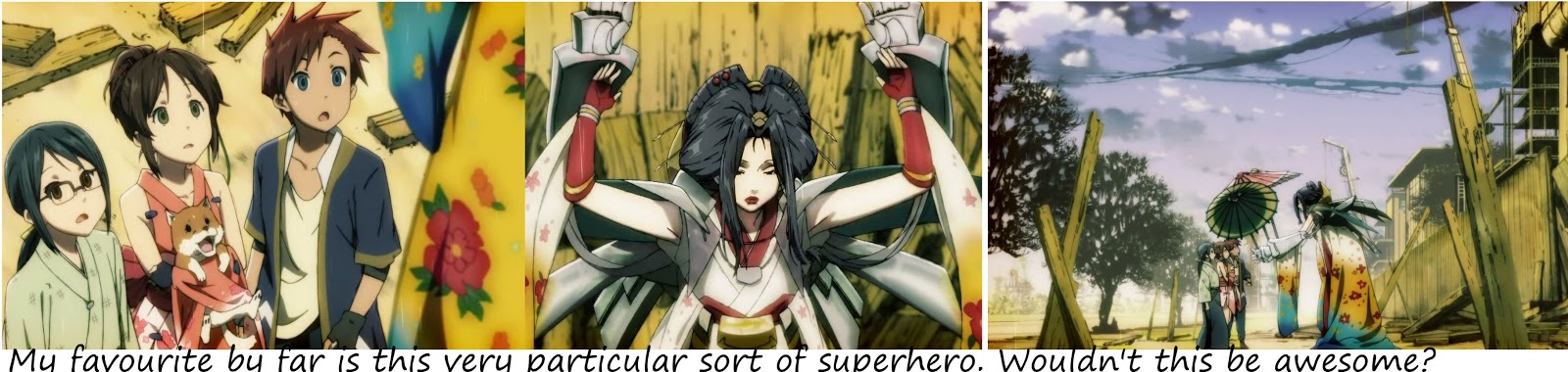
The now-(in)famous commercial that led to Free! was in fact the ninth in a series. And the other eight haven’t gone viral, nor become a new series. Indeed, there are other little shorts that I think I’d rather have seen made into a full series – especially the one about a huge robot woman in a traditional kimono who saves the day with the big metal arms on her back and then rockets off into the sky, which was even more brilliant in its absurdity than an openly homoerotic series about cute boys in very little clothing. But most are not animations that would lead to something bigger. That’s simply not what they are.

There are broadly speaking some obvious boundaries between three different thematic backgrounds here. The first mini-animations are basically eyecatches, pleasant adverts for the studio itself – kids plant flowers or skydive to form the Kyoto Animation logo. They, along with the little dance routine celebrating imagination and escapism that is the third in the series underline the KyoAni of K-On! and Haruhi – there’s a focus on cuteness, prettiness and that very nice-to-look at facial style that most of the studio’s leading series has, though it’s slightly disconcerting how the little kids basically look exactly the same as those oh-so-cute high school girls.
After that, the commercials become a place for animators to experiment, to create shorts in styles they otherwise wouldn’t get to try out. Little pencil sketch kids come to life, dive through the air and end up sitting on logos. A woman who looks like a fashion sketch imagines inanimate objects are coming to life and tries to interact with them – all drawn in a very slender way with colours that remind me of pastels, and the aesthetic comes over as very Western…despite the catgirls.

Finally, the last phase is little snippets of an imagined world – the shorts that could potentially be developed into something longer. Sure, one cute one about cat pilots reminiscent of Porco Rosso and a pretty girl going into a store in a lovely overgrown building is linked to KyoAni’s online shop, but the last four animations could definitely become series of their own. As I said, the one with the robot woman in traditional Japanese clothes and what seems to be a 1940s setting would be my favourite, but the guys doing magic and the cat pilots are also very interesting.

And then with the strange thumping song and the perfect muscled bodies comes A New Challenge, a snippet of a swimming anime. I suppose part of why it’s compelling is that it hints at competition and rivalry, that semi-obsessive sense of competition between young boys that made Hikaru no Go so good. But ultimately it seems to have hit a note because it’s absurd, even more absurd than robot women in kimono saving kids from a collapsing building. Not inherently, but in large part because it’s funny imagining anime fans watching the commercial. It’s funny to picture teenagers insecure in their sexuality looking at the taut bodies and unashamedly suggestive expressions and being discomfited. It feels a little inappropriate and yet amusing. It’s pure camp. And you don’t quite know whether it’s meant seriously or not.

But I’d like to see some of these other ideas fleshed out. Perhaps this commercial series will become the equivalent of What a Cartoon! for Cartoon Network…!

Wednesday, 26 December 2012

中二病でも恋がしたい! / Chuunibyou demo Koi ga Shitai! / Second-year Illness aside, I want Love!

Chuu-ni-byou, ‘the illness of the second year of junior high school’, is a very funny condition. It’s the mental delusion in young teens where their adolescent angst makes them create a fantasy world filled with ridiculous attempts to be cool. In the case of main character Yuuta, that meant calling himself the ‘Dark Flame Master’ and donning a big trenchcoat, trying to imbue fancy swords with supernatural powers. When the story starts, he is deeply embarrassed by that past, blushing and cringing right down to the floor when he thinks of it, which is a very endearing trait. When he goes to his high school, he gets it out of his system with one last display on a balcony – but the one person who sees it is of course the girl who is still mired in the worst delusions of chuunibyou, cute little Takanashi Rikka. With his secret revealed, he is drawn into the strange plans of this girl, joining an odd club with another more energetic chuunibyou called Dekomori, a sleepy girl called Kumin, a clownish boy called Makoto and a popular cheerleader called Nibutani who is initially an antagonist of sorts, but becomes an ally largely because she, too, has a past as a chuunibyou and the others have blackmail material on her.

From the offset, the odd couple comedy is rather like ToraDora clashing with Black Rock Shooter – an unlikely match of a misunderstood guy and a girl with a damaged history who acts out, overlaid with another world that allows for bravura animation with huge, silly weapons. It also struck me as rather like Shakugan no Shana if the supernatural action had all been imagined. But the hook of this embarrassing past is a wonderful one, and I had some of the biggest, most affectionate laughs I have had in any anime since…probably Ika Musume, which had a similar direct and ingenuous way of presenting humour.
Part of the initial hook of Chuunibyou is attached to how that sort of escapism is likely to resonate with the target audience. 
The greater part of anime fans must either have done embarrassing things in their youth or know people who come over as delusional, which adds to the humour. I found it all immediately appealing, and thought this perhaps the ideal mixture of Kyoto Animation’s previous styles – the romantic big-eyed Keyadaptations, the wacky anything-goes humour and the gentle but dull cute-girls-doing-cute-things with adorable art. It had humour, spectacle and romance, and for the first time a male lead who was not sarcastic and handsome and standoffish but as cute and goofy as the girls – though the harem he assembles here is particularly childlike and adorable and in design terms owes a lot to K-On. It didn’t hurt that occasionally the show would present delusions as if real, especially when the ice-cool, detached big sister character would come to knock some sense into Rikka with a ladle, and that as well as Rikka’s umbrella would be transformed into huge sci-fi anime weapons.

Of course, after about half its short 12-episode run (plus six cute little internet shorts), Chuu-2 did what almost all anime in its style inevitably do, and swung towards drama rather than comedy. I must say, I wish the comic element had lasted longer, even if that meant a longer series or the dramatic parts more truncated – as it was, they were paced fairly slow, anyway. Ultimately, it becomes apparent that Rikka’s illness is a result of repressed feelings of grief – of course, for it can’t just be a nice, light story – and by living in her silly dream-world, she is hurting her family and putting off truly being able to mourn.

The way this issue is ultimately dealt with – an irritating half-measure where the status quo can be restored and Rikka finds catharsis and a way to confront what she has repressed while within her fantasy world, rather validating it and removing the interesting angle of ‘If she doesn’t grow up and leave this behind, she can never truly mourn for her loss,’ which was kinda the whole point of the serious turn. Add in the unfortunate turn of a funny sleepy character behaving very oddly – apparently a character original to the anime – and a very unlikely moment in the classic anime tradition of ‘We’ll hold them off here – you go on ahead!’ and it all struck me as very hollow and artificial.
Which is a shame, because until the very last three or four episodes I really enjoyed Chuunibyou. It was a neat little set-up with great potential for humour, utterly adorable girls and a couple of adorable boys as well – all doing cute things – and some very memorable images. It was on course for being one of my favourites in years, winning big points from me especially because of the way Yuuta and Nibutani would get so embarrassed when they remembered their past silliness, and how even as one who disliked Geass I can find it funny when Fukuyama Jun put on his Lelouche voice for his daft past self, usually much more in his adorable Riku-from-Onmyou Taisenki / Aruberu from Gankutsuou / oh god that hideous creature from Okane ga Nai mode. But just like Sword Art Online, when it changed tack and took some risks, it went too far, and ended up rather spoiling what went before it. What a pity, for I had hoped for a bit of a classic here.
Still, I’ll definitely want to catch the OVA next year, and any future animation. Hopefully they’ll have a less seizure-inducing opening animation, too.