Showing posts with label literary. Show all posts

Sunday, 9 September 2012

Higglety Pigglety Pop! or There Must Be More to Life


 I didn’t know much about Maurice Sendak before the hipster-friendly Spike Jonze adaptation of his Where the Wild Things Are. It wasn’t part of my childhood and though I’d seen those iconic illustrations before – as well as Sendak’s weird In The Night Kitchen and his lovely old-fashioned drawings for Little Bear, the latter of course having a charming animated series – but the film was a memorable, brilliantly melancholy work. But it was not until his tragic passing that I heard of Higglety Pigglety Pop!, and the fact that it was his favourite of all his stories.

Written as an affectionate tribute to his recently-deceased dog as a way of coping with both that loss and, according to most reports, the loss of his mother, the story is a stream-of-consciousness-like flight of fancy in the Alice in Wonderland vein. Silly, selfish little doggie Jennie, despite having every whim taken care of, decides there must be more to life and runs away from home. She meets a pig advertising for a new leading lady for a theatrical troupe, but the position requires experience. From a feline milkman she learns of a vacant position for a nanny – which will, she is assured, be an experience. So after helping herself to most of the milkman’s deliveries, she becomes a nanny for Baby, only to find out that the nannies who fail to feed the querulous child get thrown to the huge lion in the basement. Will she be able to do it? And when push comes to shove, will she remain self-serving or grow up a little and learn to sacrifice herself for others?

Though the ‘animation’ here is minimal – Clyde Henry Productions were approached after the success of the stop-motion Madame Tutli-Putli but did not have time to create another such a short in the time they were given so opted for puppetry – the aesthetic is very in-keeping with animation and the human characters are the ones who look odd in the world. Still frames of this short look remarkably realistic and the cat costume in particular is a phenomenal piece of craftsmanship.

Included as an extra in the Blu-Ray of Where The Wild Things Are, this peculiar and entertaining little extra is well worth a watch, and perhaps more excitingly for me, led me to the other Clyde Henry Productions short, which I watched straight after. 

Monday, 26 December 2011

The Sword in the Stone (1963)


I’ve been meaning to write my thoughts on The Sword in the Stone for a little while, as – being one of the few Disney films we had on VHS – it was one of the animated films I watched the most as a young child. Since I had the happy experience of waking up on a Christmas morning and turning on the television to see it there, bringing back waves of nostalgia, I thought now was as good a time as any.

There are many ways in which this film has influenced my psyche. My love for all things strigine surely derives in part from the loveably grumpy Archimedes the Owl. Wart’s voice actor(s) inured me to the idea that if you are young, attractive and sympathetic in a world full of people with English accents, it makes perfect sense for you to sound American – long before I had any idea about accents at all. And though the film’s art perhaps had the opposite effect on some, I think it may on some level have been the film’s firm assertion that human-animal romance is weird, comic and doomed that steered me well away from furry propensities, whatever effect Thundercats may have had on my young mind.

The Sword in the Stone is an adaptation of one of the Once and Future King books, and takes a stab at Arthur’s youth, a subject that Malory doesn’t cover. In this version, Uther is dead and his bastard child (it can be inferred, though all we know from the film is that he is an orphan) Arthur has been fostered by a noble household, working for them as a lackey and hoping to one day become a squire. He is clumsy, scrawny and accident-prone, though, and is referred to by his surly foster brother Kay as ‘Wart’. Everything changes when Wart meets Merlin, who decides he will tutor the boy, moving into the castle and teaching him various things by turning him into different animals – which gets him into various scrapes, one leading Merlin to take part in a Wizards’ Duel with the barmy Madam Mim. When it becomes apparent that the boy’s ambition falls far short of his potential, Merlin loses his temper and gets ‘blown to Bermuda’, but quite on his own, Wart manages to find the Sword in the Stone in London and pull it out, securing his future as King of England.

Like many Arthurian stories, this one is set when many of the stories were written down – in Medieval England – and not when they were set, making Arthur English rather than a Breton. I’ve never worried about anachronisms in Arthurian stories, though, as they’re all based on very fanciful myths and legends and it isn’t as though what’s in Geoffrey of Monmouth is by any means a universal tradition. Besides, the film (and book) embraces anachronisms and makes a point of it – indeed, Merlin’s return from Bermuda is so jarring the style of humour preempts that of Aladdin by decades.

The plot is very thin, and arguably nothing in the story really affects the final climax, but this is really a series of setpieces and works very well for an animation: it’s great seeing (some of) the Nine Old Men really having fun with animation, from underwater scenes to birds in flight to magical transformations, giving a real exuberance to the story. It’s all helped along by the slapstick humour, much of which is based on the Tom & Jerry idea of predators deserving to be painfully foiled.

Sword in the Stone isn’t the best-known Disney film. Its songs are too character-based and situational to get onto the various Disney compilations. It doesn’t have great revelations of characters or tragedy to give its story weight. But as a light comedy, it’s almost peerless, and the animation was fine enough Disney recycled it several times in their usual way that generation after generation find shocking and scandalous, as though it was a great deception and Disney (or at least, director Wolfgang Reitherman) were horribly cheap. As Floyd Norman pointed out, he did it because he wanted to, not because he had to, or because it cut costs. He actually liked reusing favourite sequences in different films.

Disney has revived its tradition of fairytail princesses. I’d like to see them revive stories centred on preteen (human) boys like The Jungle Book and Peter Pan. That tradition died with The Black Cauldron, and it’s a shame. The Sword in the Stone is remembered primarily for Merlin (he alone shows up in the Kingdom Hearts games), but there’s much more to it than just him. Funny, sweet, witty and exuberantly animated, it’s a very fine piece of Disney animation.

Thursday, 20 October 2011

Ghibli Shorts – Night of Taneyamagahara, On Your Mark, Ghiblies, Sora-iro no Tane and CMs

(more to come when I get the extras with Ghibli ga Ippai)

種山ヶ原の夜 / Taneyamagahara no Yoru / The Night of Taneyamagahara
The honest truth is that if not for the fact that this was a Ghibli short film, directed by superb background artist Oga Kazuo, I would not have bothered. It’s a little folk story by Miyazawa Kenji, the mind behind the wonderful Gauche the Cellist and Night on the Galactic Railroad, but is only a tiny fragment of a story and barely animated.

Very much like cheap educational television animations and Jackanory-style storytelling programmes, it is less a piece of animation than a series of still images with the camera panning over them while a soft voice reads out a story. In this case, the plot is that when a man falls asleep in a group on the Taneyamagahara mountain, he dreams the grass and oak trees are talking to him, asking him to care for them when he buys the land, and not to cut too many trees down to make charcoal. Just as he is coming to an agreement, he steps on a young lightning god by accident and is punished. That’s about it. There’s a nice, wistful mood, yes, but very little to identify with or see progressing.

And honestly, while the art is lovely in terms of its backgrounds, they’re not the visual spectacle of Iblard Jikan and the human characters are clearly intended to seem ordinary and unglamorous, but end up not very appealing at all. Plus, perhaps unsurprisingly, when much of your screen time is devoted to talking leaves, things get a little dull and repetitive.

オン・ユア・マーク/ On Your Mark
Wow - the music video Studio Ghibli made for Japanese Rock duo Chage & Aska’s song ‘On Your Mark’ in 1995 is so unutterably beautiful that I was stunned. So much story, so many fascinating questions raised in such a short time that it’s got to be the best non-performance music video I’ve ever seen.

(originally written 1.9.06. Even now when I see clips of the short video appear in things like AMV Hell it takes me aback how high the quality is, particularly for a mid-90s piece of Japanese animation, and how ambitious it was)

ギブリーズ/ Ghiblies 1&2
It’s been a long while since I watched the Ghiblies shorts – about five years – but they still make me smile. Crude 4-koma-like art not so distant from that of Tonari no Yamada-kun or Sazae-san portrays the everyday lives of the Ghibli workers – albeit fictionalised into the ‘Giburi’ studio, based on the joke that the way ‘Ghibli’ is said in Japan (‘Jiburi’) is a misreading of the Italian word, which should have a hard ‘g’. With a great little bassline in the second short and some fun jumps into a more realistic style and CG experiments, it records what are clearly funny moments from the office.

Only a few minutes each, they’re well worth the watch for any fan, if perhaps a little baffling for the uninitiated.

そらいろのたね/ Sora-Iro no Tane / The Sky-Colored Seed + Nandarou
Funny, childish little animations for Nippon Terebi, these little animations are cute bits of nothing. Nandarou, meaning something along the lines of ‘Thingy’ or ‘wassat?’. In the TV spots created for their 40th anniversary in 1992, it variously shoots out mini versions of itself, reabsorbs them and eats some characters of the studio logo before turning into various other, similar-looking things. Oh, and one where it goes all huge and CG. These are just little bits of fun for a few seconds each.

Sora-Iro no Tane was created at the same time, directed by Miyazaki. A cute, colourful animation looking like a typical kids’ cartoon, it has a bit more substance than Nandarou, albeit still being somewhat hallucinogenic. A small boy trades his toy plane for a sky-coloured seed from an anthropomorphic fox. The seed sprouts into a house at first big enough only for a little chick. It keeps growing, until a cat can fit in, then the boy, and soon elephants and numerous other creatures want to be included. The fox decides the trade has been unfair so swaps again so that he can have the whole house to himself, but the edifice gets too close to the sun and pops, presumably teaching him his lesson. A minute and a half of innocent fun.

Various commercialsThe Nisshin Seifun commercial is probably the best thing Miyazaki Goro has yet worked on. Storyboarded by him and directed by Katsuya Kondo, it’s about a silly fat cat chasing a butterfly drawn in a nice line-art style. A fun bit of frivolity.

Miyazaki Hayao’s House co. commercials are probably the most richly animated snippets for TV the studio has made. The lovely little clips show 50s kids from the point of view of adults, delighting in catching sight of (presumably) their parents. Beautifully done and endlessly adorable, they’re indispensable viewing for fans. An odd, warbly song from a Ghibli seiyuu about the chicchana onna no ko called ‘Okaasan no Shashin’ (mother’s photo), though, which if anything I’d have changed.

Umacha, or ‘Delicious Tea’, were two short ads for an iced tea from Asahi. Oddly, it was made in tandem with a live-action version. It’s done in the Yamada-kun watercolour style, and essentially the idea is that the tea is very refreshing. Directed by Tanabe Osamu, they seem to me somewhat throwaway, perhaps reflecting a lack of input from studio writers.

Wednesday, 24 August 2011

Beowulf

Beowulf turned out to be quite a surprise, albeit not a very good one.

I didn’t think it was going to be animated to the extent it was. I thought it would be like 300 or Sin City, heavily stylised live-action with lots of CG overlaid. But alas, Robert Zemekis is no Robert Rodriguez, and is still hung up on his Polar Express experiments, so Beowulf takes the interesting step of having real actors, motion-capturing them, faithfully recreating faces and expressions, but sticking them into computer animation. The final effect is like human faces pasted onto the Pillsbury Dough Boy, and the opening scenes in particular, with lots of sub-Shrek crowd scenes, look terrible. Scenes with horses make the intro to the original Tekken look state-of-the-art, and everything still looks moulded out of plastic, be it skin, fabric or eyes. Aesthetically, a total failure. They may have made Ray Winstone look young and muscular and Brendan Gleeson look like Gimli, but it really wasn’t worth it for the floating, swollen, immune-to-momentum mannequins we had to watch, even in glorious 3D – and this really isn’t a film to see without the 3D effects, because they provide what little interest there is in the visual spectacle.

The story is a typical Gaiman reimagining, the kind of thing that looks really clever in a single comic issue if you’re familiar with the source material, because a flaw is shoe-horned into Beowulf’s character so that there can be clever-clever talk of unreliable narrators. To be fair, though, for a movie to work, some way to tie the dragon into the main storyline was needed, and that was really quite a seamless way to integrate it. Despite this advantage, the whole fight against the dragon was so Saturday morning that it became intensely dull.

And this is really the problem with the film. The two- or three-part narrative of the poem (ah, much scholarly debate about which it is) all gets neatly tied together, in a very modern femme fatale sort of a way, and there’s the macho revivalism of 300 at play, but this film fails where 300 succeeded because it just isn’t any fun. The fights are plastic and false, Beowulf isn’t interesting as a man or hilariously excessive as a warrior (as is Zack Snyder’s Leonidas), the conclusion is gobsmackingly cheesy and the CG falls way short of what it needs to for this film to be in any way watchable in ten years’ time. Oh, and ‘hiding the penis’ gags may work in Austin Powers or The Simpsons, but they really don’t belong here.

Kudos to Gaiman and collaborator Roger Avery for their little Macbethian revisionist unification of the tale and their attempt to humanise an idealised hero, but as a film, this really did fall flat.

Tuesday, 12 July 2011

Aladdin (1992)

The Lion King was the Disney film that dominated my childhood, but right alongside it was its immediate predecessor, Aladdin. And because it was one I watched as a child, it was only later that it struck me how very bizarre a film this is. It’s unlike other Disney films, unlike other comedies of the period, unlike other musicals and visually extremely bold. And key to it all is Robin Williams and the free reign he was given to put his hyperactive brand of improvised comedy on tape.

Released in 1992, it came during a strong period for Disney, in the wake of success stories like The Little Mermaid and Beauty and the Beast. This was also when I was a happy child consumer, so I not only had the video tape and the songbook, but the tricky SNES game and, when it came out, the slightly-above-average video sequel The Return of Jafar.

Aladdin was familiar to me through the pantomime interpretations of the Arabian Nights story: thus I felt a bit surprised when I first saw this. I expected a Chinese setting and a rather younger Aladdin. Indeed, early production had Aladdin in his early teens and a mother planned, even if she probably would have resembled Widow Twankey very little. I soon came to see the reinterpretation as I do now: a very wise and intelligent one. The fantasy Arabian setting is a defining point gives the film so much character, and let’s face it, Ala’ ad-Din never sounded very Chinese. Aladdin in the orphan tradition actually manages to be a role model as a loveable rogue, despite ‘gotta steal to eat, gotta eat to live’ not really being very excusable, and as an 18-year-old is much more believable as a romantic lead.

And of course, Robin Williams’ Genie character is what makes this such a bizarre and excellent animation. His freewheeling style is matched perfectly with animation that brings experimentalism back to Disney after a long absence. Having 90s pop culture references and innumerable anachronisms is braver than it might seem in hindsight and could have fallen flat. But it works brilliantly and makes the film unique and startling. I’d rather they hadn’t let Williams do his slightly dubious generic-Arab voice for the turbaned peddler at the start, though. I’ve never been quite comfortable with him.

The plot is simple, the romance mawkish despite excellent songs and the supporting characters obvious, but this film reminded the world Disney could take risks and produce some images with incredible visual flair.

Saturday, 18 June 2011

Coraline

I was very impressed by Coraline. Stunning animation, witty character design, great humour and tension, some wonderfully creepy imagery and strong voice acting made for a great movie, and the 3D effects for once actually elevated the film they were applied to, rather than cheapening it.

There were some plot issues, but apparently they were the changes from Gaiman’s original: why, for example, take so long to raise the issue of the buttons, making it seem like they were all Coraline objected to, as well as making it confusing that the Beldam (a term I remember from studying Keats and having to differentiate from ‘Belle Dame’!) wanted to keep them hidden? Why lock Coraline in the place she’s bound to discover some ghosts if you are still hoping to convince her how pleasant her life can be?

Minor niggles aside, this was a great story, pure idiosyncratic Gaiman. I was also happy with the casting: Fanning was great, Hatcher perfect and French and Saunders were fun as ever!

Critically lauded and successful, I found Coraline's success to be gratifying.

(originally written 12.5.09)

Thursday, 12 May 2011

火垂るの墓/Hotaru no Haka/Grave of the Fireflies - Live action version

(This review may not make sense without first reading my review of Ghibli’s version)

In my review of Studio Ghibli’s Hotaro no Haka, I pondered how the movie would have worked if it were made in live action. Having now seen the recent non-animated adaptation of the same novel, I think I was right in my conclusions then – while it is perhaps easier to empathise with live-action actors, there are certain elements that worked better in animation because they were no more or less realistic than everything around them, whereas here there were occasional jolts of unwanted Brechtian V-effekt purely because the special effects weren’t realistic enough to be believed.

But I couldn’t tell you which version of the story is superior, because both have considerable merits. However, I would say that the animation tells the core story with more brevity and simplicity, and it was the live action piece that felt like it was complimentary, rather than the other way around. But who knows? Maybe I’d’ve felt differently if I’d seen this version first. Indeed, if I’d read the novel, perhaps I’d think something else entirely.

While a lot of visual images seem to purposely echo the Ghibli version, this is a very different film. For one thing, the narrative framework and the first half of the 250-minute drama are centred not on young Seita-kun and Secchan, but on the relative who takes them in when they lose their mother, but whose selfishness eventually drives them away. It’s an interesting and daring idea, to tell the tale from the perspective of the least sympathetic character in the piece, and keeping her unsympathetic even though we can understand her motives a little more here, but it works well. We see the aunt’s hardships, trying to feed six children and her brother-in-law, whose physical handicap keeps him from the fighting, but we also see her merciless decision to protect her own and drive out the children who need her. She is more obviously conscious of her failings and her callousness here, and she is given some degree of redemption towards the end, but that does not change her behaviour.

However, the shift of focus towards her makes sense, because the actress who portrays her (Matsushima Nanako from Ringu) gives a brilliant performance, dignified and yet so very hateful; the way she uses silence or simply ignores the beseeching words of her daughter or brother-in-law is chilling, especially when we know that the façade isn’t perfect and have seen her at her most emotional on other occasions.

But this Japanese dorama, which I believe was made for TV, suffers many of the same problems that blight British made-for-TV dramas: one or two superior performances surrounded by a supporting cast who really aren’t up to the same standard (the young actors in particular), a budget that makes directors ambitious but doesn’t get the special effects, cinematography or set construction to the level they need to be (the CG fireflies in particular, despite being one of the most important motifs of the movie, look very poor – resulting in the aforementioned V-effekt), music that knows no restraint and as a result smothers powerful scenes in molten cheese...and an inflated sense of self-importance that here results in not only the excessive running time but also a horribly vulgar montage run under the credits, where shots of Setsuko and Seita are juxtaposed with a lot of children from the Middle East, presumably Iraq and perhaps Afghanistan, with a moralising message reminding us that today, there are still many young war victims like the ones in the story. It’s unnecessary, it’s patronising and it’s inappropriate. The message isn’t wrong, of course, but evening drama shows are not the kind of forum for glib politics.

But this doesn’t change the fact that the deeply sad story is one of the best ever told about war, one of the most tragic and one of the most moving. Even though the men who die in the war are featured in this version (they are absent in the animated version), it is the fact that the film brings home the way that tragedy does not just happen on the battlefields that makes it so potent. While I personally found myself feeling more sorry for the younger-looking Secchan and the Seita-kun driven to worse extremes of petty crime in the Ghibli version, whose acting I never felt to be questionable or excessive, I’m quite sure that there are a lot of people who will find it much easier to feel for real children than drawings. Both media are equally valid, and I can only advocate seeing both.

Would I ever have seen this if not by association with anime, though? Well, no…but that would have been my loss.

(originally written 5.11.06)

Saturday, 7 May 2011

巌窟王 / Gankutsuou / The King of the Caves / Gankutsuou: The Count of Monte Cristo

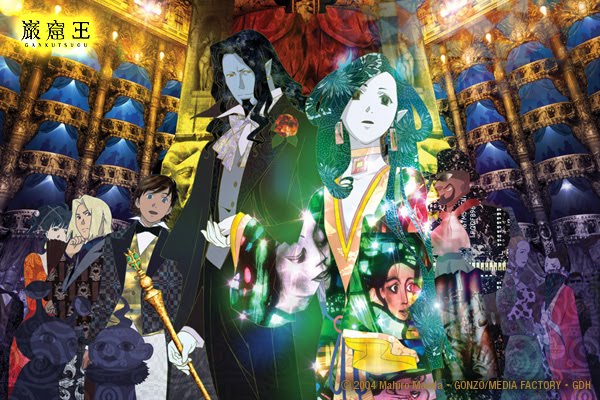
Gankutsuou truly is something quite different, standing head and shoulders above the vast majority of the trite anime releases of its season, and every season since. Here is something intelligent, daring, beautiful and compelling, with a story from classic literature. Gankutsuou is the Japanese title for Dumas’ The Count of Monte Cristo, and this a clever sci-fi adaptation set in an imaginative future. The heart of the story remains Dumas’, however, and the futurization is mostly aesthetic – yet it is in aesthetics that Gankutsuou is most striking. Gonzo chose to use a transparency effect instead of colouring many of the items of clothing in the series, instead using strange static textures for a rich and rather bizarre visual effect. Coupled with brilliantly excessive scenery and simple but attractive character designs with a striking colour palette, the effect is striking to say the least.

The story is not quite like the novel’s, focussing not on Dantes, but on Albert de Morcerf, beginning with his meeting with the Count to watch the execution – in effect starting a third of the way into the book and turning its exposition into a mystery story. It is a clever way to make a thrilling but quite clinical story very human, and throws the count’s revenge into a very different light to that of the book, our sympathies becoming more mixed by us consider another point of view more attentively. Towards the end the series loses its way a little and some of the ways Dantes’ character is presented are a little badly judged, but I staunchly disagreed with those who complained the novel was 'butchered': this does not replace Dumas’ book, which despite its daunting length is actually very light and compulsively readable, and if anything is a treat for fans, encouraging as it does a slightly different way of looking at the work. This to my mind makes for something much more interesting than a slavishly accurate rendition.

Very pretty to look at, iconic, clever in its adaptation and presentation of a different and likeable protagonist, and of course still having at its core Dumas’ deliciously seductive revenge drama, Gankutsuou is easily my favourite Gonzo work.

(tweaked from original version written 24.2.05, with interpolation from thoughts from 4.4.05)

Thursday, 28 April 2011

長靴をはいた猫/ Nagagutsu-o Haita Neko/Puss ’n Boots

This makes me very cheerful. Nagagutsu-o Haita Neko is from the glory days of Toei, and another stop on the Miyazaki trail. Considering that in 1969, he was also working on the pretty awful but good-hearted Sora Tobu Yuureisen, Miyazaki’s work as a key animator clearly shaped him in different directions, but if he got one key scene to play with there, here he was given free reign (shared with future collaborator Outsuka Yasuo), and developed the pacing and comic timing of slapstick chase scenes that would last him a career.

The film itself was successful enough that Toei made Pero the Cat their mascot (Pero…Perrault…get it?), and you often hear it referred to as a classic, in Ghibli fan-circles, at least. It sticks fairly closely to the original storyline from the Perrault classic: a poor peasant boy and Puss In Boots (who had boots before meeting young Pierre, here) set out together to make their fortune, trick high society into accepting them and end up besting an ogre, or in this case the Maou (demon king) Lucifer. The trick that ends the old story doesn’t work here, so an extended chase scene ensues, contrasting the epic and the comic to great effect: it’s the last twenty minutes that the film is remembered for, and there that we see the masterful slapstick animation that recurs in such later works as Cagliostro and Laputa.

The art is a little simplistic, much more reminiscent of Disney and other Western houses than the earlier Horus’, perhaps seeking a broader appeal, and oddly enough, there are a few times where the lead characters look strangely like they’re from Family Guy. This is very much a 60s animation, which shows in the palate and the transfer, as well as some odd psychedelic effects, but the animation is smoother and the backgrounds are lovely, and sometimes the colour choice shines through marvellously. Toei Douga had finally found its feet and was producing some classics.

With a conventional plot, the lead characters are a bit thin, but I really liked Pierre, with his girly hair, slightly stoned expression and propensity to blush. It was interesting that even though yes, he develops athleticism and swordsmanship out of nowhere, we also see him failing, for example when trying to jump from ledge to ledge. Remarkable that his voice actress, 19 at the time, would 30 years later be voicing Tai from Digimon. He’s not in the sequels, and that diminishes my interest in them more than new staff does.

The other characters are charming. Pero is actually likeable, for a wiseguy, more like a Kurosawa clown than one from Disney. The dopey smallest cat and the mice are hilarious, but not in an understated way, which is a pleasant surprise: they seem unintentionally funny, which is much more entertaining than someone who thinks they’re hilarious. I’m not sure about Lucifer: I like that he has a comedic side as well as a menacing one, but his design is just a little too simple and unsightly.

Throughout, I was wondering if Disney had been influenced by this in making Aladdin, since there are a lot of resemblances to the parts that don’t come from the folk story – poor kid looking at a princess with unsuitable suitors, masquerading as a noble with the help of a sidekick in order to woo her before admitting it all in a paroxysm of guilt, and a sympathetic bumbling monarch getting swayed by riches – there’s a fair bit that’s reminiscent, and we all remember The Lion King’s relation to Kimba…

Warm, funny and absorbing, there’s not much that’s startlingly new here, and it’s very much a conventional kiddies’ cartoon, but it’s probably as good as kiddies’ cartoons can get.

(originally written 14.8.08)

Tuesday, 26 April 2011

Старик и море and Моя любовь / The Old Man and the Sea and My Love

Aleksandr Petrov is quite unique in the modern animation scene, perhaps in the whole history of the art, not for conceiving of his way of creating moving pictures, but for actually doing it. A student of Yuri Norstein, he starts from a similar basis but his methodology is at once simpler and far more artistically challenging. Petrov uses just one pane of glass and paints upon it with oil, and for the changes between frames, he adjusts the paint where possible, and where larger changes are needed, he repaints. In other words, every single frame of this animation is an oil painting, quite literally.

I discovered Petrov through the twin prongs of Ghibli’s support of him, helping to release his work and including it in their museum library, and his contribution to the Winter Days project, where his aesthetic was unique.

The Old Man and the Sea is his most lauded work, and in my experience the best. It won the Oscar for best short animation and perfectly balances artistry, innovation and a compelling, classic story. Based on the Hemmingway novella, it is the simple tale of an old fisherman who is considered washed up by his community, having failed to catch anything in 84 days. Even his young apprentice is told to find a new boat to fish with, and has to comply despite his loyalty. The old man goes out alone and so begins a battle with a huge fish that threatens to overcome his fading strength. It’s not a novel story but it allows for powerful moments and for an impressive showcase of Petrov’s painting skills, bringing with it as it does chances to paint not just people but shifting water, grand skies and most impressive of all, the fish down in the murky deep.

My Love feels almost resentful, as a follow-up. It feels as though The Old Man and the Sea was a very sincere effort to gain worldwide fame and renown, and the recognition was not enough. Petrov returns to Russian dialogue – The Old Man and the Sea being released in English and French – which is welcome, but the art style is much more impressionistic and less realist, and while the possibilities of the medium are better-explored – the light in an open door becomes the pages of a book, the characters transform to classical lovers and poets, the ground rushes up to become a wave – it all feels forced and contrived. The plot, based on a story by Shmelyov, revolves around a 15-year-old boy coming of age and initiating a romance with two possible love interests, treating them with typical – even shocking – immaturity, could function well for this kind of animation, but it just doesn’t feel like Petrov is interested. I know this is mostly speculative, but I was gratified to learn that Petrov’s contemporaries, including Norstein, found this film to be soulless and more of a technical showcase than a sincere animation. For a story about love, it seems so distant from its characters and almost disdaining. Of course, the technical side would have stunned me but for seeing it done more to my personal tastes in The Old Man and the Sea, which strikes the right balance between painterly and realistic both for animation and for my preferences in oils.

I want Petrov to be given a real chance. I want to see this incredible art form given a feature-length film release and to be amongst the most beautiful pieces of cinema ever seen. But story comes first – and the sincerity and love with which it is told. The Old Man and the Sea was perfect for a short film. It is that side of his art I’d love to see Petrov develop.

Saturday, 16 April 2011

Piglet’s Big Movie


During Disney’s early-2000s slump, it may be easily forgotten that Piglet’s Big Movie got released in cinemas, unlike most of the studio’s adaptations of their lucrative Pooh franchise.

I saw it on July 20, 2003, and was unimpressed: ‘Went to see Piglet’s Big Movie. I didn’t think it would be so bad, especially as The Tigger Movie managed to capture Milne’s style, had wonderful music and showed how dear the originals were to the team (particularly in the splendid end sequence). But sadly, this latest offering is disgraceful - in particular, the poor, poor story, shackling together bastardised versions of some Milne excerpts, surgically removing all the most charming parts (Rabbit’s plan, for instance), mixing in unlistenable, whiny, tuneless songs by Carly Simon, and even appending a terrifying credit sequence of her gurning and looking decidedly washed-up. We went home laughing about how sub-par it was, sad to say.’

This was the problem with the Disney of the period – when Pixar were going from strength to strength, it should be noted. You didn’t know what you were going to get, or when they would decide a film was a mistake and more or less bury all traces of it. DisneyToon was established just to churn out poor direct-to-video cash-ins, sometimes getting big-screen releases. Winnie the Pooh would seem a safe property, but as this film makes clear, it is also easy to make a mess of.

Sunday, 8 August 2010

カフカ 田舎医者/ Kafuka Inaka Isha / Franz Kakfa’s A Country Doctor


Much as I love anime, when one thinks of arthouse, it is not where the mind first turns. Anime may have outgrown its eighties clichés of ultraviolence, big-boobed airheads getting molested by tentacles and plotlines with little more to them than good guys and bad guys have a scrap, but while modern anime is more sophisticated, little of it appeals to international arthouse crowds. Osamu Tezuka’s experiments are long in the past, and seldom revisited. Today’s anime is dominated by cutesy comedies, fantasy action series and a few shows which aim for realism. Arguably some of SHAFT’s stranger work has a heavy arthouse influence, Takahata’s work with Studio Ghibli has an artistic angle that balances Miyazaki’s populism, and some of the releases from Madhouse and Studio 4˚C have certainly been exceptional, from Mind Game to Tekkon Kinkreet, but these are recent examples, and that they stand out so much is indicative of how little they represent the immense anime industry.

But anime, especially in 2010, is getting to be as broad as cinema in general. While the minds of those who think of arthouse animation may still go first to Yuri Norstein or the Zagreb School, arthouse anime is still being made. And here is a rather unsettling, grotesquely beautiful example, directed and seemingly almost wholly realised by Yamamura Koji. A Country Doctor is a pretty direct attempt to render Franz Kakfa’s weird short story of the same name in visual terms. Thus, the hallucinogenic and Protean way the narrative weaves about and hints at political commentary comes through as a strange, scratchy and almost monochrome animation in which characters and objects swell and change and move without weight, but remain recognisable and can interact with one another, while overlaid filters shift and blend, giving a scratchy overall texture not too distant from Norstein’s work. At times the delivery seems juvenile: choral delivery of narrative in spooky, flat voices immediately brings student theatre to mind, for example. However, as a whole the mood is unsettling, iconic and grotesque and suits the strange story well.

Of course, the question of the validity of Kafka’s narrative, which quite probably means nothing at all in conventionally storytelling terms and is instead a series of emotional expressions, is a debate far too large for this page, but this anime at only 20 minutes long can bewilder, disturb and to a degree amuse without becoming tedious.

Never to be a popular hit, nor to be of much note in any history of Japanese animation, it is nonetheless an award-winning animation worthy of attention and interest. Unfortunately, at least in the West, those who would be impressed generally steer clear of anime as lowbrow, while those who adore anime are more ‘in it for the pretty’ and would be baffled and irritated by something like this. Ah well. In my view, that is their loss.